
Milford Track
旅遊行程
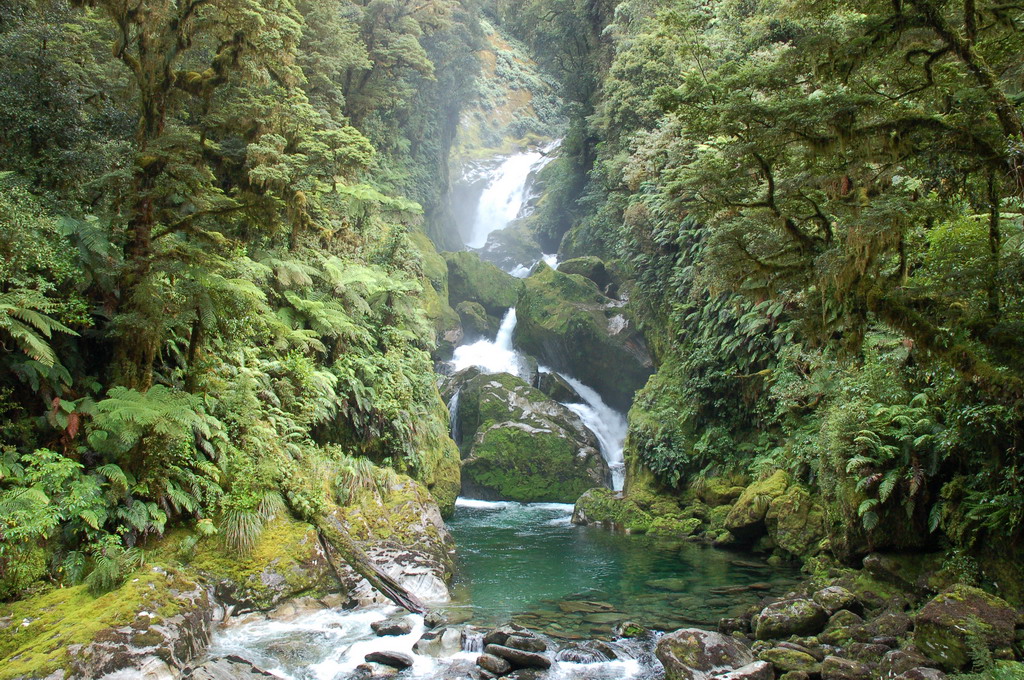
The Milford Track is a hiking (tramping) trail (track) in Fiordland National Park on New Zealand's South Island. It is one of New Zealand's Great Walks.
Understand
The Milford Track was formed in 1888 following the discovery of the Mackinnon Pass by Quintin McKinnon and Ernest Mitchell. Until the Homer Tunnel opened in 1954, it served as the only land route into Milford Sound. Today, it is a Department of Conservation Great Walk and is widely considered one of the finest hikes in the world. The entire 53.5 km track takes four days to complete and must be walked in one direction, from the Te Anau end to Milford Sound.
Prepare
The track is not recommended for children under 10, and those under 15 must be accompanied by an adult. Peak season runs from late October to late April. Bookings are required during this time. These bookings can be made online. Make sure to book early, as popular dates are often booked many months ahead of time. Many dates in December and January are fully booked within minutes of booking opening (usually in June or July). In May 2022, the track was fully booked for the whole summer 13 minutes after booking opened. In 2025 the start of the season was delayed due to avalanche damage and some October and November bookings were cancelled.
Great Walks Booking Desk, Fiordland National Park Visitor Centre, Lakefront Drive, Te Anau, ☏ +64 3 249-8514, fax: +64 3 249-0257, [email protected]. For the 2025-26 summer season, the hut fees are $456 for international visitors and $318 for locals. You can also book the connecting boats to the start and from the finish. (updated Jan 2026)
Eat Independent walkers must pack in all their own food, as there are no opportunities to purchase supplies on the track. It is recommended to carry high-energy, low-weight foods and at least one extra day of emergency rations. While gas cookers are provided in the huts during the peak season, you must bring your own pots, lighters, and utensils, such as a spork. In the off-peak season, walkers must also carry their own stoves and fuel. Those on a guided walk with Ultimate Hikes have their meals provided in private lodges, significantly reducing their pack weight.
Drink Water is available at all huts, sourced from nearby rivers or rainfall. This water is not regularly tested for Giardia, so while many trampers drink it directly, treatment via filters or iodine tablets is recommended. It is vital to carry a bottle or hydration bladder to ensure you can drink regularly throughout the day.
Sleep
Accommodation on the track is provided in communal huts. Independent walkers sleep in bunkrooms on provided mattresses, but they must carry their own sleeping bags as no linens or heating are provided. Because bunkrooms are shared with a large number of people, earplugs are a use
Get in
Te Anau can be reached by car or bus from Queenstown (2 hours) or Invercargill (2 hours). It serves as the primary base for hikers. From here, you must travel 27 km north to Te Anau Downs to board a boat to Glade Wharf, the official start of the track at the head of Lake Te Anau. Real Journeys (now RealNZ) operates these lake transfers; reservations should be made at least one week in advance, though popular peak-season dates often book out months ahead. Sandfly Point is the track's conclusion and has no road access. To leave, you must take a 15-minute boat transfer to the Milford Sound wharf, where pre-booked coaches transport hikers back to Te Anau or Queenstown. For fit runners attempting the 53.5 km track in a single day, the logistics are inverted: a 7 AM boat departs Milford Sound for Sandfly Point (approx. $220 NZD for up to four people as of 2023), with a strict 4 PM cutoff to catch the return boat from Glade Wharf. Missing this window is costly, with late fees starting at $600 NZD for the 6 PM boat plus hourly penalties. A car shuttle service is available to relocate vehicles from Milford Sound to Te Anau Downs for those running the route.
Walk
The route described here assumes that you are walking independently and staying at the DOC huts. If you do a guided walk, you will follow the same route, but have different overnight stops and so will generally be an hour or two behind the independent walkers. This prevents walkers feeling crowded. Walkers on the guided walks have relatively luxurious facilities, but pay about five times as much as those using the DOC huts. Due to the booking system of the Great Walk, it is not an option to pass a hut in an effort to move on to the next hut. Also, there is no camping allowed on the Milford Track. During the peak season the huts, Clinton, Mintaro and Dumpling, have gas cookers, tables, cold running water, lighting and heating in the common area. The bunkrooms are communal with mattresses provided. Flush toilets are also available.
As somewhat of a gift from the DOC, the first day is rather easy with just over an hour consumed riding on a boat to the track start. On the boat trip you will pass a memorial cross at the point where Quintin Mackinnon's empty boat was found after he went missing in 1892. From the landing at 1 Glade Wharf you tramp about 5 km. to the Clinton Hut where you will spend your first night. Along the way you will pass Glade House, the hut for guided walkers. The track is track is fairly level and follows the Clinton River. Once at Clinton hut, you may take some time to go swimming in the Clinton River or take a short trip through the nearby wetlands on a boardwalk. Depending on the DOC staffing at the hut, the warden(s) may offer an interpretation trip in the late afternoon. After dark you can go for a few hundred yards along the track (in the direction you will go tomorrow) to a small community of glow worms.
1 Glade House. 2 Clinton hut. DOC hut, sleeps 40 split between two bunkrooms.
The track is a gentle ascent, following the Cliton River toward Lake Mintaro. This section crosses through more than 50 avalanche passes, making it extremely dangerous in the off-peak season. There are several sections of the track where stopping is not permitted due to the risk of avalanche - avoid stopping for a break or lunch in these sections, but a 10
Stay safe
Safety on the Milford Track depends on being prepared for the region's notoriously volatile weather and extreme rainfall, which can lead to rapid flooding or hypothermia. Because the area is remote and lacks road access, aircraft are the primary method for search and rescue if you become lost or injured. It is essential to carry a comprehensive first aid kit, pack plenty of insect repellent to protect against relentless sandflies, and always check the latest weather forecast at the Fiordland National Park Visitor Centre before starting your journey.
Go next
The Milford Road will take you back to Te Anau. Routeburn Track Rakiura Track on Stewart Island
本指南改寫自 Wikivoyage (CC BY-SA)