
Lao phrasebook
旅遊會話手冊
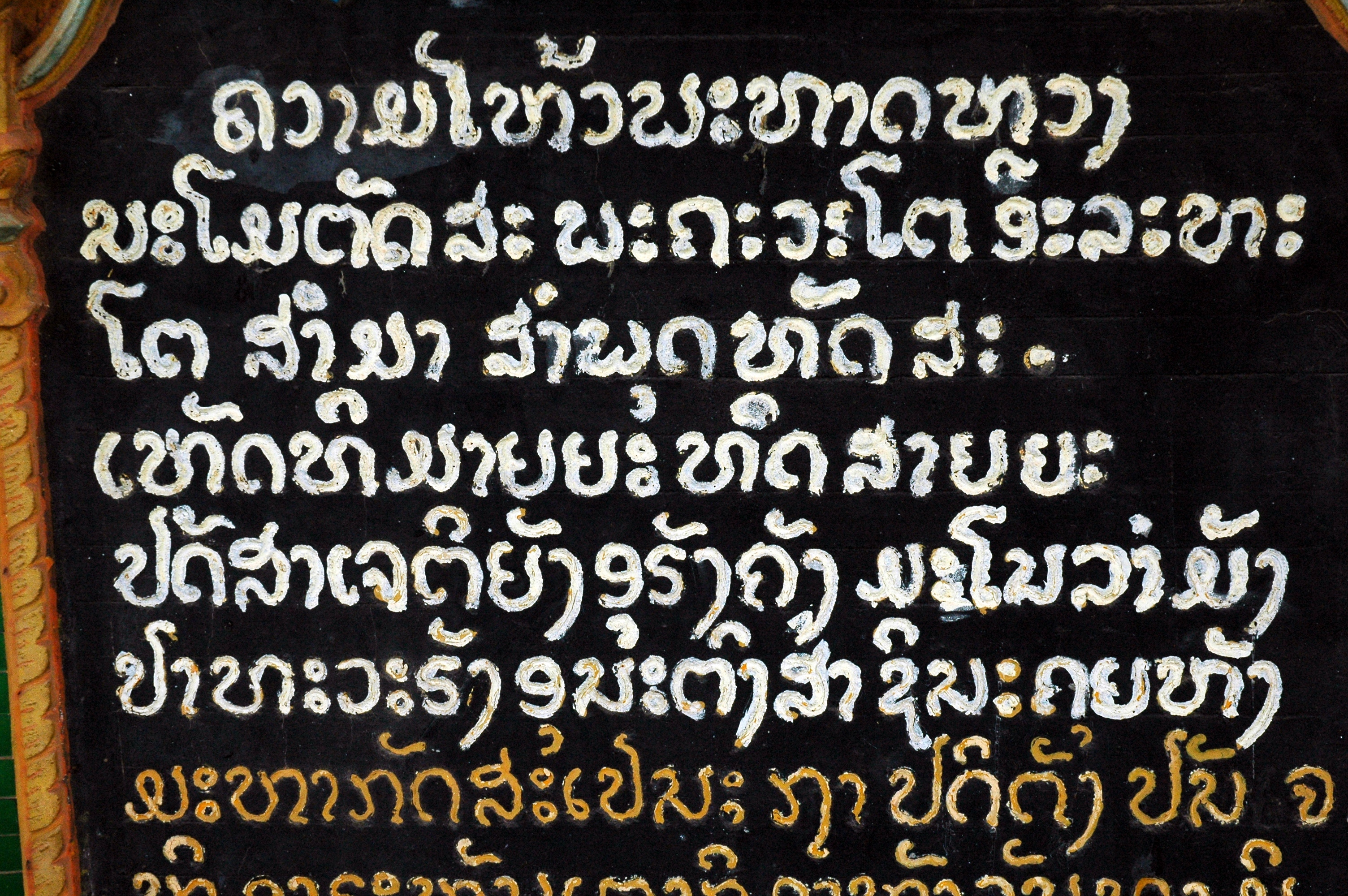
Lao (ພາສາລາວ pháa-sǎa láo) is the main and official language of Laos. Thai is also closely related to Lao, and the Isaan dialect spoken in the northeast is, with minor differences in vocabulary aside, virtually identical to Lao.
Pronunciation guide
Lao is a tonal language with six tones in the Vientiane dialect: low, mid, high, rising, high falling, and low falling. Meanings are dependent on the tone, so try not to inflect your sentences; in particular, questions should be pronounced as flat statements, without the rising intonation ("...yes?") typical to English questions. The script used to write Lao has the same Indic base as Thai, Khmer and Burmese, and Thai readers will be able to figure out most of it. The Lao written language is essentially alphabetic and, thanks to extensive post-revolutionary meddling, now considerably more phonetic than Thai or Khmer. Still, there are 30 consonants, 15 vowel symbols plus 4 tone marks to learn, and the Lao also share the Thai aversion to spaces between words. Lao remains a bit of challenge to pick up, even though it is usually considered easier to learn than Thai. Like other Indic scripts, the Lao script is an abugida, meaning that each letter represents a consonant, and vowels are indicated by modifications to the consonant letter (e.g. with a diacritic mark). Lao romanization is bedeviled by the incompatibility between French and English pronunciation. Most older transliterations are French-based, while newer ones are English-based. The French-style "Vientiane", for example, is more accurately spelled "Wiang Chan" in English. Wikivoyage uses a modern English-based orthography modeled on the Thai system, but the French transliterations have been noted below when appropriate.
Vowels
Lao has a complicated set of vowels that distinguishes between vowel length (short and long) and vowel position (front and back). Vowel signs are always written around consonants. French transliterations use "ou" for "u" (eg. "Louang Prabang") and often tag an unpronounced "e" at the end of words to stop the consonant from being swallowed (eg. "Kaysone Phomvihane").
i like in the 'i' in 'nit' ii like in the 'ee' in 'beer' or 'Feet' a like in the 'u' in 'bum' aa like in the 'a' in 'father' ae like in the 'a' in 'fat' e like in the 'e' in 'fence' eh like in the 'a' in 'bait' u like in the 'u' for 'fruit' ou like in the 'oo' in 'mood' aw like in the 'aw' in 'saw' am like in the
Grammar
Lao grammar is generally straightforward and simpler compared to other languages around the world.
Nouns Lao nouns do not have a grammatical number (singular and plural forms), are not gendered (masculine, feminine), and are not declined. Nouns can either be singular or plural depending on the context. For example, the word ປຶ້ມ (which means book) can either mean "book" or "books".
Verbs Lao verbs do not have tenses.
Phrases
Basics Hello. ສະບາຍດີ (Sa-bai-Dee.) What's Up? (Pen Jung Dai?) How are you? ສະບາຍດີບໍ່ (Sa-bai-Dee Baw?) Fine, thank you. ດີຂອບໃຈ (Dee, Kup-Jai.) What is your name? (Jâo Seuh Maen/Bhen Nyung?) My name is ______ . (Khàwy Seuh Maen/Bpen _____.) Please. ກະລຸນາ (Kawlunaa) Thank you. ຂອບໃຈ (Khawp Jai) It's nothing. (Baw Pen Nyung.) Yes. (Maen Laeow/Doi/Eur/Jao) No. ບໍ່ (Baw) Excuse me/I'm Sorry. (Begging Pardon) (Khǎw Thôht) Goodbye and Take Care (Sôhk Dee Deuh) Do you speak English? (Jâo Wâo Pháa-Sǎa Ung-Kit Dai Baw?) I can't speak English very well. (Khàwy Baw Wâo Pháa-Sǎa Ung-Kit Dai Dee) I can't speak ____. (Khàwy Wâo Pháa-Sǎa ____ Baw Dai.) Please speak slowly. (Kalunaa, Wâo Sah-Saah) Do you understand? (Jâo Khào Jai Baw?) --Yes. I understand. (Maen Laeow. Khàwy Khào Jai) --No. I don't understand. (Baw. Khàwy Baw Khào Jai) Go to sleep ໄປນອນ (Bpai Náwn) Where is the bathroom? (Hàwng Nâm Yuu Sǎi?) (Ethnicity) I am ____. (Khoy Pen Khon ____.)
Problems Leave me alone. (Ya gwuan khoy) Don't touch me! (Ya jup khoy) I'll call the police. (Khoy si toh jaeng dtum louat.) Police! Police! (Dtum louat!) Stop! Thief! Stop! Thief! (Yud! Kee Luck) Can you help me?. I need your help. ('Suay khoy dai boh') It's an emergency. ສຸກເສີນ. (souk sern) I'm lost. (Khoy lohng taang) I lost my wallet. (Khoy seeuh gkapow) I lost my bag. (Khoy seeuh tong) I'm sick. (Khoy pben kai/Khoy boh sabai) I've been injured. (Khoy jep/Khoy Theug baad jep.) I need a doctor. I need a doctor. (Khoy tong kan Maw ) Can I use/borrow your phone? (Khoy sai/yeum tolasup dai boh?) May I talk to _______? (Khoy lom num _______?) I don't understand koi boh kow jai
Numbers Lao numbers are effectively identical to Thai, the two quirks worth noting being that 20 is sao (not yii-sip) and 100 is hoi. Speakers of Cantonese will find many quite familiar. Lao has its own set of numerals, but these are used quite rarely.
0 ສູນ (soon) 1 ຫນຶ່ງ (neung) 2 ສອງ (song) 3 ສາມ (saam) 4 ສີ່ (sii) 5 ຫ້າ (haa) 6 ຫົກ (hok) 7 ເຈັດ (jet) 8 ແປດ (paet) 9 ເກົ້າ (kao) 10 ສິບ (sip) 11 (sip-et) 12 ສິບສອງ (sip-song) 13 (sip-saam) 14 (sip-sii) 15 (sip-haa) 16 (sip-hok) 17 (sip-jet) 18 (sip-paet) 19 (sip-kao) 20 ຊາວ (sao) 21 (sao-et) 22
本指南改寫自 Wikivoyage (CC BY-SA)