
Danube
旅遊行程
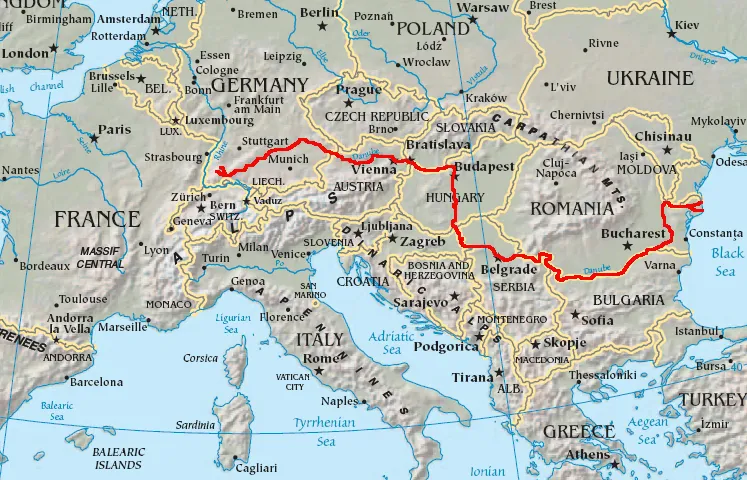
The Danube is the second-longest river in Europe, with a length of 2,850 km (1,770 mi). It begins in the Black Forest in Germany and flows east to the Black Sea, forming the Danube Delta on its western coast. From west to east, the Danube passes through or borders ten countries, including four capital cities:
Understand
The Danube is a major tourist attraction. Over the years, it has played an important role in the history of Europe. It passes through four capital cities as well as a number of other influential, historic and beautiful towns and stunning landscapes. At the height of the Roman Empire in the first century AD, the Danube marked the country's northern border. The Danube also coincides with a climate border; by and large crops such as grapes grow poorly north of the river.
Get in
By boat
There are a few cruise ships that travel from the Rhine via the Main River and the Rhine–Main–Danube Canal to the Danube, making it possible to travel from the North Sea to the Black Sea.
Go
By bicycle The Danube Cycleway runs the whole length, the German and Austrian sections being very popular.
By foot Donausteig from Passau to Grein (between Linz and Melk). Sultans Trail from Vienna to Smederevo (between Belgrade and Požarevac)
By canoe or kayak Some ambitious canoe or kayakers attempt to travel the "length" of the river. Whilst some undertake the trip independently, others participate on the Tour - International - Danubien (TID). Run annually starting in Ingolstadt and finishing at the Black Sea, some join the TID for specific sections whilst a few attempt the entire Ingolstadt to Black Sea journey. However such a trip is a significant undertaking and requires skill and experience.
By cruise ship
There are many cruise liners along the river, some just short sections other, such as Avalon, Uniworld and Viking going from Passau to the Delta. Nearly all of the river is navigable, but cruises normally begin no further west than Passau, because the water is often too high for the boats to pass safely under some bridges, especially during the flood-prone spring season. During the dry summer months, the water may be too low, which commonly results in itinerary changes such as the need to change boats or riding a bus between two ports.
Germany
Source of the Danube: Confluence of the headwaters Brigach and Breg near Donaueschingen. The InterRegioExpress rail line from here to Ulm almost exactly follows the course of the Donau. 1 Tuttlingen near the Danube Sinkhole Sigmaringen Ulm. End of the IRE line from Donaueschingen. Train riders may transfer to the agilis to Ingolstadt which again follows the course of the river. Ingolstadt. End of the agilis line from Ulm. Another agilis line approximately follows the Danube to Regensburg (but bypasses Kelheim). Kelheim. This is where the Main Donau Kanal meets the Danube.
Regensburg. End of the agilis line from Ingolstadt. Another rail line runs parallel to the Danube (but a few kilometres off its right bank) via Plattling to Passau (bypassing Deggendorf on the left bank). You can either use the ICE high-speed train or a local train to Plattling and then a regional express to Passau. Deggendorf
Go next
The Main Donau Kanal links this river with the Main, an important tributary of the Rhine
本指南改寫自 Wikivoyage (CC BY-SA)