
Cycling the Western Sahara
旅遊行程
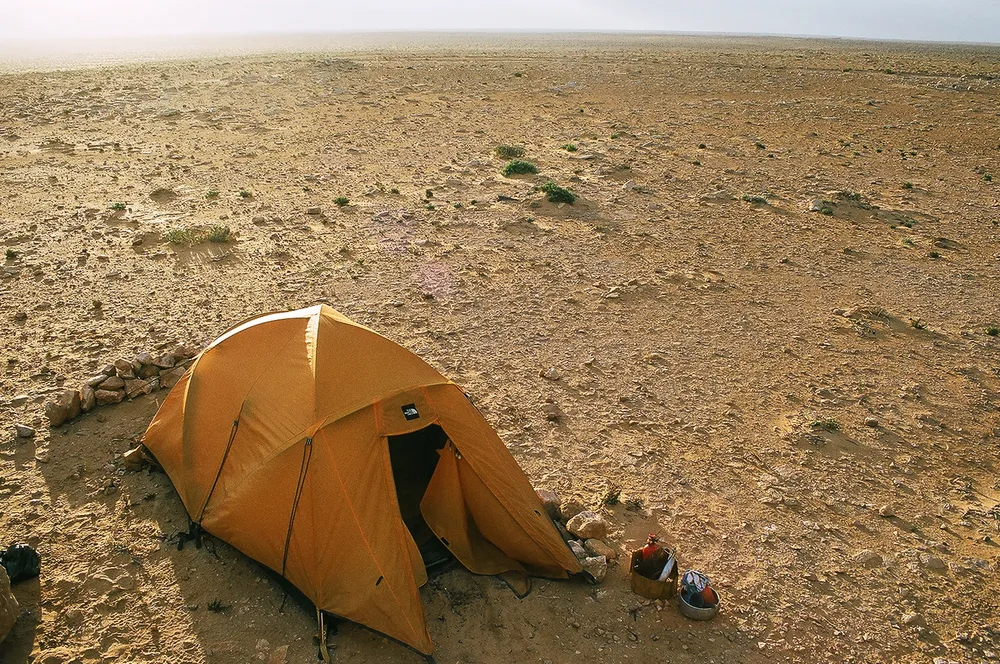
The Western Sahara cycle route runs from Guelmim in Morocco via Mauritania to Saint-Louis in Senegal. It is 2,100 km (1,300 mi) through the Western Sahara, crossing the westernmost part of the Sahara (bordering the sea) while avoiding disputed territories controlled by the SADR (Saharan Arab Democratic Republic).
Understand
The route is asphalted from Morocco to Senegal. Only a few kilometers along the Moroccan-Mauritanian border are soft slopes (as of 2006). There are supply possibilities at the latest every 150 km (93 mi), which corresponds to 2–3 days. This route is the easiest way to cross from North Africa to the Sub-Sahara countries by bike (as of 2006).
Geography The Western Sahara is divided geographically into a northern part, from the Cape Boujdour, where flat-corrugated gravel and deserts (Hammada) dominate. The terrain gradually rises from the coast to the interior of the country to a height of about 400 meters. The southern region is almost completely flat with isolated sand dunes (erg), which provide only a little variety in the uniform, almost vegetation-free gerbera. Grassy and bushy areas as well as acacia mark the transition from the desert steppe to the Saw Saw in Southern Mauritania. Animal species adapted to the dry habitat are found, for example, scorpions, snakes, Jaculus jerboas and spiny-tailed lizards. In the caves on the Atlantic coast, especially on the Cabo Blanco peninsula near Nouadhibou in Mauritania, live the largest populations of the endangered Mediterranean monk seal.
Climate The Sahara is a turning-desert, caused by the constant, dry-hot north-east trade wind. Even in the age of shipping, the trade winds served as powerful tow-lifts. On the bike, you are constantly pushed southwards by the wind. It also transports a lot of dust and sand near the ground. Especially in the spring and autumn strong deep-pressure areas can suck Saharaluft over the Mediterranean. The dry, hot south-south-east sand and dust winds, the Schirokko, are formed. Due to the large amounts of sand dust, the air turns yellowish-reddish-brown. The strong headwind can make it difficult to get to the South and quickly get you into an unpleasant situation. Along the coast, north of Nouakchott, the temperatures are moderate due to the balancing influence of the Atlantic. The cold canal stream provides for the cooling, but is also responsible for the powerful fog in the coastal area. Around the turn of the year it has 20 °C (68 °F), in September and October the temperature ris
Prepare
The situation can change dramatically along the route. Settlements can change, roads can become impassable through wandering dikes. Much of the information on the Internet or in books refer to the route before 2005, when the road was not yet developed. At that time large sections had to be crossed over sandy slopes. So always check that your information is up to date. Therefore, accurate searches are required before departure. Locals are a valuable resource, as are other travellers.
Stay healthy Water is surely the first thing that comes to mind when travelling through the desert. The daily per capita consumption of drinking water is about 5 liters. For tours further inland, with extreme temperatures, up to 6 liters and more. Add the water needed for cooking. It is best to avoid the midday heat and bike in the early morning and afternoon. In the case of the large liquid loss by sweating, the salt loss should also be compensated for. The World Health Organization recommends, for each liter of water, a teaspoon of salt and 6 teaspoons of sugar. However, too much salt or sugar can aggravate dehydration. The Rehydration Project uses only half a teaspoon of salt with 6 teaspoons of sugar per liter of water. Contrary to popular opinion one can not adapt to water deficiency.
Cooking The consumption of water for cooking can be reduced by using water-saving food. You need a cup of water for a cup of couscous and, for rice, twice the amount. The supply of gas cartridges is scarce in the Western Sahara. Benzine fuel is available in every major place.
Cycling First choice would be a touring bicycle. With 28" tires you can get on the asphalt fast and are nevertheless armed for desert descents. Ideally a bike with a steel frame as if repairs are required steel welding tools can be found more commonly than aluminum welding tools. Sand and dust act like sandpaper on the sprockets and the chain expands under stress. To increase longevity you can take two or three chains and change every 800–1,000 km (500–620 mi). This means that you can reach distances of up to 10,000 km (6,200 mi). Then you should change the entire drive system.
Get in
Guelmim is the last place before the desert and starting point of the bike tour; check its page for information how to get there.
Go
1 Guelmim (Arabic: كلميم, also Goulimine or Guelmin) is a provincial capital of about 12,000 inhabitants in the Guelmim-Oued Noun. The place Bir Anzarane is the center of the city. Here you can find the 1 Banque Populaire with ATM and the 1 post office. The 1 bus station is north of the square, along the Blvd Moulay Rachid.
From Guelmin to Tan Tan (130 km (81 mi)) Leaving Guelmin via Avenue 3 Mars, head south-west. Past the Mosque of Guelmin you pass the city gate.
1 Crossing the Oued Siyad. 1 Café Blue House (25 km (16 mi) past Guelmin). (updated Feb 2006) 2 Turnoff to Ait Yassine and Aferkat. to Ait Yassine 11 km (6.8 mi), to Aferkat 20 kilometres (12 mi) 3 Bus stop, turnoff to Labyar (Arabic: البيار) (44 km (27 mi) past Guelmin). Village is 2.5 kilometres (1.6 mi) north (updated Feb 2006) Simple restaurant (50 km (31 mi) past Guelmin). simple restaurant atop a small hill (updated Feb 2006) 4 Settlement Rass Oumlil with Restaurant and Magasin (70 km (43 mi) past Guelmin). (updated Feb 2006) Viewpoint (88 km (55 mi) past Guelmin). hill with nice view (updated Feb 2006) 5 Crossing the Oued Draa. which, after its long journey from Zagora, flows through the desert just a few kilometers further west into the sea.
Tan Tan 6 Tan-Tan (Arabic: طانطان, also al-Hamra, the Red) with 70,000 inhabitants is the capital of the province of the same name in the Guelmim-Oued Noun region. The city is located south of the main street Ave Hassan II, on which one finds the 7 post and the bank 8 BMCE, with ATM, next to the Shell gas station. The second main road is the Ave Mohammed V, which crosses the city to the south. There is the 9 Banque Populaire and the 10 Busstation (Gare Routiére) at Place de la Marche Verte in the south of Ave Mohammed V. The 11 airport of Tan Tan Plage Blanche Airport (TTA IATA) is located 8 km (5.0 mi) west of the N1. It is served by the Royal Air Maroc, which connects Tan Tan with Casablanca and Guelmin.
From Tan Tan to Tarfaya (213 km (132 mi))
If you leave Tan Tan to the west on the N1 you reach the turnoff to the airport after 6 km (3.7 mi). A kilometer further on, the R101 turns of left, which leads to Smara (Arabic: السمارة), some 24
Respect
Religion
Morocco is a Muslim country and faith is much more deeply rooted in everyday life than in Europe. The religious customs are observed. However, non-Muslims are treated with respect as different believers in Morocco. This is especially true during Ramadan. While most Moroccans fast, the sick, the young, the old and the pregnant do not, and neither need the travellers. Mauritania is officially an Islamic Republic, and is considerably less tolerant than Morocco, at least officially. Make sure not to do or say anything that could be considered blasphemy against Islam or proclaim yourself as an atheist while you are in Mauritania, and make sure to wear modest dress; atheism and blasphemy are punishable by death in that country, while "offending public indecency and Islamic values", "breaching Allah’s prohibitions" or assisting in their breach can be subject to up to two years in prison and a fine up to 600,000 Ouguiyas. Although 92% Muslim, Senegal is officially secular and known for its liberal Muslim majority; it also has a well-respected Christian minority and other smaller religious minorities that practice freely.
Photography The desert is a breathtaking stage for photographers. The inhabitants are a bit different. The Moroccans and the Mauritians are not keen to be photographe
本指南改寫自 Wikivoyage (CC BY-SA)