
Braddock Expedition
旅遊行程
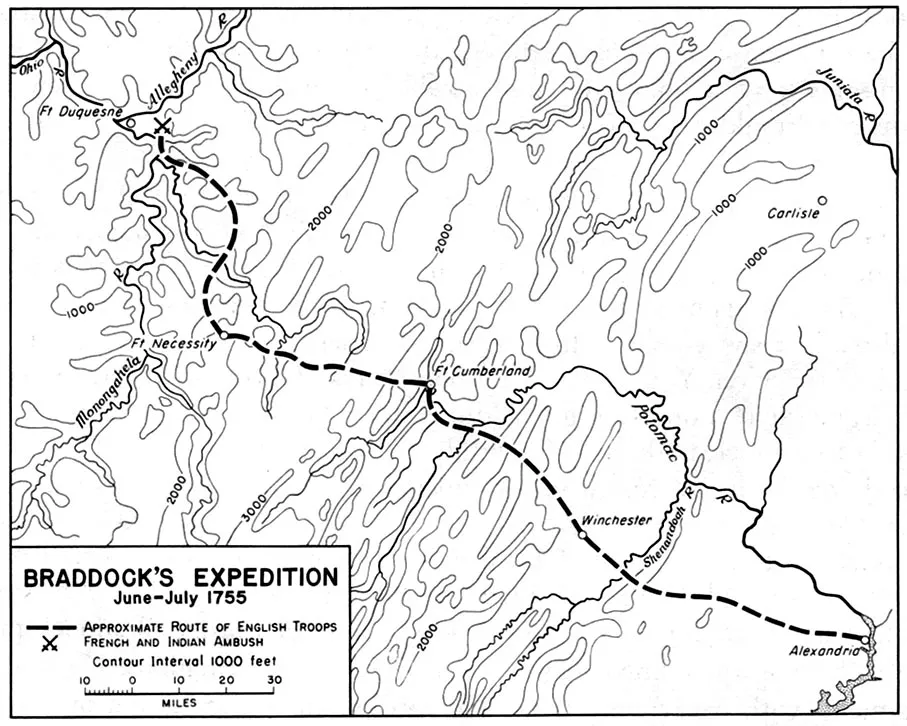
This itinerary attempts to follow, as closely as possible by car, the original route of the Braddock Expedition through Northern Virginia, West Virginia, Maryland, and Pennsylvania up to the crossing at the Monongahela River where General Braddock's ill-fated expedition ended and the young Colonel George Washington earned his fame.
Understand
In 1755, General Edward Braddock, Commander-in-Chief of His Majesty’s Forces in North America, was commissioned with expelling the French from the Ohio Valley by taking Fort Duquesne in present-day Pittsburgh. Additionally, Braddock's expeditionary force would clear a road from Fort Cumberland (Cumberland, Maryland) to Fort Duquesne. This action was performed in conjunction with several other campaigns against the French in North America that year. From April 9th to July 9th, Braddock's force of nearly 1,500 men marched approximately 250 miles. On July 9th, Braddock's force of British regulars, continental regulars, and militiamen fought a meeting engagement with 900 French soldiers and Indians just after crossing the Monongahela River south of Fort Duquesne. The Battle of the Monongahela resulted in a tragic defeat for General Braddock. The British soldiers' poor discipline resulted in a panic-stricken rout, allowing the French and Indians to easily pick them off. Washington was recognized as Virginia's war hero as he was able to form a defense and save the remainder of Braddock's force. Braddock, however, did not survive the battle. Washington also played a key role as an advisor to General Braddock. Washington spent his early adulthood surveying the lands granted to the Fairfax family. This gave him valuable information on the best route from Alexandria, Virginia to Cumberland, Maryland. He also held a deep interest in settling the Ohio Valley. Washington believed that the future of America lay in the fertile farm lands of the Ohio and a trade route to this area was key. While Fort Duquesne was not taken, the trail blazed by Braddock's expedition proved to be a major commercial link to the West and provided part of the basis for the construction of US Highway 40 - the National Road, one of the first major improved highways in the US. The road also proved valuable during Washington's term as president: In 1794, he led 13,000 men up the Braddock Road to suppress the Whiskey Rebellion — the last time a sitting president of the U.S. led troops in battle. Today, the trails followed by Braddock's men are much different than in 1755. In Northern V
Prepare
The route follows some city roads and mostly rural roads. Part of the route traverses the Appalachian Mountains. A typical first aid kit in your trunk will do. While a typical trip from Alexandria to Pittsburgh takes 4 hours, this trip will take from 6 to 10 hours. Plan on a whole day to allow time for all of the sites. A good road atlas of Virginia, Maryland, West Virginia, and Pennsylvania is highly recommended. A detailed road map (such as those published by ADC) of Northern Virginia is also good to have.
Get in
The trip begins at Founders Park in 1 Alexandria, Virginia. From points north (i.e. Baltimore), take I-95 south, cross the Wilson Bridge and take the Route 1 exit north into Alexandria. Take a right on King Street and follow it to the water's edge. From points south (i.e. Fredericksburg, Richmond), take I-95 north and take the Route 1 exit north into Alexandria. Take a right on King Street and follow it to the water's edge. From points east (i.e. Annapolis), take Route 50 west to I-495/I-95 (Capital Beltway) going south toward Richmond. Cross the Wilson Bridge and take the Route 1 exit north into Alexandria. Take a right on King Street and follow it to the water's edge. From points west (i.e. Winchester), take I-66 east to I-495 (Capital Beltway) going south toward Richmond. Follow the Beltway around to the Route 1 exit north into Alexandria. Take a right on King Street and follow it to the water's edge. There is usually plenty of parking near the water's edge. You can walk to Founders Park by walking to the left when facing the river. The park is past the wharf area (where the Torpedo Factory and Charthouse restaurant are).
Drive
Alexandria
The tour begins in Alexandria, Virginia where King Street meets the Potomac River. This area used to be Alexandria's port. It was the main point of entry and departure for merchants shipping tobacco and food to the Old World and importing luxury goods into the New World. As shipping focused more on the port at Norfolk, Alexandria became the central marketplace in Northern Virginia for slaves. In the years leading up to the civil war, only slaves that were born in America were sold here as importing slaves from abroad was illegal. From 1790 to 1846, Alexandria was part of the District of Columbia but was retroceded to VIrginia as the Alexandrians across the river from DC shared little interest with those in the District. During the Civil War, Alexandria was occupied by Union troops, and heavily fortified in order to repel a Confederate assault on Washington for the duration of the war. As the Federal government grew in the 20th century, Alexandria has become a wealthy city home to government contractors but it has maintained its links with the past by keeping the "Old Town" area's shops and old homes intact. Braddock's journey started in Cobh near Cork, Ireland. He sailed into Hampton, Virginia and then into Alexandria. It was here in this port where he arrived with his two regiments and began planning his march.
Carlyle House In Alexandria, Braddock established his headquarters at the John Carlyle house. To get to the Carlyle House from the port of Alexandria, travel West (away from the river) on King Street for two blocks and take a right onto North Fairfax Street. The house is on the right. Here at the Carlyle House, Braddock met with five colonial governors and tried to convince them to support his campaign against the French. The governors were unable to convince their colonial assemblies to support the mission. This incident highlighted the divide that was growing between the United Kingdom and the American colonies. Braddock stayed three weeks at the house, and was reported by the house's owner to be "too fond of his passions, women and wine...” and that the general had “abused his house and furnishings...” With the campaign
本指南改寫自 Wikivoyage (CC BY-SA)