
Berlin Wall
旅遊行程
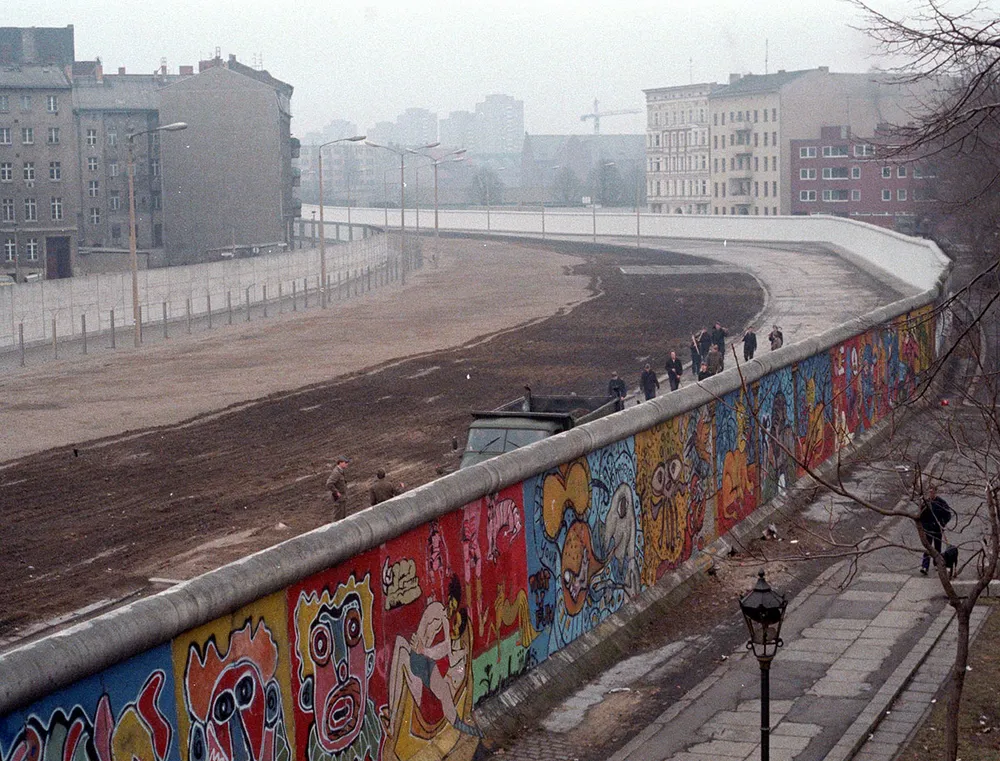
The Berlin Wall (Berliner Mauer) was a concrete barrier separating Western and Eastern parts of Berlin from 1961 to 1989. It is regarded as one of the symbols of the Cold War. While most of it was dismanted after German reunification, parts of it still remain for tourists to contemplate.
Understand
Named officially Anti-Fascist Protection Rampart by German Democratic Republic, the Berlin Wall encircled the entirety of the West Berlin border with a 155-km-long set of barriers. However, the main threat posed by West Berlin was not military but economic, as many residents of East Germany escaped through the enclave to the West. The GDR government was seriously afraid of losing most of its population (20% of which left before wall was constructed); this was the real reason why the wall was erected.
History Construction started on August 13 of 1961 at midnight when tens of thousands of military and security forces encircled West Berlin and started spreading barbed wire in what became known as the "Barbed Wire Sunday". It was the last day when significant number of people managed to escape East Germany. A few days later first wall was constructed using concrete blocks. Wall was continuously expanding during next 20 years until its destruction in 1989. With complete four generations of wall 'technology', beginning from simple concrete wall and barbed wire, through prefabricated panels to the final 'death strip'.
The last generation wall built in 1980s was nearly completely impenetrable, with few successful escape attempts. It included guard towers, an outer wall with a smoothed edge to reduce grip, a barbed wire wall, 2,000 guard dogs, anti-personnel mines, Czech hedgehogs, an anti-vehicle ditch and seismographs to prevent undermining. These were all used to prevent people from escaping. Not to mention extensive monitoring of the outer wall by the infamous Stasi to prevent any potential escapees from even coming close to the structure. It also became a scene of many memorable events, including political speeches: "Ich bin ein Berliner" by Kennedy and "Tear down this wall" by Reagan. In the late 80s, a number of concerts were held close to the wall, with one in 1987 by David Bowie prompting protests over the eastern side. Final end to the wall was brought by unfortunate speech by Günther Schabowski who was supposed to announce opening of border crossing for East German citizens on the next day. As soon as he announced immediate opening of the border people rus
Prepare
Camera, shoes and some euros if you wish to buy souvenirs. Most of the interesting objects are located open-air around city centre and require no fee to access.
Get in
See Berlin get in for information about getting into the city. And get around section for transportation within the city. Most sites should be accessible by short walk from U-Bahn/S-Bahn stations. Some further sites in the southwest of Berlin will require bus or car to reach comfortably.
Go
1 East Side Gallery, Mühlenstraße. Established in 1990 a collection of mostly political graffiti painted over eastern side of the wall. It is the longest remaining section of the wall at 1.3 kilometers of length. Contains the famous painting of Fraternal kiss between Honecker and Brezhnev. (updated Mar 2025) 2 Checkpoint Charlie (Checkpoint C) (Zimmerstraße/Friedrichstraße corner). Most famous Berlin Wall border crossing featuring replica of American guard house and warning plaque. To the north there is an educational path with information about the wall. (updated Mar 2025) 3 Topography of Terror, Niederkirchnerstraße 8 (west of Kochstraße station). Destroyed headquarters of Nazi security and intelligence services found itself on East Berlin side and in 1961 became part of the Berlin Wall. Ruined basement was excavated in 1980s in an ironic twist of fate and now you can see Berlin Wall preserved just above the walls of former oppression central. (updated Mar 2025) 4 Tränenpalast (Palace of Tears), Reichstagufer 17 (Friedrichstraße station), ☏ +49 30 46 77 77 911, [email protected]. Tu-F 09:00-18:00, Sa Su 10:00-18:00. Former rail border crossing used by West Berliners visting their relatives in the East. Place of many tearful separations from which its name is derived. Now it hosts an exhibition detailing customs and border crossing procedures in divided Berlin. Original passport control booths can be seen here. You can also listen to recollections of personal stories about staying in touch with each other, smuggling items and escaping to the West. Free entry. (updated Mar 2025) 5 Invalids' cemetery (Invalidenfriedhof), Scharnhorststraße 31 (north of main railway station). This former cemetery for war veterans of Prussian Army was mostly destroyed to make way for Berlin Wall which parts remain on its western side. A memorial for Berliners killed trying to escape is located here. (updated Mar 2025) 6 Liesenbrücken segment (east of Reinickendorfer Straße station). Small (15-metre) segment of the wall located to the north of the Domfriedhof cemetery. Mostly covered in greenery, empty space that was used to be occupied by the wall can be noticed on the ce
Stay safe
Precautions that work in Berlin should also work for the Berlin Wall. Pieces are generally in nice areas near city centre or in west Berlin and worst you can expect are pickpockets. Though it may be a good idea to avoid Warschauerstraße station at night (close to East Side Gallery). Near Checkpoint Charlie, you will see people setting up booths offering to stamp your passport with souvenir stamps in exchange for a small fee. You are strongly advised not to let them stamp your passport, as these are not official government stamps and could invalidate your passport. If you want the stamps, bring along an expired passport, or a small booklet like a novelty passport.
Go next
Cold War Europe German Empire, World War I, World War II in Europe and Holocaust remembrance for earlier German history
本指南改寫自 Wikivoyage (CC BY-SA)