
Belgian coast by tram
旅遊行程
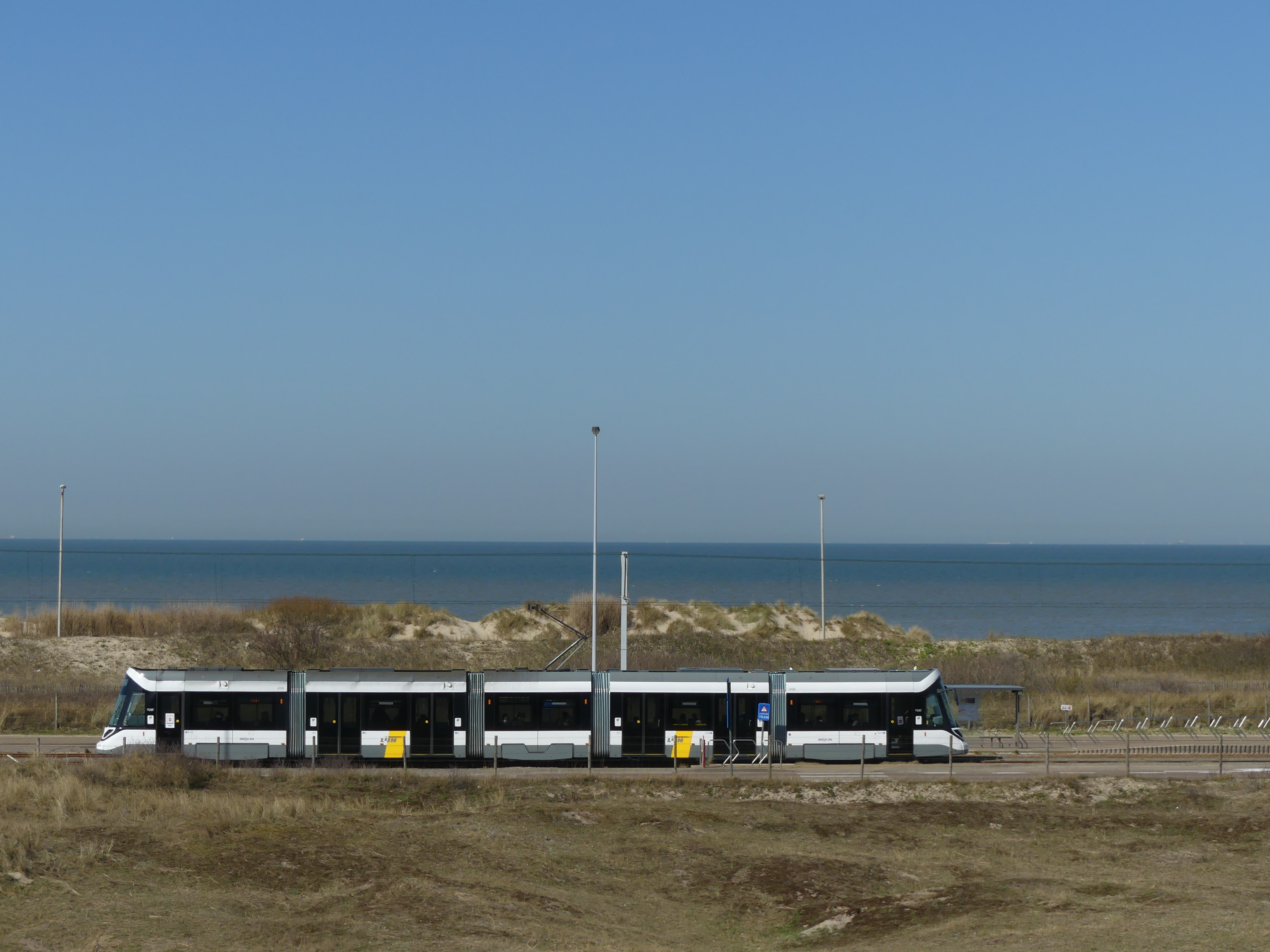
Stretching from Knokke to Adinkerke, the Kusttram (Dutch for "Coast Tram") makes it possible to travel almost the entire length of the Belgian coast by tram. The 67-km (42-mi) journey through coastal Flanders takes slightly under two and a half hours non-stop. However, if you take it a bit more slowly, you'll be rewarded with access to many of the top Flemish attractions: maritime sites, World War I heritage, tramway history, Belle-Époque architecture, and dune landscapes.
Understand
Belgium's coastal tramline runs from the train station of Knokke-Heist, via Zeebrugge, Blankenberge, Ostend, Nieuwpoort and Koksijde, to De Panne, making it possible to visit almost all of the Belgian coast, excluding some bits towards the borders with the Netherlands and France. The 67-km-long route sees some 16.5 million passengers per year travel on the line.
History The modern-day tramway was formed from several lines of the Belgian Local Tramways (Dutch: Nationale Maatschappij van Buurtspoorwegen or NMVB for short), with the first construction of lines taking place around 1885, connecting Ostend and Nieuwpoort-Dorp. The NMBS (Belgian National Rail) operated many other lines branching off of what is now the Kusttram, most of which have since disappeared. The line was, and to this day largely is single-tracked, with trams running left-handed like Belgian trains do. Electrification on parts of the lines started in 1909. That winter, services were continued year-round for the first time. Some other lines of the NMVB network that remained in operation are some portions of the Charleroi light metro, the Aisne Tourist Tramway and the Lobbes-Thuin Tramway. During the First World War, the tramway was severed by the Western Front around Nieuwpoort. The line was put to use for goods transport towards the trenches on either side of the front line. In 1919, the normal passenger service was reinstated. The modern-day route of the tramway formed in the late 1920s, as connections to De Panne were made and electrified. The line since runs almost parallel to the coast, only dipping inland to connect to Nieuwpoort. Plans to bypass Nieuwpoort were made, but never materialised. The Second World War saw the Belgian coast become a part of the Atlantikwall, which put in place many limitations on passenger transport. Citizens along the coast needed special permission to be allowed to travel inland. In 1940, before Nazi German occupation, the line was already set to be dismantled, though the outbreak of the war put a stop to those plans. During the occupation, the electric wiring between Ostend and Middelkerke was removed; this was later followed by a suspension of all services
Prepare
The trip goes through built-up areas with shops, restaurants and other services so you don't need to make any big preparations. Just make sure you have a valid ticket and dress according to the weather (perhaps bring an umbrella). A towel and swimwear can be good to bring if you want to go to the beaches. When travelling with a bike, the tram driver may deny you access if there are already too many bikes onboard or the tram is too crowded. You must buy a bicycle pass (€2 for 60 min) in addition to your personal ticket to bring a bike onto a tram. If you are travelling with dogs, you may take them on the tram for free, provided that you can keep them on a lead or on your lap. It's recommended to travel light, though if you have no other way, stow your luggage away somewhere where it doesn't block a seat, for example on your lap, between your legs or somewhere else where it will not hinder other travellers. It is also not allowed to eat while travelling on the tram, to keep the vehicles clean.
Accessibility While the trams are either partially or entirely low-floored, allowing for wheelchair access, not all platforms are at that same height. As of 2019, the wheelchair-inaccessible stops are: Knokke Station; Duinbergen Watertoren; Zeebrugge Vaart and Strandwijk; Oostende Marie-Joséplein; Middelkere Casino; Oostduinkerke Bad; Koksijde Bad; De Panne Canadezenplein, Centrum, Kerk and Moeder Lambic. Mobility scooters are not allowed on board the tram.
Get in
By plane Ostend has an airport, Ostend-Bruges International Airport OST IATA, but it mostly receives cargo traffic. A much more sensible option would be to fly to Brussels Airport and take a car or train from there.
By train
Below is an overview of all connections to the Belgian rail network. The recommended and useful connections have been underlined.
1 Knokke : The tram terminus in Knokke is located about 200 metres north of the train station. Trains stopping in Knokke are Intercity 23A (Brussels Airport - Brussels-Zuid/Midi - Ghent-Sint-Pieters - Bruges - Knokke), as well as a peak hour and tourist train connecting to Bruges during the week and weekend respectively. IC 23A: Brussels Airport — Brussels-Zuid/Midi — Ghent-Sint-Pieters — Bruges — Knokke ICT 6600: Bruges — Knokke, tourist train, operates on weekends only. 2 Duinbergen, Kerk , some 300 metres south from the tram stop of the same name, but is not recommended as the station is just one stop away from Knokke, which is the turn-around point for trams, hence making the connection easier. Yet, if you need to shave several minutes of time off of your journey and are heading for Heist, Zeebrugge or further west by Kusttram, consider catching the tram here instead. Heist itself also has a train station, though it is 700 metres (770 yd) from the nearest tram stop. 3 Zeebrugge-Dorp : Zeebrugge Vaart tram stop is located about 200 metres north of the train station, at the end of the Azorenstraat. Zeebrugge-Dorp's train services don't operate during weekends, with services being rerouted to Zeebrugge-Strand instead, which does not have a useful connection to the Kusttram. L 550: (Mechelen —) Ghent-Sint-Pieters — Bruges — Zeebrugge-Dorp, weekdays only. 4 Blankenberge has trams stopping right outside the train station. Blankenberge can be reached using one intercity (IC) and three tourist trains (ICT): IC 03: Genk — Leuven — Brussels-Zuid/Midi — Ghent-Sint-Pieters — Bruges — Blankenberge ICT 6700: Charleroi-South — Mons — Tournai — Mouscron — Bruges — Blankenberge ICT 6705: Antwerp Centraal — Ghent-Sint-Pieters — Bruges — Blankenberge ICT 6710: (Neerpelt/Turnhout —) Herentals — Mechelen — Ghent-Sint-Piete
Knokke — Blankenberge
In Knokke-Heist
Starting just north of Knokke's railway station, the eastern terminus of the Kusttram, 1 Knokke, Station , can be found opposite the 1 Sint-Margarethakerk. The church isn't that old, but the shorter tower you're looking at while waiting for the tram to depart is, dating back to 1642. The church sustained heavy damage during the Second World War, and a new church was built between 1955 and 1958, which incorporated the former main tower. Running between houses, the tramway eventually meets up with the Elizabetlaan near the 2 Duinbergen water tower and Park 58, a small nature reserve of barely 10 hectares (25 acres). Shortly after, you reach the 2 Duinbergen, Kerk stop, which stands outside the 3 Heilige Familiekerk. Dating from 1939, this modern Gothic church features some art deco elements. Duinbergen itself, meanwhile, dates largely from the early 20th century, having been shaped after the creative vision of German architect and urban designer Hermann-Josef Stübben. The concession for development of Duinbergen as a whole was given out in 1901, and within seven years, some 80 villas were already constructed. The many villas in Duinbergen give this area a charming view, though tourism introduced a desire for large apartments along the coast, which replaced many of the villas there. Entering into Heist, the tram next stops at 3 Heist, Willemspark. Unsurprisingly, it is located by the entrance of the 4 Directeur-Generaal Willemspark. Formed from a dune ridge, between both World Wars this park housed two batteries constructed by the German Empire and demolished by the Nazis. Between the wars, these batteries were a museum of sorts, with admission fees funding veterans' welfare. After the war, the dune landscape was reconstructed and the park was created. The paths in the park are named for political prisoners from Heist that didn't see the end of the Second World War, the only exceptions being the Keunepitpad (rabbit hole path) and Bunkerpad (bunker path). The park was rejuvenated in 2015, and borders the seashore. In the town centre of Heist, the tramway inches closer to the
本指南改寫自 Wikivoyage (CC BY-SA)