
Bangkok to Singapore overland
旅遊行程
Travelling from Bangkok to Singapore in Southeast Asia, or vice versa, takes you across a journey over the Malay peninsula, and lets you see three countries in one go: Thailand, Malaysia, and Singapore.
Understand
Thailand, Malaysia, and Singapore are three countries with three different vibes - on the southern end of this journey is Singapore, where in between its concrete jungles is an atmosphere emphasizing on cleanliness and orderliness, and on the other end is Thailand, a place best described as 'fun, free and wild'. In between these two countries lies Malaysia, blending the atmospheres of both Singapore and Thailand. As you journey through this route, the landscape around you also gradually changes. Heading down south from Bangkok, you will find endless patches of farmland and palm plantations, rainforests and mountains, in between major cities such as Hat Yai, Kuala Lumpur, and Malacca, until you arrive at Singapore. With the exception of Thailand, the only Southeast Asian nation to not be colonized, both Malaysia and Singapore are former British colonies. However, all three countries drive on the left.
Prepare
Citizens from most Western countries, Latin America, Japan, South Korea, and ASEAN member states can visit all three countries without a visa. Burmese nationals can apply for a Malaysian 30-day e-Visa while Israeli nationals are barred from entering Malaysia. As of 2025, all three countries require foreigners to fill in a Digital Arrival card. However, if you are a citizen of Singapore, or are a Permanent Resident or Long-Term Pass Holder in either Singapore or Malaysia, you are exempt from submitting the digital arrival card for either one or both countries. For more details, see Thailand - Get in, Malaysia - Get in and Singapore - Get in. All three countries uses different currencies - the Thai baht (฿), Malaysian ringgit (RM), and Singapore dollar (S$). There are plenty of ATMs along the way, and you can find them in cities. Credit cards are widely accepted too. You can also find currency exchanges in shopping malls, which usually offer better rates than those at the airport or border. As a general rule, goods in Thailand are cheaper than goods in Malaysia, and goods in Malaysia are cheaper than goods in Singapore. Therefore, if you visit the border regions during weekends, you can see lots of people coming from the other side to stock up on everyday goods. You can use international SIM cards or use an eSIM service to save yourself the hassle of changing SIM cards whenever you enter a new country.
Talk
Thai is the main language of Thailand, but in the southern region of Thailand, especially the provinces in the deep south, the local Malay population might be able to speak a dialect of Malay (similar to Kelantan or Kedah Malay, depending on province). Furthermore, in places heavily frequented by Malaysians such as Hat Yai and Betong, you can frequently hear Malay, Mandarin, Cantonese or Hokkien. In Bangkok, people who serve tourists regularly usually speak some basic English. Things become significantly easier as you cross the border into Malaysia. Malay is the official language, but English is widely spoken by middle-to-upper class Malaysians, particularly in the major cities. Mandarin and various Chinese dialects (which vary depending on city) are commonly spoken by the Chinese minority, and Tamil is commonly spoken by ethnic Indians. As you arrive in Singapore, you will have no problem communicating with locals as English is the lingua franca and medium of instruction in local schools, and many even consider it their mother tongue. Additionally, most signage are written in English.
Get in
This trip starts from Bangkok, where you can arrive either by air, land, or sea. See Bangkok - Get in for more details. You can also try going northwards from Singapore, in this case either by air or sea.
Go
Unlike in Europe where direct trains between capitals exists, here you have to switch trains. As of 2025, even the luxurious Eastern and Oriental Express no longer runs the Bangkok-Singapore route, instead offering excursions into Malaysia.
Bangkok to Kuala Lumpur
The first leg of the trip connects you with the Thai capital of Bangkok to the Malaysian capital of Kuala Lumpur, and takes at least one to two days. There are several border towns for you to choose from, depending on how adventurous you are.
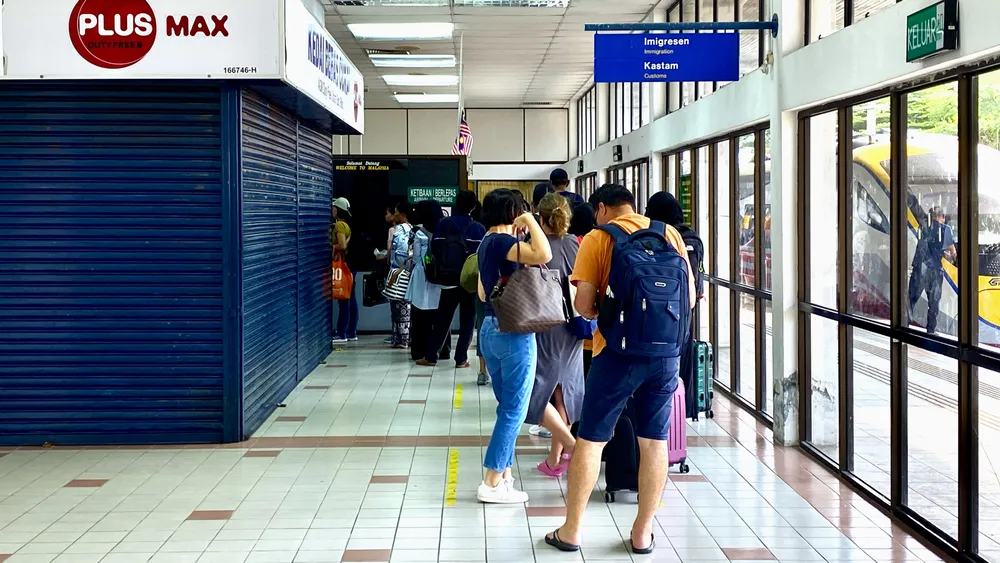
The route via Padang Besar is most convenient because there is a train station where both Thai and Malaysian immigration are located. From here, you can directly transfer to Malaysian rail lines. As of 2025, train no. 45 leaves Krung Thep Aphiwat Central Terminal at 16:22, passes through Hat Yai at 06:35 the next day, and arrives at Padang Besar at 08:05. After arriving at Padang Besar, you can either continue by rail onwards to Penang as a stop, or head directly towards Kuala Lumpur.
Alternatively, from Hat Yai, there are long-distance bus services to Penang and Kuala Lumpur, passing through Bukit Kayu Hitam. On the Thai side of the border lies Dannok, which is primarily a nightlife town for Malaysians to go wild. Hat Yai also has frequent bus/minivan services to Betong, another border town that is frequented by Malaysian tourists because of its cool weather. If you decide to stop over at Betong, note that the border is quite some distance away, so you need to negotiate with a tuk-tuk driver to take you there. After crossing the Malaysian border, you will then need a taxi to take you to Pengkalan Hulu, the closest town with bus services to Kuala Lumpur. Lastly, you can take the Thaksin Express from Bangkok directly to Thailand's southernmost town of Sungai Kolok, separated from the town of Rantau Panjang by a river. You enter Malaysia via a bridge, and from there, you can take taxis to Kota Bharu in Kelantan. Feel free to stop by and check out the unique Kelantanese architecture and cuisine, before continuing to Kuala Lumpur by bus. A more creative approach would be arriving at Ko Lipe from Hat Yai, spending a few days on the idyllic island, and then enteri
Highlights
Thailand Bangkok, the 'City of Angels' full with temples and street food. The royal palace, Wat Pho and Wat Phra Kaew are the city's most visited attractions, while Yaowarat offers you a glimpse into Thai-Chinese culture. Hat Yai is the largest city in southern Thailand, boasting a floating market and a morning market, while neighboring Songkhla offers a beach and an old town. Betong is surrounded by hills and is known for its cool climate and Chinese cuisine. The town is also multicultural - you can find Thais, Malays and Chinese residents living in harmony. The main attraction here is the underground tunnels of the former Malayan Communist Party. Sungai Kolok is as Malay as you can get without leaving Thailand. The Malays in the deep south of Thailand speak a similar dialect to the Malays of neighboring Kelantan, so many locals would listen to Kelantanese music. Ko Lipe is known as the 'Maldives of Thailand', and for good reason. Its white beaches and crystal clear waters attract tourists from all over the world, but getting there is quite a hassle due to distance and transportation. Therefore, tourists who visit Ko Lipe tend to also visit Langkawi and head southwards to Malaysia.
Malaysia Penang is the 'foodie capital' of Malaysia, while the old quarters of George Town is a UNESCO World Heritage Site. Don't forget to stop by Armenian Street, best known for the mural of two kids on a bicycle. Ipoh, the capital of the state of Perak, is surrounded by mountains. The town is majority Chinese, as such the flair is similar to that of George Town. Aside from natural attractions, there are landmarks left over by the British, and many delicacies that were developed by the locals. Kuala Lumpur, or just KL, the capital city dotted with iconic skyscrapers such as the Petronas Twin Towers, Merdeka 118 and KL Tower. Head to Kampung Baru to experience traditional Malay food and culture, Petaling Street for Chinese, and Brickfields (Little India) for Indian. Klang, the royal capital of Selangor, is known for a fragrant pork soup known as bak kut teh (肉骨茶, 'pork bone tea'), and the largest Little India in Malaysia. Malacca, anot
本指南改寫自 Wikivoyage (CC BY-SA)