
American Industry Tour
旅遊行程
The American Industry Tour showcases the industrial heritage of the Northeastern United States. As many other historical trails in North America, the tour follows migration routes from east to west, with a chronology from colonial times to the present day. Starting in Boston in the 17th and 18th centuries, we visit the 19th century factory clusters around Albany and New York City, and carry on through industrial regions of Pennsylvania, Ohio and Michigan, which had their heyday during the 20th century, ending in Chicago.
Understand
From 1776 to 1945, the United States transformed from an agrarian country of 2½ million inhabitants to the world's leading superpower, and the home of 140 million people. Most feats of innovation and engineering happened in the north-east. However, the Industrial Revolution began in the United Kingdom, which held eastern North America as a colony (see Early United States history). In the Market Revolution during the early 19th century, the textile business was an early adopter of industrial processes. From the mid-19th century, steam-powered factories became more common, and railroads started replacing canals and roads as main transport routes. During the American Civil War, the industries of the Northeast were mobilized to produce arms, supplies and ships, contributing to the Union victory. The colonization of the Old West truly began during the War, as the Southern secession from Congress allowed investment in rail lines and other colonization policies. See Industrialization of the United States for a guide to the political, social and cultural history of the whole country from the 1860s to the 1940s. The late 19th century was called the Gilded Age, with a rising capitalist class, and increased corruption, especially in large industrial cities. The turn of the century saw the rise of organized labor, not least in Chicago. The early 20th century was known as the Progressive Era, with labor reforms, antitrust laws, and women's suffrage. World War I again increased demand for military supplies. The automobile had its breakthrough during the Roaring Twenties, and Detroit became known as the Motor City. The 1929 Wall Street Crash caused the Great Depression, which hit the north-east hard, though the New Deal during the 1930s provided some relief. As World War II in Europe began in 1939, the USA supplied the Allies with arms. The 1941 Pearl Harbor attack brought America into the Pacific War, and brought large-scale industrial mobilization. After the war ended in 1945, industry shifted to consumer products. Since the 1960s, Northeastern industries have been downsizing, moving south, west, and abroad, causing unemployment and urban decay, causing the region to be rena
Get around
The journey is around 1,250 miles (2,000 km) in total. By car, the trip takes around a week (or two, as long if all venues are visited). However, as railroads were an integral part of industrialization, and most of the sights are in major cities, many legs of the tour can be done by rail. Some itineraries that give a background to early American history are:
From Plymouth to Hampton Roads: a road trip along the Atlantic coast, which showcases colonial and antebellum history. Touring Shaker country: The Shakers are a Christian sect, which played an important role in the early industrialization of America. Black Belt: The plantation region which many African-Americans left for the North during the Great Migration.
Go
Day 1: Boston area Our chronology starts in the 17th century in Boston, Massachusetts, where some industries could be found already during the Colonial era. Before the Age of Steam, industry took use of rivers for propulsion and transport. The humid climate of New England allowed many waterwheel-powered workshops. The textile mills used locally produced flax and wool, as well as cotton from the South. New England also has abundant wood, and enough iron ore was available for the first metalworking industries.
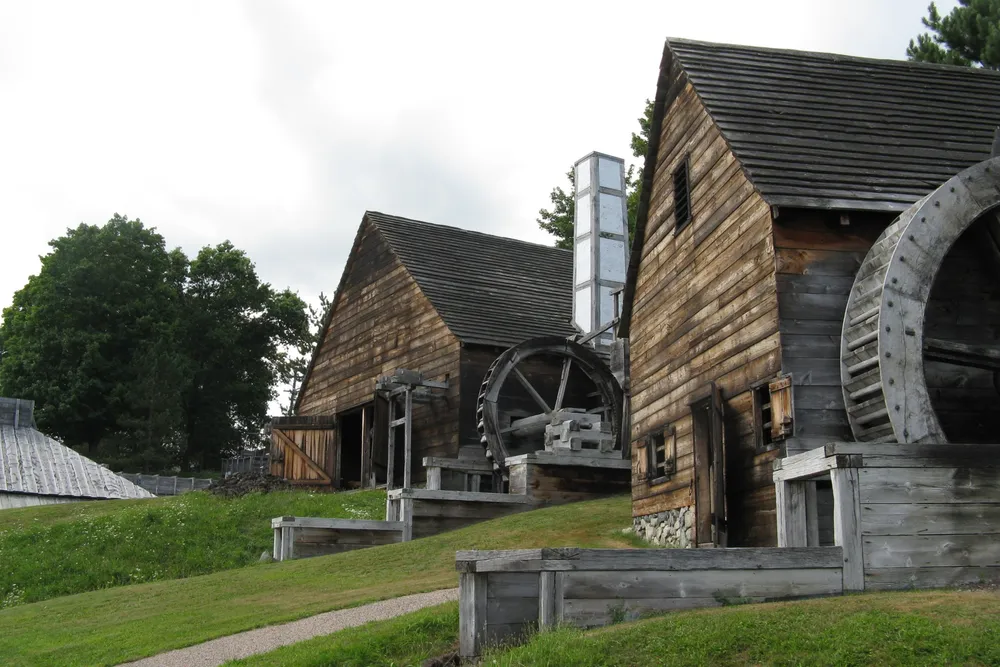
1 Plimoth Grist Mill Museum, 6 Spring Ln, Plymouth, Massachusetts (off Summer St., a short walk away from the waterfront). late Mar to end of Nov, open 7 days a week, 9AM - 5PM. Formerly known as the Jenny Grist Mill but now affiliated with Plimoth Plantation. An authentic working mill rebuilt on the site of the original 1636 mill. Tours and exhibits. Adult $11; Senior $9.90; Child $8; Free for members. 2 Saugus Iron Works National Historic Site, 244 Central Street (Saugus, Massachusetts). The site of the first integrated ironworks in North America (1646-1668). It includes the reconstructed blast furnace, forge, rolling mill, and a restored 17th-century house. As one of the first known industrial facilities on the continent, this is a good place to start our voyage. (updated Mar 2024) 3 USS Salem & the U.S. Naval Shipbuilding Museum, 739 Washington St (Quincy, Massachusetts). The USS Salem is a 716-foot -long US Navy Heavy Cruiser Gunship and is the world's only example of that class of ship. The Salem was among the most advanced war ships of her day and served until 1959. She is now permanently moored at the place of her birth, the former Fore River Shipyard in historic Quincy. The ship is also home to the US Naval Shipbuilding museum and has on display thousands of items relating to Naval history and shipbuilding. 4 The Quincy Quarries (Quincy (Massachusetts)). The Quincy Quarries have supplied granite to Boston and buildings around the world with the tell-tale 'fingers' and bluish color. Now, they are empty and great places to hike or take a walk during the day. Some areas are filled with color by generations of teenagers' graffiti, others are used f
Go next
In Chicago, our chronology reaches the 1950s, as the city was at its peak. Since the 1960s, the industries of the Northeast started downsizing, due to automation and outsourcing. Crime-driven emigration to the suburbs made the city centers decline, though in the 21st century, many city centres are experiencing a renaissance due to gentrification. America's center of gravity for population and industry moved on to the southwest, with especially California as the new land of opportunity, together with the Pacific Northwest, the Southwest and Texas. Minneapolis/St. Paul, St Louis, Kansas City, Milwaukee and Denver are some other important industrial cities in middle America. Historically, the iron ore for all that steel came primarily from Northeastern Minnesota, and a considerable amount of ore is still shipped out of Duluth and adjacent Superior. The whole region has numerous active mines and exhibits of its industrial past. Before the advent of the Interstate Highway System there were just a few highways and railroads across the Rocky Mountains, and only the elite could afford air travel. Some of the classical routes are still available today:
Empire Builder has run from Chicago to Seattle since 1929. California Zephyr, a streamliner train service opened in 1949 across scenic terrain, to the San Francisco Bay Area. Lincoln Highway (1913-1930), the first transcontinental highway, reaches San Francisco. These named auto trails predated the 1926 US Highway System. Route 66 (1926-1985) was the legendary highway that connected Chicago to Los Angeles. It was replaced, piece-by-piece, by the Interstate system (established in 1956) with the last segment bypassed near Williams (Arizona) in 1984.
本指南改寫自 Wikivoyage (CC BY-SA)