
Amber Road
旅遊行程
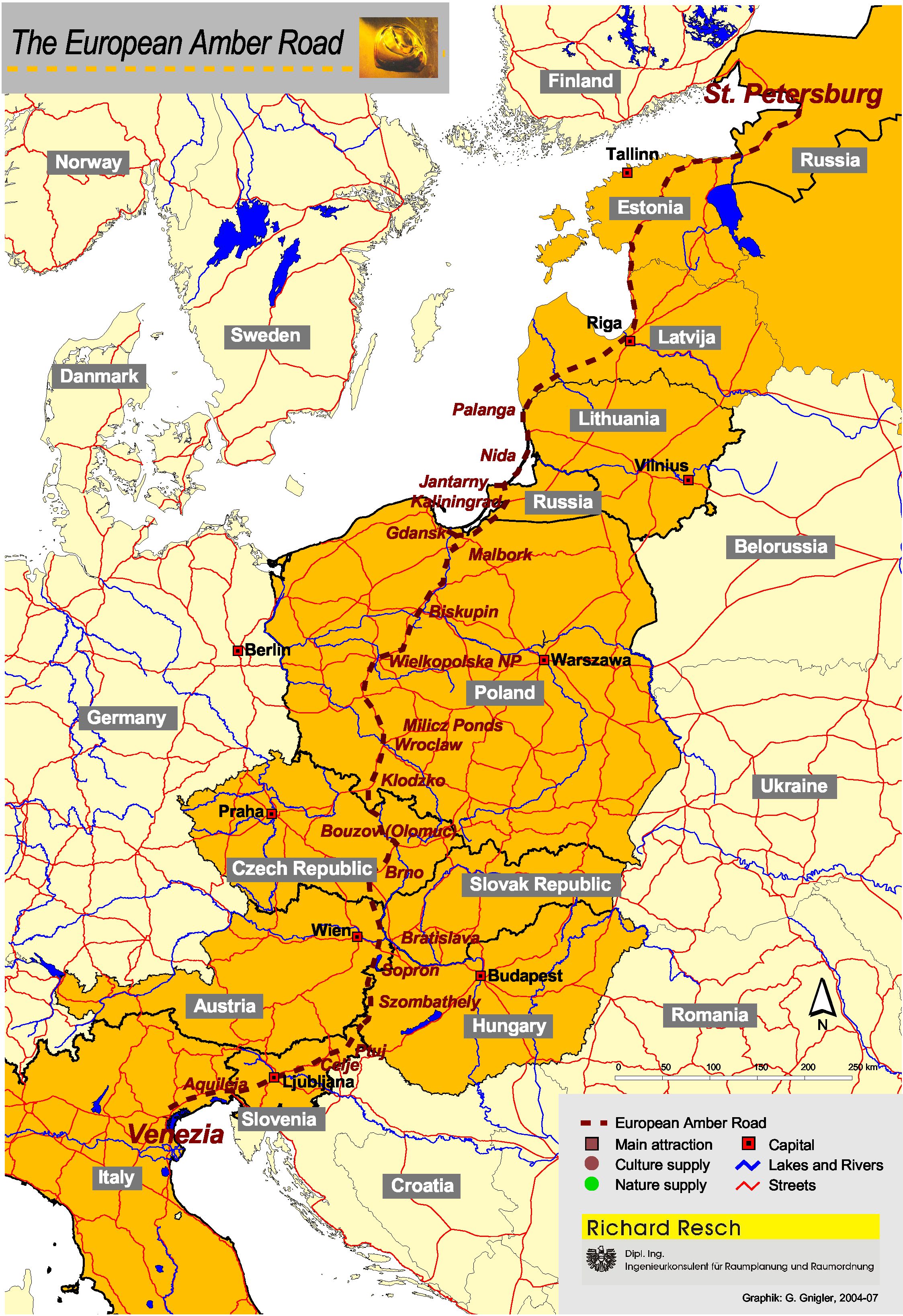
The Amber Road (German: Bernsteinstraße, Italian: Via dell Ambra) is an ancient trade route which connects the Baltic Sea with the Adriatic Sea. The Amber Road leads from Aquileia near Venice to Saint Petersburg and passes through Italy, Slovenia, Hungary, Austria, Czech Republic, Poland, Lithuania, Latvia, Estonia and Russia.
Understand
One of the largest amber deposits is in the Baltic region. Accordingly, the amber trade prospered and a number of trade routes emerged. See gemstones for more general discussion.
Establishing of the Amber Road We don't exactly know when the "Amber Road" was established, but findings from prehistoric times prove that trade along this corridor existed long before the Roman Empire. Excavation sites near the Baltic Sea in Juodkrante have found a neolithic treasure of processed amber stones. These can be seen nowadays in Palanga Museum in Lithuania. Other excavations from the copper age have revealed amber beads in Schletz, Austria now stored in Asparn an der Zaya museum, while in Northern Italy amber remains were found dating to the bronze age. There were many routes through which amber was traded from north to south, notably through the rivers Rhine and Rhone to Marseilles. Though the trade only really blossomed during Roman Empire period.
Roman Amber Road During Roman antiquity, amber was a very sought-after gemstone. Pilnius reported expedition ordered by Nero to the 'Amber coast'. Reportedly, Roman rider led group of traders from Carnuntum to the land of Aesti located somewhere in current Baltic States. They took large amounts of amber back Rome, so much that even the arena nets were decorated with them. Large number of Roman coins were dispersed across entire route up to Lithuania providing record of lively trade on the road. Tiberius had rebuilt part of the Amber road to military road standard also known as Via Gemina. It went from Emona (modern Ljubljana) to Carnuntum near the Danube. The road was composed of gravel with ditches on the sides and had wooden and stone bridges; stone pavement was used only in cities. Traces of this road can be found nowadays in Burgenland, in Hungary and Slovenia, and of course, in Aquileia, Italy. North of the Danube there were no fixed roads. However there is evidence of a route that went from Carnuntum through Lower Austria and South Moravia. From Olomouc the road passed through Wrocław in Silesia to Greater Poland and finally to the Baltic Sea near Gdańsk or to Lithuania.
Central European North-South corridor Extens
Prepare
The road itself is pretty long, however it goes mostly through populated areas, so you should never run out of supplies. It only gets sparsely populated north of Riga. It is possible to go through the entire route in just 2-3 days, however if you want to enjoy the trip it is an entire vacation which will realistically take about one-two weeks to complete. Preferable mode of transportation is car; as it is a long route, it should be in very good condition. It is also possible to complete the journey by public transport, with a combination of rail and bus, however it may be tedious and time-consuming at certain parts and you may not be able to stop everywhere you want. Specific trains to consider include Adriatic Express on Slovenia, Austria part (only in summer) and Baltic Express in Czech Republic and Poland. Travel by foot or bike will take a lot of time and there are many hilly/mountainous segments on the road, also you will likely need to use a bus to cross the Russian border as there is no foot crossing between Russia and Poland. If you are travelling by car there are many different toll schemes working in countries along the way. Slovenia, Austria, Hungary and Czech Republic use vignettes which have to be bought on the internet before arrival. In Poland and Italy you can expect toll booths on highways. To the north in Lithuania, Latvia, Estonia and Russia roads are tolled only for heavy vehicles (above 3.5 tons) Your car and health insurance will usually apply only in Russia or the Schengen area and you will have to buy additional insurance before crossing the border. Most car rentals will not allow you to drive to/outside Russia. Not having car or health insurance may invalidate your visa and result in being turned back on the border. If you wish to do part of the road north of Poland it will require multiple-entry tourist visas for both Russia and the Schengen area; these are much more difficult to obtain than simple single-entry visa. Total of 3 border crossings will require about 10 additional hours to pass through. It may be good idea to swap some elements from the itinerary to cut on border crossings (e.g. go by plane from Kaliningrad to Saint Petersb
Go
1 Venice. (updated Apr 2025) 2 Aquileia. Starting point of Amber Road during Roman era. (updated Apr 2025) 3 Ljubljana (Emona). (updated Apr 2025) 4 Šempeter v Savinjski Dolini. (updated Apr 2025) 5 Ptuj. (updated Apr 2025) 6 Szombathely. (updated Apr 2025) 7 Sopron. (updated Apr 2025) 8 Carnuntum. a castle known as Desolate Castle (Odes Schloss) is a former Roman Empire stronghold, establishing control on the Danube and providing a safe crossing point for traders. The castle dates to 130 AD. (updated Apr 2025) 9 Vienna. (updated Apr 2025) 10 Brno. (updated Apr 2025) 11 Olomouc. (updated Apr 2025) 12 Kłodzko. (updated Apr 2025) 13 Wrocław. (updated Apr 2025) 14 Kalisz. (updated Apr 2025) 15 Biskupin. (updated Apr 2025) 16 Toruń. (updated Apr 2025) 17 Gdańsk. (updated Apr 2025) 18 Malbork. (updated Apr 2025) 19 Elbląg. (updated Apr 2025) 20 Kaliningrad. (updated Apr 2025) 21 Yantarny. (updated Apr 2025) 22 Nida. (updated Apr 2025) 23 Juodkrantė. (updated Apr 2025) 24 Palanga. (updated Apr 2025) 25 Riga. (updated Apr 2025) 26 Pärnu. (updated Apr 2025) 27 Saint Petersburg. (updated Apr 2025)
本指南改寫自 Wikivoyage (CC BY-SA)