
Western Isles Overland Route
United Kingdom · Europe
關於Western Isles Overland Route
The Outer Hebrides are the most westerly islands of the Hebrides, west of the Scottish Highlands. They're sparsely populated with poor soil and few resources; historically they were in separate local government areas, which hindered their development and culture. But during the 20th century much of the island chain was linked by road causeways, their air and ro-ro ferry links improved, and they became the combined local government entity of the Western Isles (Gaelic: Na h-Eileanan Siar). In 2021 their population was 26,830.
Western Isles Overland Route旅遊指南
城市概覽
The bedrock of all these islands is gneiss laid down 3 billion years ago, very hard-wearing and impermeable. On Lewis this lies flat, so a peat bog has built up over it, and on Harris it's contorted into gnarly hills; the Uists further south are a mixture more flat than gnarly. They are all a dismal prospect to farm. People have nevertheless lived here since prehistoric times, leaving their burial cairns, "dun" fortresses, and standing stones. They got about by sea in small craft that could draw up in little coves, as did the Celts and Vikings. During the Middle Ages the Vikings transitioned into the nation of Norway, and were forced to cede the Hebrides to Scotland after their defeat at Largs in 1263. Clan chiefs feuded with each other and with Edinburgh or London authority, but their battles were elsewhere. One such battle, at Culloden in 1746, broke the feudal Clan system and brought in a capitalist economy and distant landowners looking to increase their profits. In the 19th century this led to ruthless evictions - "Clearances" - of the tenant smallholders, and the stark empty scenery you see today was created in that era. The hillsides are haunted by ruins of abandoned farmsteads and entire villages, and the furrows of potato plots. There was never large-scale industry here - weaving textiles such as Harris tweed remained a cottage industry, and fisheries were hampered by the distance to market. The population has therefore remained small, with no influx of mainland workers. One result is that Gaelic language and culture is preserved, and is the primary language on road signage. Everyone is fluent in English but learning a few Gaelic phrases will boost your welcome. There is religious gradient: Lewis and Harris are dourly Protestant and sabbatarian, so almost nothing stirs on a Sunday. Churches. Barra and South Uist are Catholic, and you may find shops open after midday on a Sunday. Benbecula is in between. Other faiths are only found in penny numbers. Summer
如何抵達
By plane There are three airports in the Outer Hebrides, so each populated island group is served. Loganair operates all the flights.
Stornoway (SYY IATA) on Lewis is the best connected, with direct flights from Aberdeen, Edinburgh, Glasgow and Inverness on the mainland, and from Benbecula. Benbecula (SYY IATA) has flights from Glasgow and Stornoway. Barra (BRR IATA) only has flights from Glasgow, which land on the beach.
By boat Calmac car ferries sail throughout the Hebrides. Buses run from Glasgow to the mainland ferry ports, and trains run to Oban and Mallaig. The routes are:
Ullapool to Stornoway on Lewis two daily, 2 hr 30 min (Nov-Mar only one on Sunday). Uig on Skye to Tarbert on Harris one or two daily, 1 hr 40 min (Nov-Mar some days in just one direction). Uig on Skye to Lochmaddy on North Uist one or two daily, 1 hr 45 min (Nov-Mar some days in just one direction). Oban to Castlebay on Barra daily, 5 hours (Nov-Mar not Th or Su). Mallaig to Lochboisdale on South Uist daily, 3 hours 30 mins (Nov-Mar not Tu or Th, and on some days sailing from Oban instead of Mallaig). See below for the ferries between the three island groups. See Hebrides#Get in for cruise ships sailing in these waters.
當地交通
By boat Calmac ferries cross between the island groups:
Berneray north tip of the Uists to Leverburgh on Harris 3 or 4 daily, one hour. Eriskay south tip of the Uists to Barra 4-5 daily, 40 min.
By bus
Buses reach all corners but are sparse M-Sa with nothing on a Sunday. A linked bus and ferry service runs the length of the Outer Hebrides through Barra, the Uists and Harris and across Lewis to Stornoway, and M-Sa it's possible to go the whole way in one day. There are half-a-dozen services part-route (eg Lewis to Harris), but for the full route you need to set off from Castlebay Barra at 06:20, Lochboisedale South Uist at 09:00, Benbecula at 11:10, Lochmaddy North Uist at 11:30 and Tarbert Harris at 16:20, to reach Stornoway by 17:30. Going south, you leave Stornoway 09:30 to reach Tarbert at 10:45, Lochmaddy at 13:45, Benbecula at 14:25, Lochboisdale at 15:25 and reach Castlebay at 17:35.
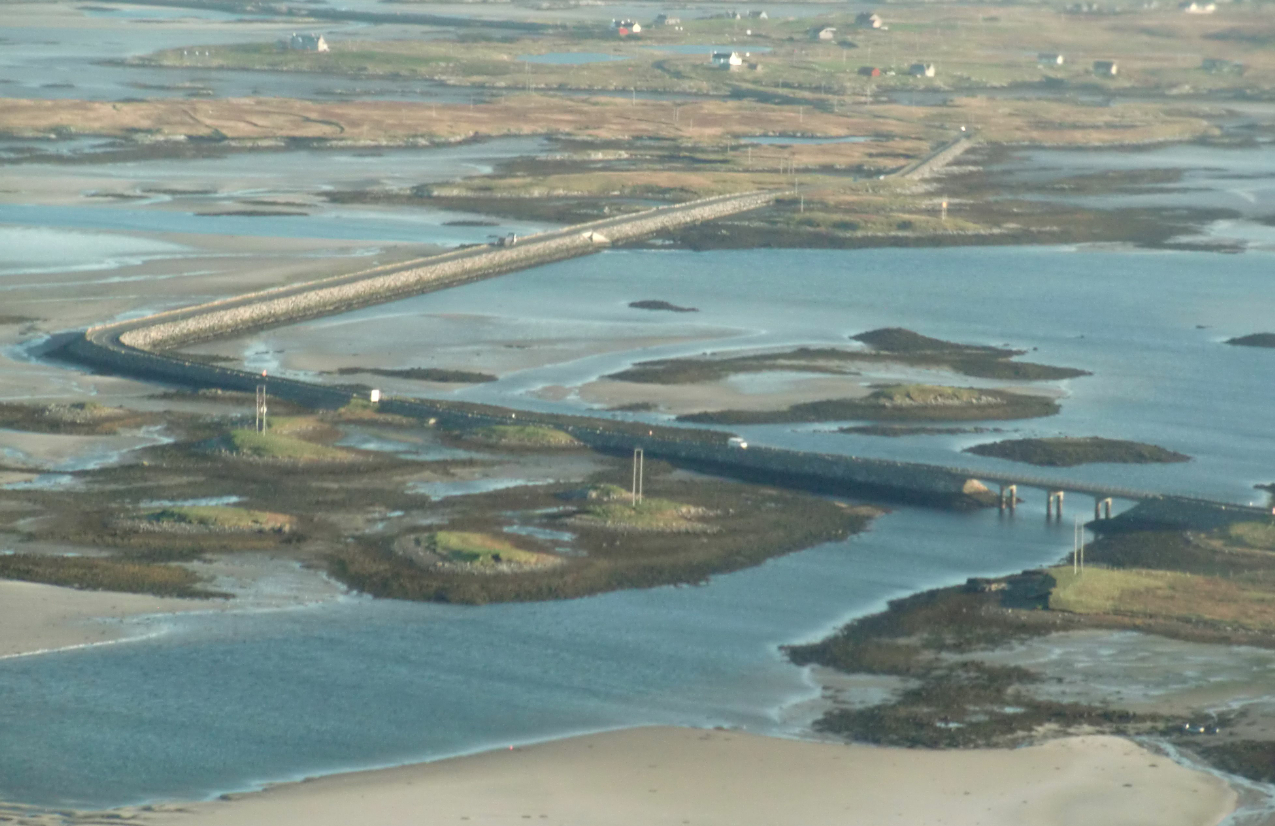
By road Some visitors bring their own car, but it's a long drive to reach the mainland ferry ports. Even from Glasgow or Edinburgh, you need an overnight stop before joining the ferry. You'll appreciate having a car to get around, as sights and amenities are scattered, and the car gets you out of the wind, rain and midges. The three airports have car hire, which you should book as the rental fleets are small. They allow you to drive to another of these islands and may allow drop off, but you may not take a rental car to the mainland. Keep an eye on the fuel gauge, distances may be greater than you expect and filling stations are sparse. The island roads are mostly single track with passing places and are in good repair, since they're not pounded by heavy traffic. They're double track on the inter-island causeways, which are toll-free and passable in all but the wildest Atlantic weather. The roads are pleasant to cycle, if you're prepared for an occasional drenching. With sight-seeing it takes a week to cycle from Barra to Stornoway.
必看景點
Castles: Lews Castle in Stornoway is an Edwardian mansion, now a museum and event space. Dùn Èistean near the north tip of Lewis is the scraps of a 16th century redoubt, on a sea stack that you reach by footbridge. Amhuinnsuidhe Castle 15 miles west of Tarbert on Harris is a posh hotel for shooting parties. Borve Castle on Benbecula is the ruin of a medieval tower house. Ormacleit Castle on South Uist is the fragments of an 18th century mansion. Kisimul Castle is a medieval bastion perched on an islet off Castelbay on Barra. Prehistoric sites abound, as the lack of population and mainland farming methods saved them from plough and pickaxe. Callinish standing stones on Lewis are the must-see. This is the chief site of a Neolithic ritual landscape, so nearby are Callanish 2, 3 and so on. Dun Carloway on Lewis is a broch, a sturdy Iron Age fortress. Bostadh on Great Bernera is an Iron Age house, though the original has been re-buried and you visit a replica. Pobull Fhinn is the best stone circle on North Uist. The wheelhouse on Grimsay is Iron Age, probably ritual not residential. Pollachar standing stone on South Uist is more accessible than most megaliths: they're often on soggy moors.
Blackhouses were traditional Hebridean dwellings, with the cattle kept at one end, and a fug of peat smoke as they had no chimney. Arnol on Lewis is a blackhouse village - many are ruined but one is restored as a museum. Garenin is another such village. Some are now holiday cottages and one is a hostel. The hostel on Bernaray is a restored blackhouse. Howmore on South Uist has several, and one is a hostel. Natural world: the islands are good places for birdwatching, with a RSPB reserve on North Uist, and many migrant and resident species. St Kilda is the stand-out if you can reach it. Seals and occ
城市概覽改寫自 Wikipedia,旅遊指南來自Wikivoyage (CC BY-SA)。照片來自 Wikimedia Commons.