
Vigevano
Italy · Europe
關於Vigevano
Vigevano is in Lombardy. It is an Italian town of 62,064 inhabitants in the province of Pavia in Lombardy.
Vigevano旅遊指南
城市概覽
An industrial center of national importance, Vigevano is known for having long been one of the main shoe production centers in the world. The first industrial model shoe factory was built there in 1866, opening a season that in the following century would have led the capital of Lomellino to produce tens of millions of shoes exported all over the world, earning the nickname of "shoe capital". Even today, the International Shoe Museum, housed in the premises of the Castello Sforzesco, preserves the evidence of a crucial period in Italian industrial history. The municipality is the second in the province by number of inhabitants after the capital and first by surface, included entirely in the Lombard natural park of the Ticino Valley. It has long enjoyed various autonomies in the course of its history, already a free municipality federated in the second Lombard League and capital of Vigevanasco, as well as a bishopric. It was also the first Lombard city to have obtained the title of city in modern times.
Geographical notes Vigevano is in the north-eastern Lomellina, on the right bank of the Ticino river, which separates it from the province of Milan. It is about 38 km from Pavia, 36 km from the center of Milan, 27 km from Novara, 14 km from Mortara, 12 km from Abbiategrasso. Vigevano is approximately 70 from Lodi and Alessandria, 100 from Piacenza, 130 from Turin and 140 from Brescia. The landscape, being Vigevano inside the Po Valley, is flat. Vigevano borders with Abbiategrasso, Bereguardo, Besate, Borgo San Siro, Cassolnovo, Cilavegna, Gambolò, Gravellona Lomellina, Morimondo, Mortara, Motta Visconti and Parona.
When to go The climate is temperate sub-continental, with humid and very cold winters (average 3.1 ° C), and very hot and equally humid summers (average 21.7 ° C). Precipitation reaches its maximum peak in October (122 mm) and the minimum peak in July (58 mm).
如何抵達
By car The town is crossed by the state road 494 Vigevanese which, passing through Vigevano, connects Milan to Alessandria. To reach Vigevano the advice is to follow the directions below:
from Milan take the west ring road: take the West ring road and take the SP ex SS 494 towards Abbiategrasso; or take the Milan - Genoa motorway to the Gropello Cairoli exit.
from Turin leave the A4 motorway at Novara, exit East. from Genoa leave the A7 motorway in Gropello, Cairoli exit from Milan Linate airport follow the direction of Bologna / Tangenziale Ovest - Exit at Vigevano-Lorenteggio, direction for Vigevano. from Milan Malpensa airport, take the SS 336 super highway towards Magenta; then follow the signs for Abbiategrasso and Vigevano. Cross Robecco sul Naviglio and then Abbiategrasso and continue towards Vigevano.
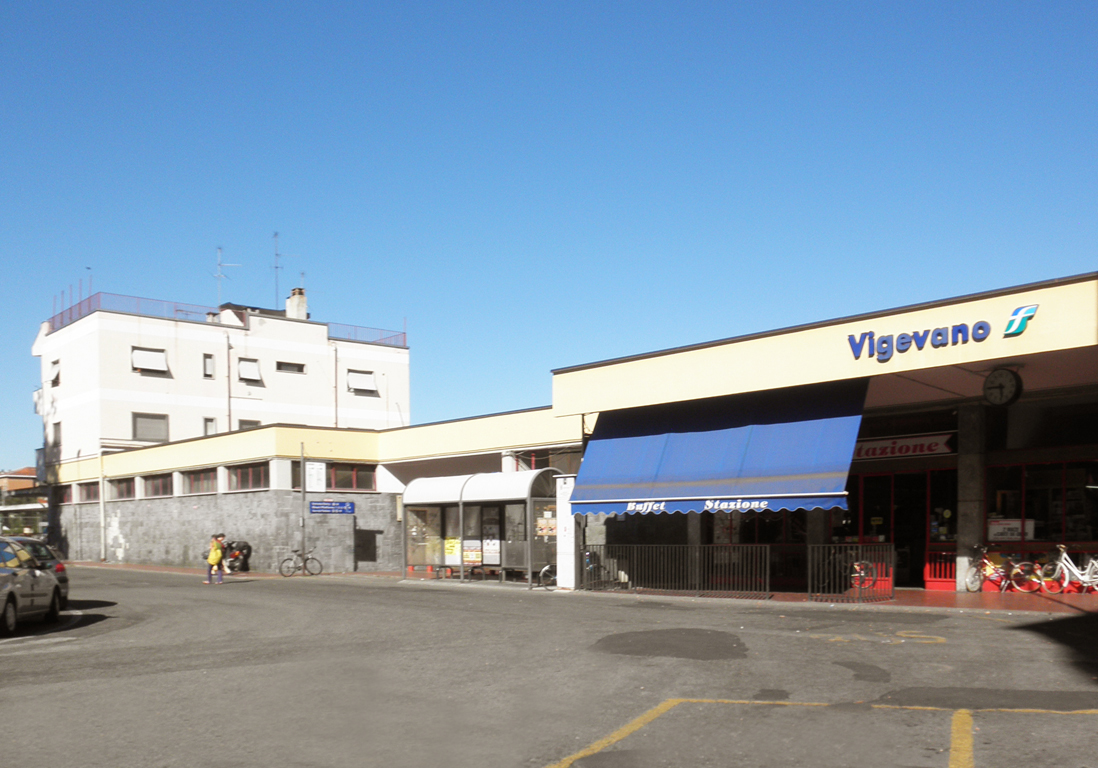
By train From Milan: it can be reached from Milano P.ta Genova (MM2) or Milano San Cristoforo (MM2) direction Mortara - Alessandria.
必看景點
Torre del Bramante. The origin of the tower, at the highest point of the city near the castle, dates back to 1198 and was finished by Bramante at the end of the 15th century, while in the 17th century the baroque "onion" dome was added to replace the original one. conical spire. The tower has an original shape which, in the 15th century, was the model for the Filarete tower in the Castello Sforzesco in Milan; it is made up of sections that narrow as you approach the top. From the terraces it is possible to admire an excellent view of the Piazza Ducale, the castle and the whole city. 75 m high from the level of the square (57 m from the level of the court), the Torre del Bramante is the current Civic Tower of the city of Vigevano, of which it has always been the symbol. Furthermore, with its 57 m it is the tallest structure in the city of Vigevano. it is created by overlapping three floors sloping upwards. The first terrace is enclosed by the Ghibelline battlements, the upper section houses the clock, while the last contains the 17th-century bell. At the top rises the octagonal belvedere that crowns the tower. The belfry, inaccessible to the public, houses "il campanone", a large 17th-century bell "split" out of necessity. In fact, in the 19th century there were no modern electronic systems to control the bells, and the tower clock, mechanical at the time, struck every half hour even at night. It seems that the sound of the "big bell" was so loud that the inhabitants of the houses leaning against the castle and the piazza were practically unable to fall asleep. So they presented a petition in the municipality in which they asked to "silence" the bronze disturber! In the end a compromise was reached: from the bell, with almost surgical precision, a segment was removed in order to make it split and muffle the sound. And this is how it can still be heard beating every quarter of an hour today. (updated Jun 2021)
Piazza Ducale. h24. The Piazza Ducale of Vigevano is a l
購物
Throughout history, Vigevano has always been famous for the manufacture of high quality shoes. Even today, the internationally renowned Moreschi company has its headquarters in the city, in via Cararola 69, with an outlet with much more affordable prices. But a tour in the center and under the arcades of Piazza Ducale will make you realize that there is no shortage of clothing and perfumery shops and jewelers also in the rest of the city center. For lovers of shopping centers, a little further on the outskirts, there is the "Il Ducale" shopping center, of the Ipercoop chain, with the traditional supermarket and a shopping arcade.
美食
Eating in Vigevano is a pleasure for your palate as you can taste the typical dishes of Lombard cuisine and, above all, the typical dishes of Lomellina which are of "poor" and "country" origin. All the restaurants in Vigevano offer excellent meat dishes and land dishes (including fish dishes) that are cooked only and exclusively with products and raw materials from the countryside and local farms. The main source of income of Vigevano is, without question, the footwear sector but also tourism is very developed thanks to the historical and artistic beauties of the city so the prices of the restaurants are not really cheap but they are not excessive or prohibitive either.
What to eat in Vigevano The gastronomic tradition of Vigevano is very ancient and has always been influenced by peasant civilization, and it is no coincidence that one of the main "ingredients" of this sublime cuisine is rice which is present in all courses, from appetizers to desserts. Let's see what are some of the best typical dishes of Vigevano that you absolutely must not give up:
Fried or stewed frogs Sautéed snails Chickpea Soup and Tripe in Broth All rice-based dishes Stewed wild boar with polenta Stewed donkey All dishes based on river and sea fish (spaghetti allo scoglio) All dishes based on pork, sheep and game (jugged hare and pheasant alla cacciatora) Rice biscuits, Dolce del Moro and Bramantini biscuits Local cured meats and cheeses (figadei and salami della Duja) The typical dishes of V
城市概覽改寫自 Wikipedia,旅遊指南來自Wikivoyage (CC BY-SA)。照片來自 Wikimedia Commons.