
Veliko Tarnovo
Bulgaria · Europe
關於Veliko Tarnovo
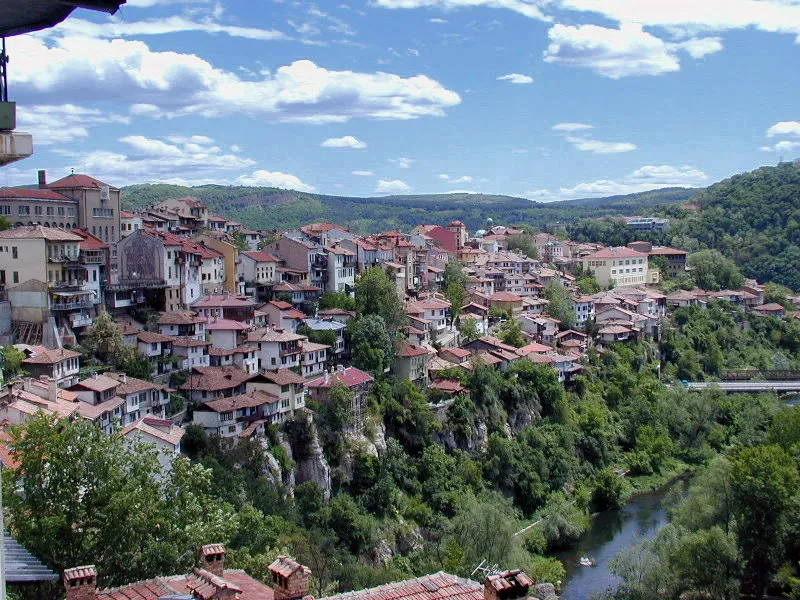
Veliko Tarnovo (Bulgarian: Велико Търново, also romanized as Veliko Turnovo) is a historic city in the central-north of Bulgaria notable for its medieval ruins and its picturesque cityscape - it was built on the steep banks of the Yantra river as it snakes through the foothills of the Balkan Mountains. In the middle ages, Tarnovo was the capital of the Second Bulgarian Empire (1185-1396) and the partially restored ruins of the Tsarevets Fortress are the main sight of the city. Today, it's a university town with a population of about 66 thousand and the administrative centre of the eponymous region.
Veliko Tarnovo旅遊指南
城市概覽
A town with very rich history, Veliko Tarnovo was the capital of the Second Bulgarian Empire and has long traditions in the culture of Bulgaria. The city is rich in museums and historical sites, combined with vivacious night life propelled by the students in one of the largest universities in Bulgaria. It is located around a major bend in the Yantra River that carved steep hillsides on which the Old Town is built. The Old Town is separated into 3 hills: Tsarevets, Trapezitsa, and Sveta Gora, while the New Town spills out into a flatter region to the west of the hills. The first syllable of the city's name is pronounced similar to "turn" in English, with a hard R - TURN-ovo rather than TAHR-novo, as the romanized form of the name would suggest. The "Tarnovo" spelling is a result of the somewhat controversial official transliteration system that conflates two separate Bulgarian vowels, 'а' and 'ъ', into a single Latin letter - 'a'. In older sources in English, the name is rendered as Trnovo, Tirnovo, or even Tirnova. The likely origin of the name is the Slavic root for "thorn". The appellation Veliko ("Great") was added to the city's name in 1965, partially as a reference to its glorious past, partially to distinguish it from Malko Tarnovo ("Small Tarnovo") in South-Eastern Bulgaria. Journalists and people who write tourist materials sometimes use the nickname "'the City of the Tsars" ("tsar" being the Slavic title equivalent to "king").
如何抵達
By plane Although Veliko Tarnovo's Gorna Oryahovitsa airport 4 km away is not open to passenger air traffic (it is possible to arrange private aircraft landings there), it is possible to fly to Bulgaria's capital city Sofia, or the coastal city of Varna and then by rail or modern coach to Veliko Tarnovo.
By train Veliko Tarnovo is one of the major stops on Line 4, which runs north-south from Ruse on the Danube to Stara Zagora in Southern Bulgaria, crossing the Balkan Mountains. Veliko Tarnovo is also very close to Gorna Oryahovitsa (less than 10 km (6.2 mi)), a smaller town known mostly as the junction between that line and the Sofia-Varna line, which runs east-west along the whole length of Northern Bulgaria, from the capital to the Black Sea. It's possible to get to Veliko Tarnovo by rail from both Romania and Turkey. Between June and September, the Bosphorus Express international overnight train runs between Bucharest and Istanbul, once daily in each direction (about 21 hr end-to-end). From Bucharest, it departs from the Bucuresti Nord station, crosses the border at Ruse, and takes about 7 hr to Veliko Tarnovo; from Istanbul, it departs from the Halkalı station (not Istanbul's central station!), passes through Çerkezköy and Edirne, and takes about 14 hr to Veliko Tarnovo. Another option for Bucharest is buying a ticket to Gorna Oryahovitsa on the Bucharest-Sofia train (also once daily Jun-Sep). Off-season, rail travel requires changing trains at the border crossings. Many national trains to Veliko Tarnovo require changing at Gorna Oryahovitsa; in that case, it can be more convenient to just buy a ticket to that town and then take a bus, minibus or taxi from Gorna Oryahovitsa station to Veliko Tarnovo. Assuming that your destination is the tourist information centre on Mother Bulgaria Sqr (ploshtad Mayka Bulgaria), the most direct route is almost exactly 11 km (6.8 mi) long and the taxi fare should be between ~€4.16 and ~€7.27.
1 Train Station (Zhe Pe Gara,
當地交通
On foot Walking is the best way to see Veliko Tarnovo. The town is fairly large but everywhere is within easy reach including attractions such as Tsarevets, the medieval stronghold. In the Old Town, walking is preferable since the roads weren't designed for modern transportation and are cramped and curvy.
By public transport Since Veliko Tarnovo is not that large, you'll probably never use it. Buses run from 07:00 till 21:00 with frequency of rides varying between 20 and 60 minutes. Buses #20, #50 and #40 go to Tsarevets. Bus 10 connects the city with Gorna Oryahovica railway station (but mini-buses are preferable). Virtually all bus lines go through the city center. Tickets can be purchased only in the bus from a conductor. The ticket is valid only for the current ride and cost ~€1.56 in 2023.
By taxi Taxis in Veliko Tarnovo are yellow and can be caught on the streets by waiving a hand or can be called. The passenger is charged ~€1.03 initial fee, and ~€0.31 per kilometer afterwards. In general, a trip within the city limits shouldn't cost more than ~€1.82-2.08. Overall this means of transport is very reliable.
By car Although Veliko Tarnovo is generally a calm city, transportation by car could be very complicated due to the frequent traffic reorganisations. The maximum admissible speed within the city limits is 50 km/h.
必看景點
The city is divided into an old and new parts. The old city is a collection of traditional renaissance houses scattered over the hills around the river Yantra and the new part consists of a mixture of communistic and modern style buildings. Since most of the touristy old town (including both fortresses) is on a natural choke point caused by the Yantra, that part will feel more cramped and crowded with tourists, and anyone looking to see a less-touristed old town should go to the western half, where the city opens up. The only problem with this is that most of the museums and monuments are located in the choke point, and most of the western half is residential, but both parts still offer great insights to old medieval European towns. There are various historical museums, located in Old Town, and an art museum on an island in the river. Nearby Arbanassi on the hilltop 4 km away is also worth a visit, a taxi will cost about ~€1.56-2.08. Right around where the old part widens, there is a large Monument to Mother Bulgaria, which commemorates Veliko Tarnovo's history as the former capital of the Bulgarian state.
1 Tsarevets. If in Veliko Tarnovo, make sure to visit the castle of the old Bulgarian capital - Tsarevets. The medieval stronghold located on a hill of the same name, served as the Second Bulgarian Empire's primary fortress and strongest bulwark from 1185 to 1393. Housing the royal and the patriarchal palaces, it is a popular tourist attraction. The castle itself offers spectacular views of the town, surrounding hillsides, and the river below. The Tower of Baldwyn (also Baldwin Tower) within the complex allows for tourists to climb to the top and offers both spectacular views and an insight into how medieval towers were designed and how they functioned. (updated Apr 2026)
美食
Bars and restaurants worth visiting:
Budget Malkia Inter, Ivan Vazov 22 sr, ☏ +358 878650023. Local cuisine, run by a nice family. It is cosy with lovely and interesting decor of a lot of musical instruments. Tasty food and inexpensive. Ego Bar and Grill. National and foreign cuisine, cheap prices. There are three "Ego" restaurants, at 17, Nezavisimost St., at 1, Slaveykov
城市概覽改寫自 Wikipedia,旅遊指南來自Wikivoyage (CC BY-SA)。照片來自 Wikimedia Commons.