
Teutoburg Forest
Germany · Europe
關於Teutoburg Forest
Teutoburg Forest, also known as Eastern Westphalia and Lippe (Ostwestfalen-Lippe in German and OWL for short), is a region in North Rhine-Westphalia, Germany.
Teutoburg Forest旅遊指南
城市概覽
The Teutoburg Forest is historically linked to a decisive battle in 9 AD between Roman troops, led by general Publius Quinctilius Varus, and a confederation of Teutonic tribes led by Arminius (called "Hermann" by Martin Luther and many later-date German patriots and historians, but probably not named that). In newer times, historians have cast doubts on the actual site of the battle, designated saltus Teutoburgiensis in Roman annals. Archeological digs on the 20th century identified the battle place at the Kalkriese Hill, near Osnabrück, rather than the area that has been called Teutoburg Forest since the 19th century. Nevertheless, this historic episode has played a big part in the region's identity. Lippe was a separate petty state within the German Empire until it was merged with the state of North Rhine-Westphalia in 1947.
如何抵達
There is a regional airport in Paderborn-Lippstadt (PAD IATA) that offers a few domestic connections and saisonal/charter flights to holiday destinations around the Mediterranean Sea. Other nearby airports are Münster/Osnabrück (FMO IATA) (65 km to the West), Dortmund (DTM IATA) (85 km to the Southwest) and Hannover (HAJ IATA) (75 km to the Northeast). The next major airport with a wide range of international connections is Düsseldorf (DUS IATA) (170 km to the Southwest). High-speed trains (ICE) stop in Bielefeld (hourly from Berlin, Hannover, Düsseldorf, Cologne). Ordinary intercity trains from Berlin and Amsterdam run every two hours and stop in Minden, Bad Oeynhausen and Bünde. In the same frequency intercity trains from Dresden and Cologne stop in Minden, Bad Oeynhausen, Herford, Bielefeld and Gütersloh. From these stations regional trains connect to other places in the region.
必看景點
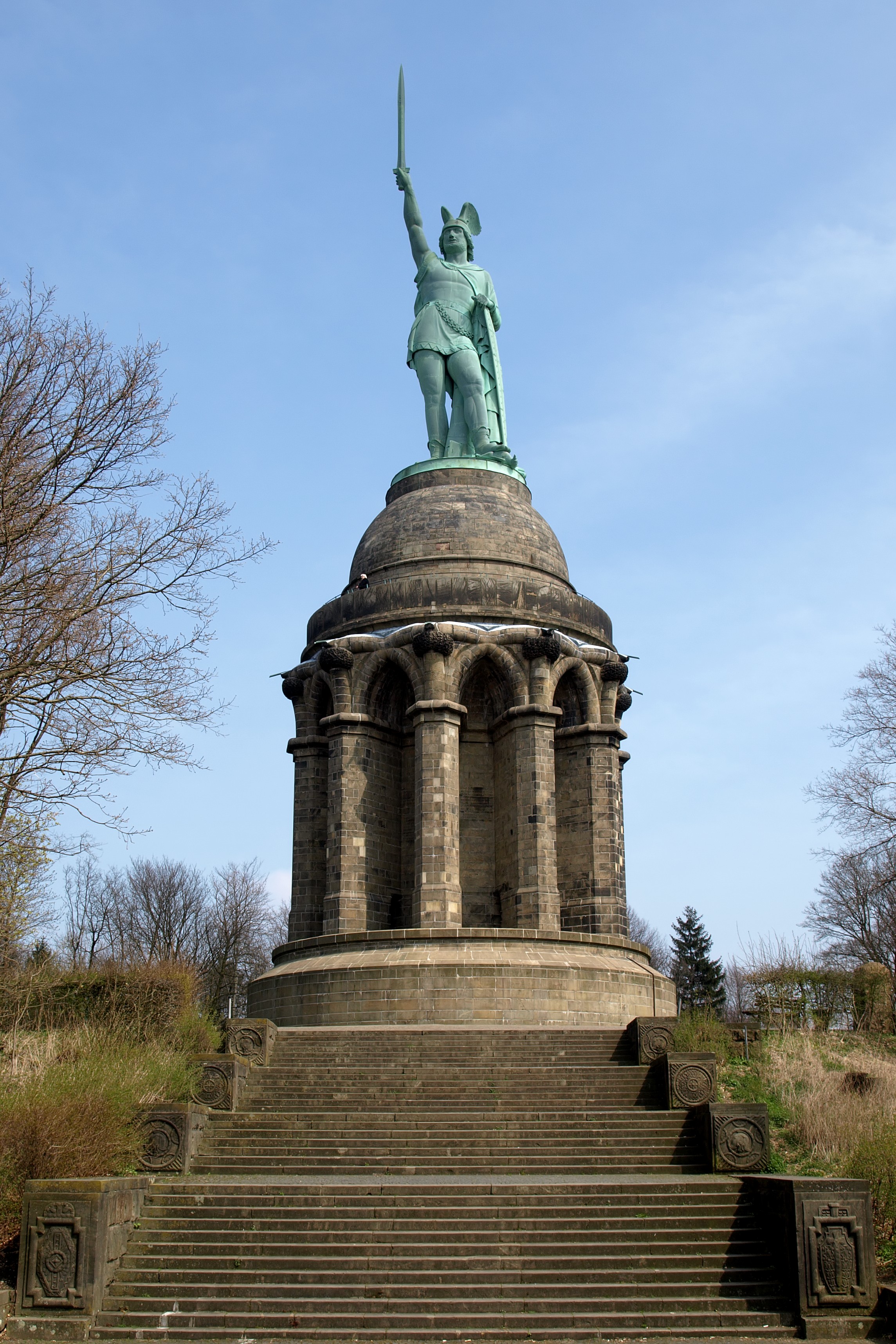
The inofficial symbol of the region is the larger-than-life statue of Hermann, chieftain of the Cheruscians and leader of the Teuton forces in the battle against the Romans who has been idealised as a German national hero during the 19th century era of romantic nationalism. The 53 metre high monument stands on a hill southwest of Detmold. Like other parts of Germany, this region was long divided into a large number of tiny territories, each ruled by an earl, baron or bishop. This has resulted in a rich heritage of castles, palaces and manors from different eras and in various styles. Most of them were constructed during the High Middle Ages and are well-fortified but were later transformed into more comfortable Renaissance-style residences (the local variant of Renaissance architecture is called "Weser Renaissance"). Among the most beautiful and interesting of them are Schloss Neuhaus of Paderborn (surrounded by a beautiful baroque garden), the former Princely Residence in Detmold and Burg Blomberg (17 km east of Detmold). The Wewelsburg near Büren (16 km south of Paderborn) is a triangular-shaped, early 17th-century Renaissance castle built for the prince-bishops of Paderborn, which was chosen as an SS cult-site during the Nazi era and redesigned after Heinrich Himmler's fancy.
The Höxter district assembles a great number of (former) monasteries, most notably the former Benedictine abbey of Corvey that used to be one of the most important monasteries in Europe during the Medieval period and whose Carolingian westwork and Civitas have been recognised as a UNESCO World Heritage site. Minden and Paderborn have notable cathedrals.
The region has many lovely parks and gardens, especially the spa gardens of Bad Lippspringe, Bad Oeynhausen and Bad Salzuflen, the earl's park of Bad Driburg, the botanical garden of Gütersloh and the former horticultural show grounds in Rheda-Wiedenbrück and Rietberg. Several towns in the Teutoburg Forest region have well-preserved histori
體驗活動
The hilly landscape is a popular hiking and cycling destination. There are many recommended and signposted paths for hikers and cyclists of different training levels. Moreover, there are opportunities for canoeing, rock climbing, horse riding, golf; as well as organised tours with hot-air balloons, vintage cars or motorcycles.
飲品與夜生活
Steinhäger. A local liquor speciality, a grain spirit flavoured with juniper berries that is comparable to gin. (updated Jul 2024)
順遊推薦
Münsterland, to the West – mostly flat, agricultural region with a hundred castles, palaces and manors; Germany's cycling capital; heartland of horse breeding and riding Sauerland-Siegerland, to the South – hilly or mountainous region, pristine landscapes, big lakes and ski resorts Middle Weser, to the North Weser Uplands, to the East
城市概覽改寫自 Wikipedia,旅遊指南來自Wikivoyage (CC BY-SA)。照片來自 Wikimedia Commons.