
Sognefjord
Norway · Europe
關於Sognefjord
Sognefjorden is a fjord in the county of Sogn og Fjordane in Norway. The district surrounding the fjord is known as Sogn. Sognefjorden is the longest fjord in Europe and the second longest in the world. Nærøyfjord, a World Heritage Site, is one of the branches of Sognefjorden. Several of the few remaining stave churches, including UNESCO listed Urnes stave church, are found in Sognefjord district.
Sognefjord旅遊指南
城市概覽
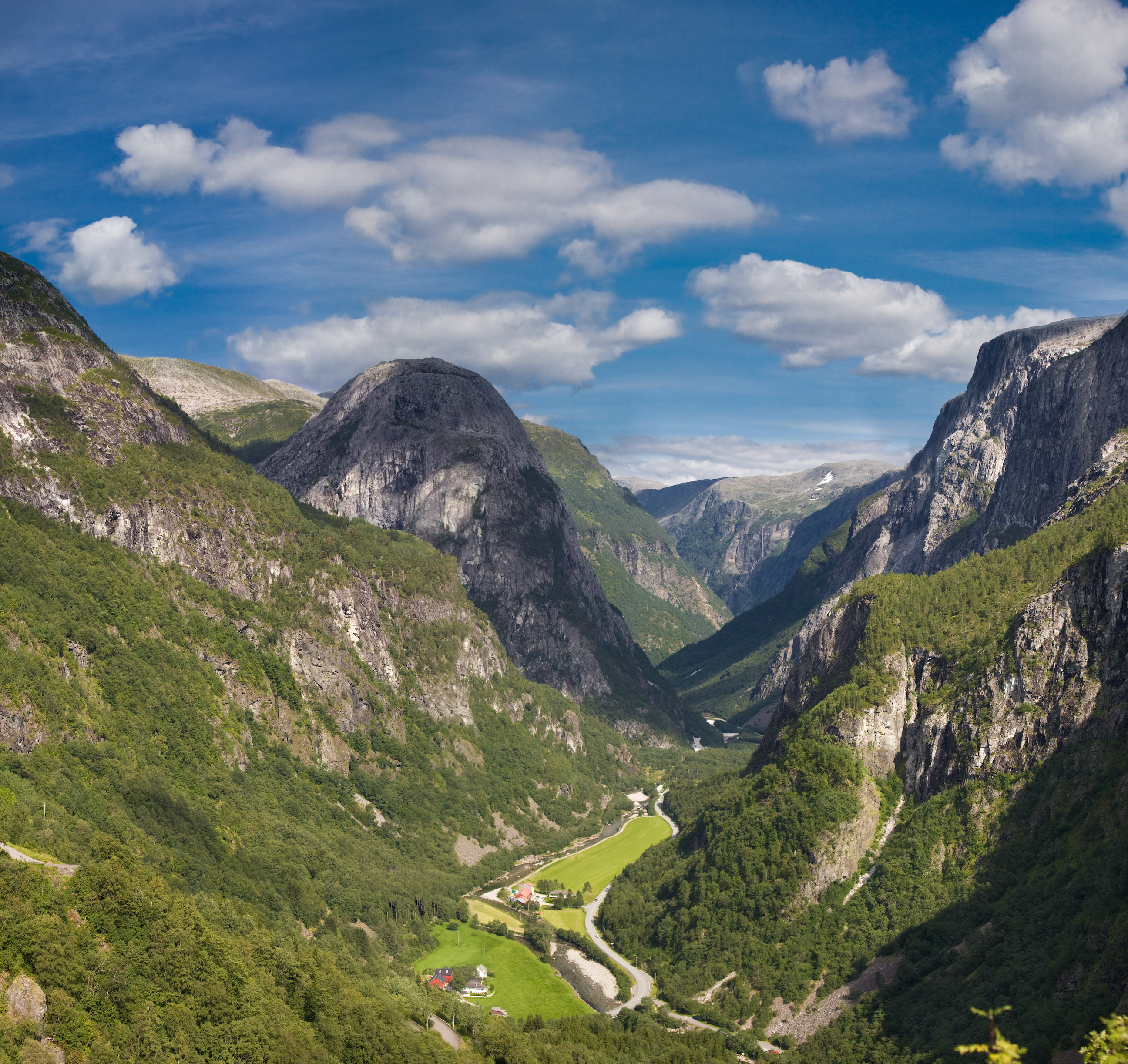
Sognefjorden is a wide fjord system. Each branch (arm) of the Sognefjord is a great fjord on its own and with its own name. Steep mountains rise directly from the water leaving little space for roads and settlement, except in the deep valleys such as Lærdal valley and Flåm valley. These river valleys are surprisingly flat offering excellent ground for farming. This complex topography makes overland transport challenging but highly rewarding in terms of scenery and impressive engineering. The Sognefjord area covers some 11,000 km² (about the size of Montenegro) with some 30,000 inhabitants. The fjord as a whole is the longest one in Europe and the second longest and the second deepest in the world. The fjord stretches more than 200 km from the rugged islands on the North Sea to the central mountains, including the alpine Jotunheimen. With the many arms or branches the entire Sognefjord system has a coastline of at least 500 km, more than the French and Italian Rivieria combined. The fjord is more than 1000 metres deep, 1300 m at its deepest point and 1500 m to the bedrock because of some 200-m-thick sediments — if all water was removed the fjord would appear as a huge gorge some 2000 to 3000 m deep. The greatest depths are in the central parts of the fjord, at the mouth there is a relatively shallow threshold of some 150 m. From the water surface to the high summits there is some 1500 to 2500 m. About 5,400 km3 were removed to create this vast gorge. Sognefjord's scale can be compared to Arizona's Grand Canyon and the Fiordlands of New Zealand. While there are large and deep fjords in Greenland and Antarctica, this is the only such great fjord that has significant ordinary settlement and is easily accessible by road or public transport. The main fjord is too deep and wide too to cross by conventional bridges. There are three main ferry crossings for each of the main roads E39, road 13 and road 5. It is basically not possible to travel in the north–south direction exc
如何抵達
There are a number of ways to get to the Sognefjord and surrounding area. Two of Norway's main roads, the E16 (Oslo–Bergen) and E39 (Bergen–Trondheim), run along or across the fjord. By boat — An enjoyable way to get in is by boat from a nearby town. The most convenient would be one of the high speed catamaran services operated several times each day from Bergen. Hurtigruten calls at Florø (near the mouth of Sognefjord) and Bergen. By air — The nearest airports are in Sogndal (SOG IATA) and Førde(FDE IATA), although the nearest international airport is in Bergen (BGO IATA). The eastern section of Sognefjord is about 260 km from Oslo airport Gardermoen, the same distance as from Bergen airport. By rail — Flåm, at the end of a branch of Sognefjord, is possible via an incredibly steep railway line. Flåmsbana, the Flåm railway line, connects to the Bergen line (Oslo–Bergen) at Myrdal. This is the only railway in the county. Alternative railway stations are at Voss and Gol, connections to Sognefjord by bus or car. By coach — Many of the towns along the fjord are also accessible by up to several daily coach services. Long distance coach services connect Sogndal with Lillehammer, Lom, Oslo and Bergen. The outer Sognefjord area is connected by long-distance coaches to Ålesund, Trondheim and Bergen. By car — Because of modest population and infrequent public transport, a self-drive may be the easiest and most flexible way to get to a distant corner of Sognefjord. The main road Oslo–Bergen (E16) runs through the area, as does the main road Bergen–Trondheim (E39). Except for the E16, travel in this area usually involves ferries – those are not separate means of transport but an integral part of the road network.
當地交通
There are several local bus lines as well as long-distance coach lines. Timetables for public transport and car ferries are administrated by Kringom. There are local high-speed passenger boat services and car ferry services. Passenger services are known as boats (hurtigbåt), while car services are known as ferries (ferje). Keep in mind that some routes may have a limited schedule. Car rental firms are found in Sogndal (major ones including Avis, Hertz and Europcar), Flåm and Årdalstangen, as well as in Førde which is not on the Sognefjord. By passenger boat — The Flåm–Balestrand service is very scenic. Other services is the combined ship sailing between villages on the southern side of the fjord between Ortnevik and Vik. One can also cross the fjord from Ortnevik to Måren and Nordeide. High-speed catamarans (express passenger boats) can also be used within Sognefjord, to cross the main fjord (north–south) or to travel east–west. By car ferry — The Sognefjord is crossed at several points by car ferries with frequent departures. During day time departures are usually so frequent that travellers should not worry about timetables. These ferries are not a separate means of transport, but a continuation of main roads E39, road 13 and road 5. Fjord1 is the major operator. Car ferries take all kinds of vehicles as well as foot passengers, but docks are usually in a remote place at the most narrow crossing. By tourist boat/ferry — There are several summer-only tourist routes, including the Fjord1-operated Bergen-to-Flåm catamaran, the ferries from Flåm and Lærdal to Gudvangen, as well as other ones on the Fjærlandsfjord and the Nærøyfjord. By bus — The larger settlements are served by local buses to rural areas, and long-distance coaches and local buses connect the settlements. The schedules may be very limited, with routes often only operating a couple of times a day, and even a couple of times a week for some sparsely populated areas. Roads E39, E16 and 5 pass through the
必看景點
The Norwegian Glacier Museum and Ulltveit-Moe Climate Centre in Fjærland offer interactive exhibits and films about the glacier and more. Glaciers are visible close to the road (arms of the main glacier). Fjærland is called the Norwegian Book Town because of its many bookshops. The Breheimsenteret visitor centre in Jostedal is the information centre for glacier national park in the glacier. Enjoy the stunning views of the Nigardsbreen from the restaurant. It is also a centre for outdoor activities. Borgund Stave Church, near Lærdal, was built around 1180. It is the best preserved stave church in Norway. The Norwegian Wild Salmon Centre in Lærdal village: explore everything about salmon and the traditions associated with salmon fisheries. There are interesting exhibits, exciting movies and a salmon observatory. Urnes Stave Church at Urnes, Luster is the oldest stave church in Norway, built around 1130 AD. It is included on UNESCO World Heritage List. Hopperstad Stave Church near Vikøyri: built around 1140 or earlier, one of the most elaborate of Norway's ancient stave churches. Hove Church near Vikøyri: this small but heavy romanesque building is one of 3 churches in Vik village. It was unusual for such a small village to keep three churches and mason
城市概覽改寫自 Wikipedia,旅遊指南來自Wikivoyage (CC BY-SA)。照片來自 Wikimedia Commons.