
Schmallenberg
Germany · Europe
關於Schmallenberg
Schmallenberg is a rural area in the Sauerland region of South Westphalia. Marketed as Schmallenberger Sauerland, it is a recognised health resort and popular vacation destination for hiking, winter sports, and other outdoor activities.
Schmallenberg旅遊指南
城市概覽
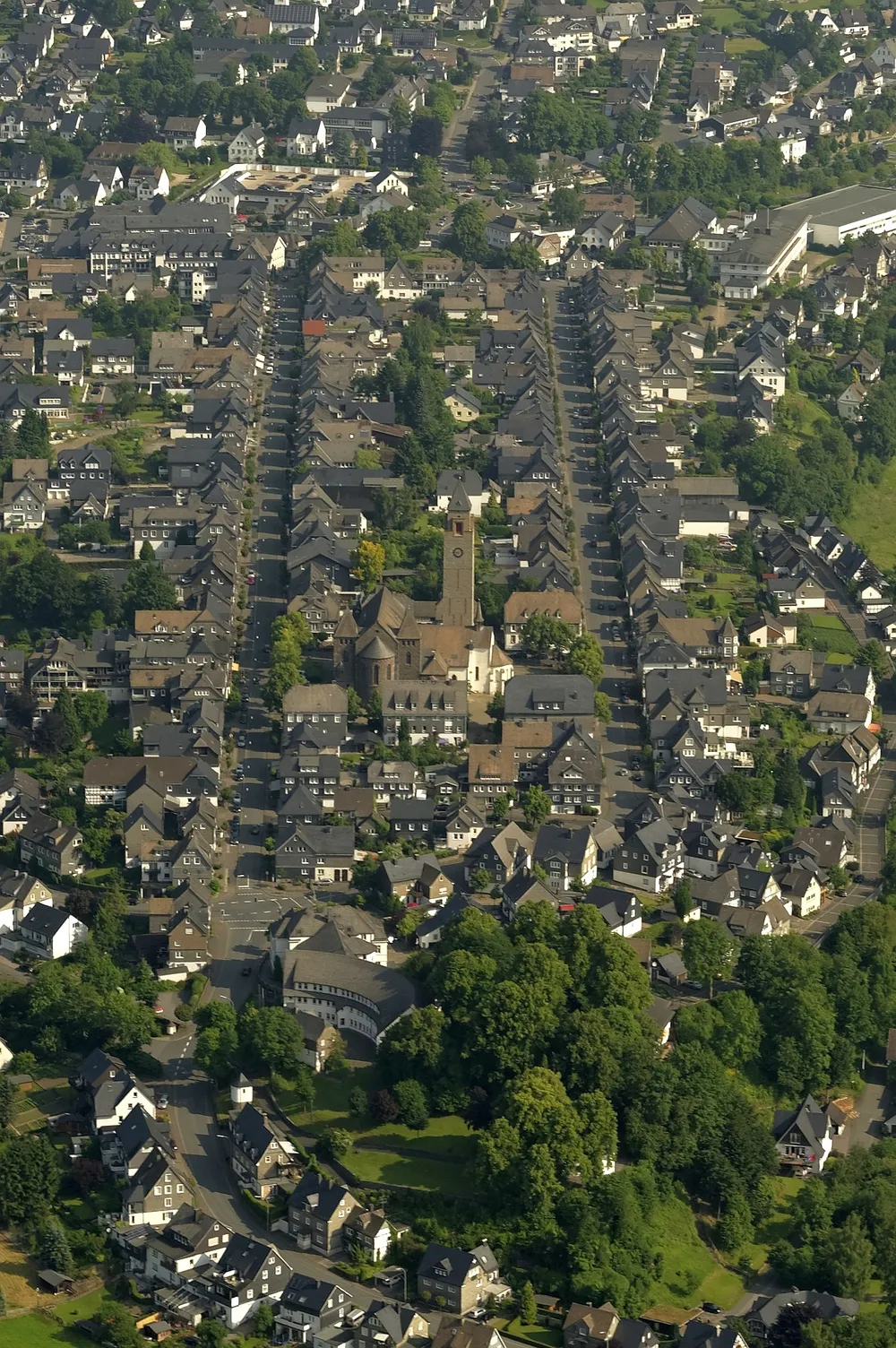
Schmallenberg is the third-largest municipality in North Rhine-Westphalia after Cologne and Münster, with a population of 25,000 in 2020, 6,100 of whom live in the main town. Of course that's only if you go by area – it's also remarkably sparse in population compared to most other parts of NRW. The municipality covers more than 300 km² and consists of the town 1 Schmallenberg and about 80 villages and hamlets that were incorporated into Schmallenberg in 1975. The whole area shares a single postal code (57392) and street addresses will not tell you whether a place is located in the core town Schmallenberg or far away in one of the surrounding villages.
History
Archaeological records suggests that the area has been inhabited since the iron age (around 200 BC). Remains of a hillfort from that time can still be seen on top of the Wilzenberg mountain to the east of the town. Written records start with the foundation of the Grafschaft Abbey at the foot of the same mountain in 1072. For its protection, a small castle (Smale Burg in contemporary language) was constructed on a ridge above the Lenne river around 1200. Over time, the castle disappeared, but a fortified settlement remained and gained city rights in 1244. The current appearance of the historic core city was shaped in the 19th century, after in 1822 a fire destroyed the city almost completely sparing no more than 16 houses and the church. As a consequence, the city was rebuild with not one but two unusually wide main roads, so that future fires would not spread so easily. The architecture from that time takes a local spin on the contemporary Prussian classicism by including traditional elements such as black timber framing and slate-covered roofs and walls. More traditional architecture can still be found in many of the older villages. From the 19th century on, and especially after World War II, Schmallenberg became the center of the local textile industry. Most competitors from that era did not survive the a
如何抵達
By car There is no Autobahn nearby, so expect between 45 min to 2 hr of cross-country driving, depending on where you're coming from. Below are a couple of suggestions for commonly used routes from different directions. These are using high-level Bundesstraße type roads as much as possible for easy driving and navigation. From north-westerly directions, e.g. coming from the Ruhr Area, Münsterland, or the Netherlands, Schmallenberg can be reached quite conveniently. Exit the A 46 in Enste or Meschede and follow the B 55 and B 511 south. Coming from Cologne, a common route is to take the A 4 and A 45 to Olpe, from where you'll follow the B 55, L 715, and B 236 via Bilstein and Lennestadt-Altenhundem. This route also works well when you're coming from southerly places like Frankfurt or even Nuremberg. There are other options from this direction that are shorter, but as they all cross the Rothaar mountains on curvy roads rather than going around them via Autobahn, they do not offer much in terms of travel time or fuel efficiency. Coming from the south on the A 7 or from the east on the A 4 (e.g. from Erfurt), a common route is to merge onto the A 5 and then almost immediately exit in Alsfeld-Ost. From there, follow the B 62 and B 252 to Münchhausen, from where the B 236 will take you to Schmallenberg via Hallenberg and Winterberg. The first part of this is not much fun to drive due to the high number of trucks and speed cameras along the B 62, so if you have time to spare maybe consider a slower alternative through the countryside. Coming from easterly places like Leipzig, there's no really convenient route available either. You can take the A 44 west from Kassel and after a short while take exit Zierenberg to get on the B 251 towards Korbach. From there it's various local roads until Winterberg and then the B 236 to Schmallenberg. From the northeast, you can aim for Bestwig and then take the L 776 (locally named Heringhauser Straße) south towards Bad Fredeburg.
By
當地交通
By car Usually, taking the car will be the most convenient way to get around. Depending on your vehicle and driving experience, the curvy mountain roads (although usually well maintained) can be a bit challenging – especially in winter. Roadside parking in the core of Schmallenberg is free, but limited to two hours at daytime. If you plan to stay longer, consider the 3 parking lot behind the Stadthalle, which is both free and unlimited. In Bad Fredeburg, the large 4 parking lot behind the Kurhaus usually is a good choice. Residential areas and villages are generally safe to park in too – the largest danger would be giant tractors squeezing through, so make sure to leave some space. Outside the settlements, there are plenty of parking lots for hikers (Wanderparkplatz) placed strategically close to the trail heads. As of 2024, public charging stations for electrical cars are still quite sparse in the villages, but more and more are popping up in the core city. Hotels are also increasingly recognizing the demand. International car rental companies are notably absent from the area. Instead, rental cars are available from the rental services of German car manufacturers through car dealers like Gierse & Schöllmann (VW Euromobil) or Müller (Opel Rent), as well as from local rental company Metek.
On foot Most villages are small enough to be conquered on foot, and the same is true for the historical centre of Schmallenberg. Outside the buildup areas, there are hiking routes galore (see Do section). Although the terrain can be steep sometimes, heavy mountain boots are by no means required here. Something waterproof is still a good idea, though, as heavy forestry vehicles can turn certain sections into a mud-fest after rain. But if the weather is fair, a pair of light trail shoes will suffice on most occasions, as many routes follow the forestry roads and smaller paths are well-maintained.
By bike Historically, bikes were never really a viable option for anything but s
必看景點
1 Local heritage museum (Westfälisches Schieferbergbau- und Heimatmuseum Holthausen), Kirchstraße 7, 57392 Schmallenberg-Holthausen (Note: Make sure to actually go to Holthausen, as there are 2 more "Kirchstraße" in other villages nearby.), ☏ +49 2974 6932, [email protected]. W F Sa 14:00–17:00; Su 10:00–13:00. On about 2.500 m² you will find information about slate mining and other aspects of local history. Grownups €5, kids €2.50. (updated Aug 2022)
Fine arts The core town of Schmallenberg is stuffed to the brim with all kinds of sculptures, and even in the villages you may find them here and there.
WaldSkulpturenWeg (Wood Sculpture Path). In many ways the largest art project in the region: A total of 9 giant sculptures are hidden in the forests along a hiking route between Schmallenberg and Bad Berleburg on the other side of the Rothaar mountains. You don't need to walk the whole 25 km trail, though, as many of them can be reached conveniently from nearby parking lots.
城市概覽改寫自 Wikipedia,旅遊指南來自Wikivoyage (CC BY-SA)。照片來自 Wikimedia Commons.