
Rakvere
Estonia · Europe
關於Rakvere
Rakvere (Tarbapea in ancient Estonian, Weisenberg in German, Rakowor in Russian) is Estonia’s fifth largest city and situated the northern part of the country, 20 km south of the Gulf of Finland and approximately 100 km east of Tallinn and west of Narva.
Rakvere旅遊指南
城市概覽
Its earliest signs of human settlement date back to the 3rd-5th century. Nowadays, Rakvere is an attractive and rapidly developing town with quite an interesting character. The modern Rakvere perfectly reflects the phenomenon of the Estonian province: with visible lowliness and calm, a turbulent cultural life flows here. Every day there is a play or a movie in the theatre, there are a lot of cafés and restaurants in the city, and the architecture is diverse and quite original. Rakvere is the place where the first Estonian Punk Song Festival took place. It’s also the host to the well-known international rock music festival “Green Christmas.” Since 1994, a biannual international theatre festival, called Baltoscandal has taken place in the unique, friendly and slightly crazy atmosphere of Rakvere. The city is also known in Estonia for its youthful hip-hop and electronic music scene. So it’s no wonder, that the motto of Rakvere is “full of power”.
1 Tourist Information Centre, Laada tn 14, ☏ +372 324 27 34, fax: +372 324 27 34, [email protected]. M-F 09:00–17:00 (break 13:00–14:00). When closed, a sign on the door suggests to take a look at the printouts of the city maps, posted in the window to the right of the entrance.
如何抵達
Bus and train schedules are easily available online – read more under Estonia#Get around.
By bus 1 Rakvere Bus Station, Laada 18a. 06:45–20:00. Modern glass pavilion with benches, cash desks and R-kiosk. The schedule is displayed above the ticket offices, so it can be read directly from the street. However, it is arranged in a completely mysterious way, contrary to any principles of design and structuring of information.Rakvere has regular bus connections to Tallinn (every hour, 1.5 hr), Tartu (every two hours, 2 hr 10 min) Narva (every two hours, 2.5 hr), Jõhvi and to a number of other cities.
By train 2 Rakvere Railway Station, Jaama 6a (1 km to the north-east of the city centre). The building of the station is actually a shop, so you might believe that no trains go from here. Unfortunately, the original building of the station in Rakvere was not preserved.Edelaraudtee runs a Tallinn-Narva train twice a day, which stops in Rakvere, and another train just to Rakvere (1 hr 20 min). With their help you can come to the city in the morning and return to Tallinn in the evening.GoRail also operates the Tallinn-Moscow line, which also stops in Rakvere.
By car Rakvere is a short distance from the Tallinn-Narva road and the Rakvere-Pärnu road #5. Tallinn 100 km, Narva 116 km, Tartu 133 km.
當地交通
The major landmark is the castle and its mountain, which stretches from north to south, along Pikk Street to the west – the most historic part of the city. The central square (Turu plats) is located in a couple of blocks to the east.
On foot Most attractions of Rakvere are within walking distance. The most distant point of interest is the railways station in the north of the city.
By bus The public transport buses are operated by GoBus Rakvere – there is a total of 5 bus lines. All of them go at intervals every hour and are unlikely to be useful to the traveler, as the sights are in walking distance. The schedules can be found at Rakvere town website. Load a Pilet.ee mobile app to buy tickets.
必看景點
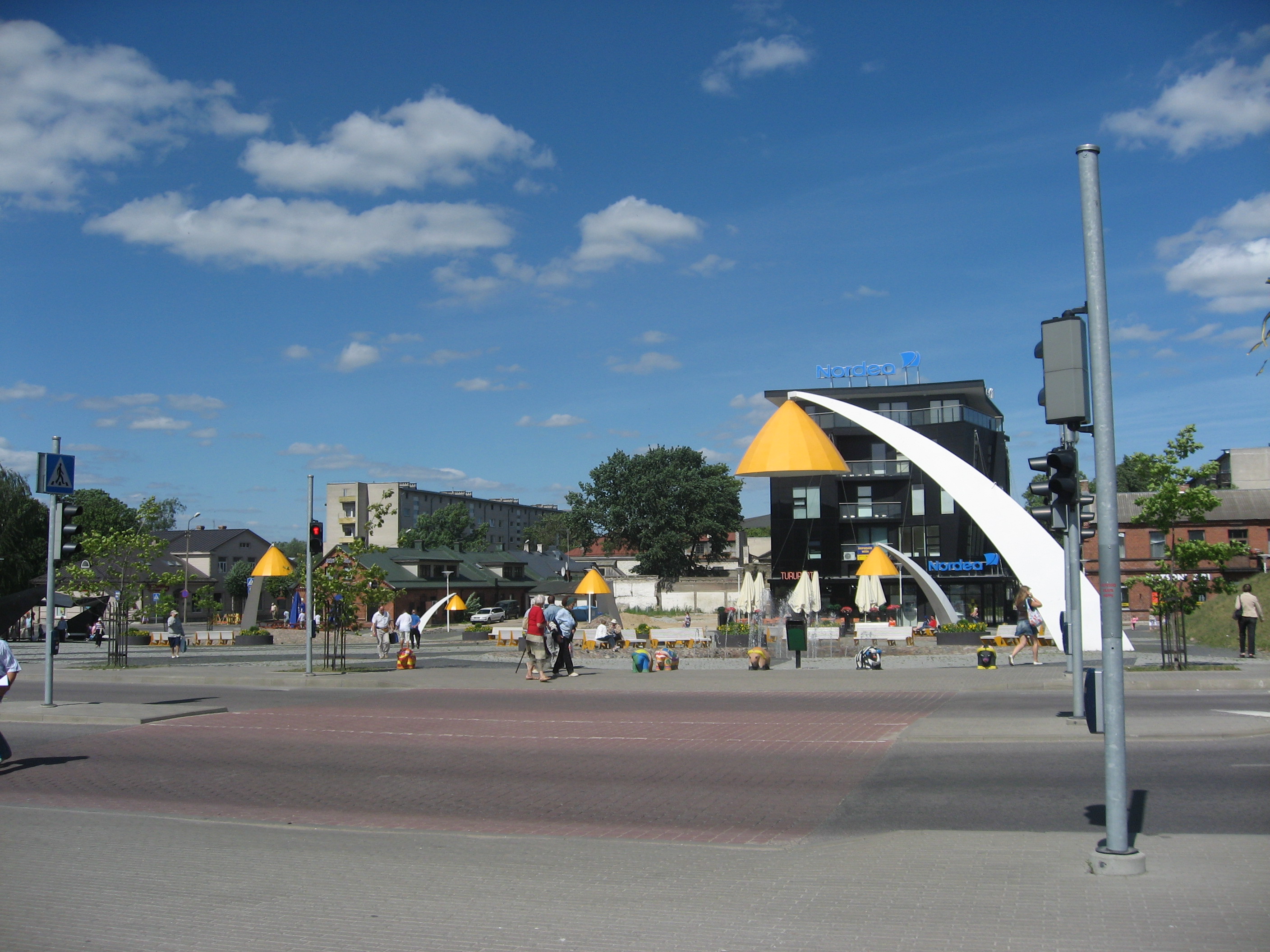
1 "Tarvas" Bull Statue (Tarva kuju / Wild Herbivore), Kreutzwaldi 1 (located near the old castle ruins). It’s considered to be the largest animal statue in the Baltics. According to the legend, there was an ox once in the world the size of the distance between Tartu and Rakvere, which destroyed everything in its way. One day it was killed, and his head fell down in Rakvere. So, the city began to be called Tarbapea (bull's head), and the rest fell to Tartu, called Tarbatu (bull). The attitude of the Tartu inhabitants to this legend is cautiously silent. 2 Rakvere's town square (Turu plats). A small square in the centre of Rakvere, and probably the most modern in Estonia. It was completely renovated in 2004, when strange yellow canopies resembling, either umbrellas or lampshades, were installed here. In 2010, the city sculpture "Young man on bicycle listening to music" was added to the umbrellas. It is dedicated to the citizen Arvo Pärt, an Estonian composer who grew up in Rakvere. Nowadays, daily at noon, his music is played by the Church of the Holy Trinity. The symbolism of all these objects is not quite clear. When resting under the umbrella, pay attention to the bank building (Turu plats 2, 1932-33) – a monument of functionalism architecture – as well as the yellow market building (Laada tn 14, 1926-28), an example of Art Deco – semicircular arches, numerous tiers with multi-sized windows and a rectangular tower were intertwined. All quite fascinating, and the building can easily be taken for the town hall or station, but not for the market, which, however, has not been here for a long time. 3 Lutheran Church of the Holy Trinity (Rakvere Kolmainu kirik), Pikk 19, ☏ +372 3243928, +372 5513771, [email protected]. This is a late medieval church with an unusually high and slender spire that was built in the 17th century. Built at the beginning of the 15th century, the church was a shelter during the Livonian war (1558-1583), during which it suffered a lot of damage
體驗活動
1 Rakvere Order Castle (Burg Wesenberg), Vallimägi, ☏ +372 3225502, +372 5076183, [email protected]. Mar/Apr/Oct W-Su 10:00-16:00, May/Sep daily 10:00-18:00, Jul-Aug daily 10:00-19:00, in winter on group request. The first fortifications on the castle hill appeared at the beginning of the 13th century, when conquered by the Danes. In those years there was either a wooden one, or an unpretentious stone fortress, which the Russians tried to capture. After the transition of Estonian lands from Denmark to the Livonian Order, in the middle of the fourteenth century, a large, well fortified castle was built on the site of the old one. Some fragments can still be seen to this day. At the turn of the 16th-17th centuries, the castle was destroyed in the course of numerous wars between Sweden, Poland, and Russia. Afterwards, the locals used the ruins as a source of stone, until the first attempts of restoration began at the beginning of the 20th century. However, the main restoration was already in the late 1970s. Nowadays, it is something in between ruins and a full-fledged castle. The castle is very picturesque (inside and outside). To get inside you will have to buy a rather expensive ticket, which includes various amusements like archery, smithy, ancient armour, and the notorious "hell" chamber. In the summer, the castle works in a medieval style tavern (with no potatoes), but if its visit is not included in your plans, you can confine yourself to an external examination. Regular visit: €9/7 adult/discount (one can bargain down to discount, pretending not to be interested). 2 Rakvere Teatre, Kreutzwaldi 2a, ☏ +372 3295444. On the weekends there are usually performances, on weekdays - cinema, and in the cafe someti
城市概覽改寫自 Wikipedia,旅遊指南來自Wikivoyage (CC BY-SA)。照片來自 Wikimedia Commons.