
Nerja
Spain · Europe
關於Nerja
Nerja is a seaside resort on the Costa del Sol, in the region of Andalucia of Spain. It is one of the few resort towns on Costa del Sol that isn't dominated by large ugly concrete hotels. It's in the attractive foothills of the Sierra Almijara mountains.
It is famous in Spain as the location of the Eighties children's TV program Verano azul a fact celebrated in one of the local parks with plaques and a replica of the boat used in the program.
Nerja旅遊指南
城市概覽
Don't be misled by the tourist brochure descriptions of Nerja as a fishing village. Tourism is this town's main industry and the few fishermen with their boats still to be seen along the beach provide a picturesque scene for visitors and a slim livelihood for local families. Until about the 1990s, the town retained a strong Spanish identity, but the influx of northern European visitors and residents has eroded significantly the genuine charm of a truly Spanish working town. Compared to many other Costa Del Sol destinations, especially to the west of Malaga, Nerja is not a very "touristy" town. It is a quiet town with a central historical area that still feels like a village, and the tourist mix is not exclusively northern European as many Spanish people use this resort for holidays, together with French and Italians. Unsurprisingly, the town's relative peacefulness and the absence of high rise developments along the coast or noisy nightclubs means many British people have retired here. The town is built on a hillside with a not too steep gradient and the sprawling centre consists of an older part with white streets partly pedestrianized mainly to the east of the Balcon de Europa, the natural focus of the town and the venue for fiestas, but beyond the 17th-century church and the Plaza Cavana more modern development takes over and it is in these areas that the town seems like any other recently developed Spanish Costa resort.
如何抵達
There is no plane, boat or train service to Nerja - the nearest city you can access with these modes of transport is Malaga to the west. The train station in Malaga is across the street from the bus station, where you catch a bus to Nerja. The port in Malaga serves cruise ships from North Africa (alternatively, there is a seaport in Almeria to the east). From Malaga Airport, which is served by flights from across Europe and America, you can drive along the A-7 E-15 motorway in the direction of Almeria and Motril, hire a taxi to Nerja (which will cost €78-100), or you can take a bus to the Malaga bus station and transfer to a Nerja-bound bus there.
By bus The bus stop in Nerja is on Avenida de Pescia, between a large roundabout and a bridge with blue railings. There's no facilities - it's just a ticket booth with benches, with taxis occasionally parking across the street. The stop is about a 10-minute walk inland from the Balcony of Europe and serves buses along the coast and to the major Andalusian cities. From Malaga there is non-stop service available and a trip will cost less than €5. There is also another bus stop a few miles outside Nerja proper serving the Nerja caves. Nerja has buses to many other places in southern Spain, but some as few as one bus a day.
By car The A-7 E-15 motorway runs parallel to the coast, with Nerja about a 10-minute drive from the clearly marked freeway exit. Be aware that the long Torrox tunnel you will drive through has cameras at both ends to calculate your speed and fines for speeding are harsh. Even in the winter months, street parking can be very difficult in the town's narrow and sometimes one-way streets, so use one of the two large central carparks instead - One is off Calle La Cruz, in the middle of town, which charges a reasonable rate per hour. The other is a larger car park off Prol Carabeo, a 5-minute walk from the town centre and the one most often used by locals but very expensive for visitors. The town has sever
當地交通
Walking is the easiest way. The centre of Nerja is small enough to be able to walk around on foot though you will find yourself walking up or down a sometimes gradual, sometimes steep hill much of the time. As the town has no specific centre, shops, banks, bars and eateries are scattered throughout the town. There is a bus from the beach near the Monica hotel which takes you uphill as far as the Sol supermarket. Next stop is about a mile out of town, before returning on the same route. Another bus from the same stop takes you uphill then along the N340 and past where the Tuesday and Sunday market is held (it stops there on the way there and back so gets very crowded on market days). Do not get them mixed up.
必看景點
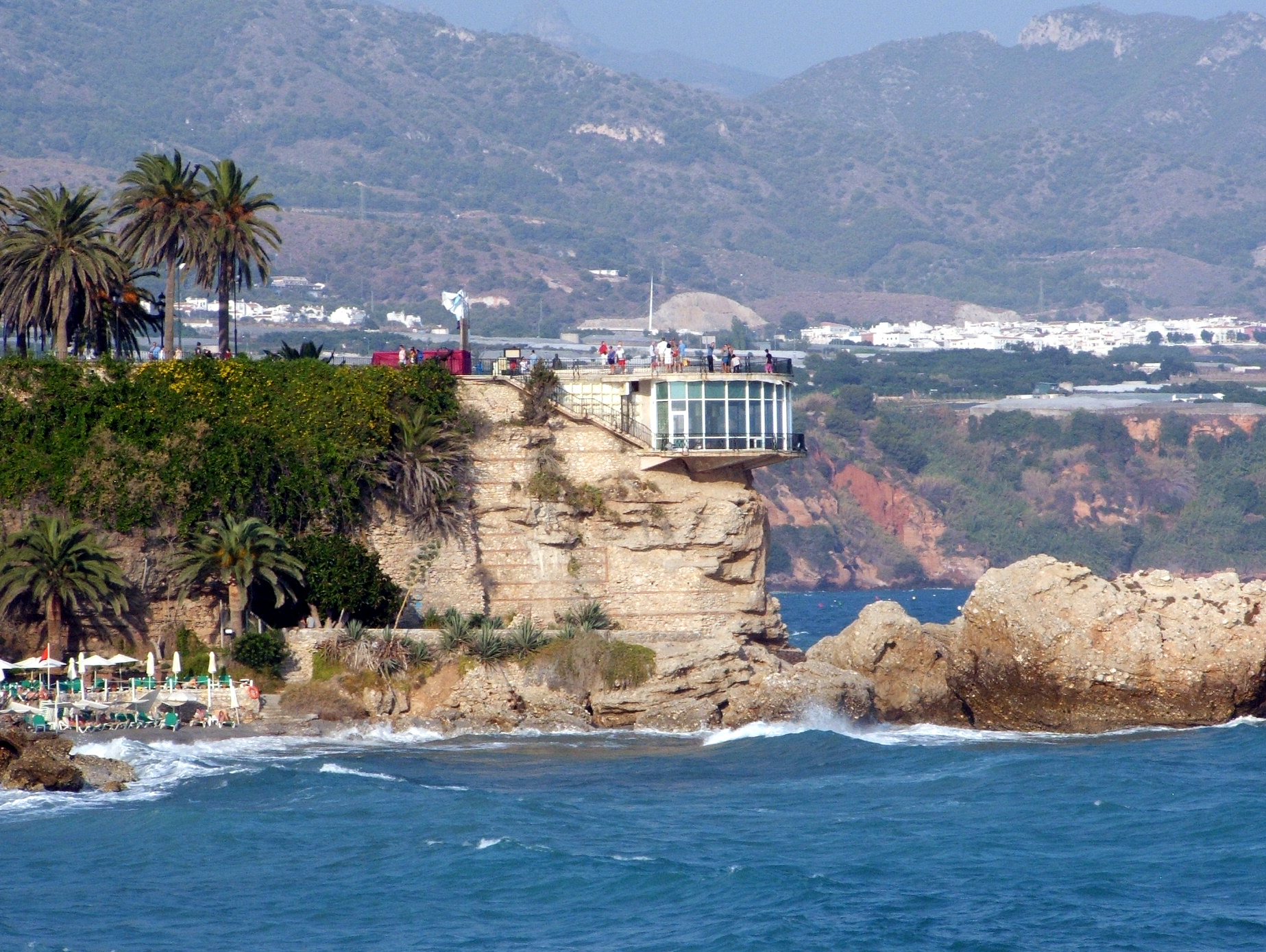
The Balcony of Europe (Balcón de Europa) is a reconstructed promenade built out onto a natural headland in the centre of town with spectacular views along the coast. It was constructed around 1487 in the place of a 9th-century castle. The balcony today is the main focus for the town, with a tree-lined paseo surrounded by cafes and ice cream shops and frequented by street performers and the occasional concert. Granted, for all the attention tourist guides give to this place there's not much to do except look up and down the coast, but the views are spectacular. Beneath the overlook, a glass-walled restaurant offers the chance to eat in a sit-down setting while taking in the scenery, but you can expect a high price tag for the privilege. El Salvador Church. Near the Balcony of Europe, facing the plaza just around the corner from the Balcony, is this attractive 17th-century church constructed in baroque-mudejar style. Nuestra Señora de las Angustias Hermitage. A 16th-century church with paintings by the Alonso Cano. 1 Caves of Nerja. A series of caverns of almost 5 km (3.1 mi). One of Spain's major tourist attractions. Concerts are regularly held in one of the chambers, which forms a natural amphitheatre. The cave has the largest stalactite in the world. Not suitable if you have any walking difficulties, as there are many stairs and no ramps. Be aware that the humid air could make your camera lens moist with unclear photos as a result. €12.75. (updated Mar 2022) El puente de Aguila (Eagle's bridge). A 19th-century aqueduct, similar to the ones built by the Romans. It was designed to bring water to the nearby village of Maro, one of the oldest settlements around the area. Visible on the way to the caves. The Rio Chillar Waterfall. A beautiful waterfall along the old river, near the Sunday Market.
Beaches. There are thirteen kilometers of beaches in Nerja. Calahonda Beach (Playa Calahonda) (immediately east of the Balcony of Europe). A pebbly beach in the cliff
體驗活動
Jeep Tours in Nerja, Life Aventure SL, Calle Antonio Ferrandiz, no39 2-2, ☏ +34 677 894 002, [email protected]. A great way of exploring the Sierra Almijara discovering the flora and fauna and natural habitat. Painting course and workshops, Painting course in Spain, Nerja which will be held from November up to February. The course will be given by Guus van Lingen. This is the way to become a better painter. See painting-course-spain.com/ There is a shop amongst the shops facing the Burriana beach which has diving gear and tanks for hire and does courses on PADI diving. There are several internet cafes around town, some of which will print off pages, including etickets if using Ryanair. Prices range from €1 (with a ticket allowing 10 or more hours over your stay) to €3.50 an hour, with most charging about €1.80. A fair
城市概覽改寫自 Wikipedia,旅遊指南來自Wikivoyage (CC BY-SA)。照片來自 Wikimedia Commons.