
Mycenae
Greece · Europe
關於Mycenae
Mycenae is a town in the Peloponnese, Greece. It's home to the ancient Acropolis of Mycenae, listed on the UNESCO World Heritage List. It is one of Greece's most renowned archaeological sites, dating to the 2nd millennium BC.
Mycenae旅遊指南
城市概覽
Admission fees As of Nov 2024
April-October: Adult €12 EU senior, and non-EU age 6-25 €6 Non-EU children under 6, EU residents under 26, people with disability free November-March: Adult, EU senior, and non-EU age 6-25 €6 Non-EU children under 6, EU residents under 26, people with disability free Combined ticket (€20) is valid for Mycenae (the Archaeological Site, the Museum and the Treasure of Atreus), Tiryns, Asini, Palamidi, Museum of Nafplio and Byzantine Museum of Argos and lasts for 3 days from its issuance.
Hours As of Nov 2024:
Nov-Mar: 08:30-15:30 April : 08:00-19:00 May-Aug: 08:00-20:00 1-15 Sep: 08:00-19:30 16-30 Sep: 08:00-19:00 1-15 Oct: 08:00-18:30 16-31 Oct: 08:00-18:00 Good Friday: 12:00-17:00, Holy Saturday: 08:30-15:30 Closed: 1 January, 25 March, 1 May, Easter Sunday, 25 & 26 December
Site information Website
如何抵達
You can visit the place by using the local KTEL [1] bus from Nafplio, priced €2.90. When coming from Athens, it is also possible to catch a bus to Nafplio, which makes a stop in the village of Fichti (4 km from the archeological site). From Fichti it is possible to take a taxi to the site. The bus from Athens to Fichti costs €11.80 as of February 2018.
必看景點
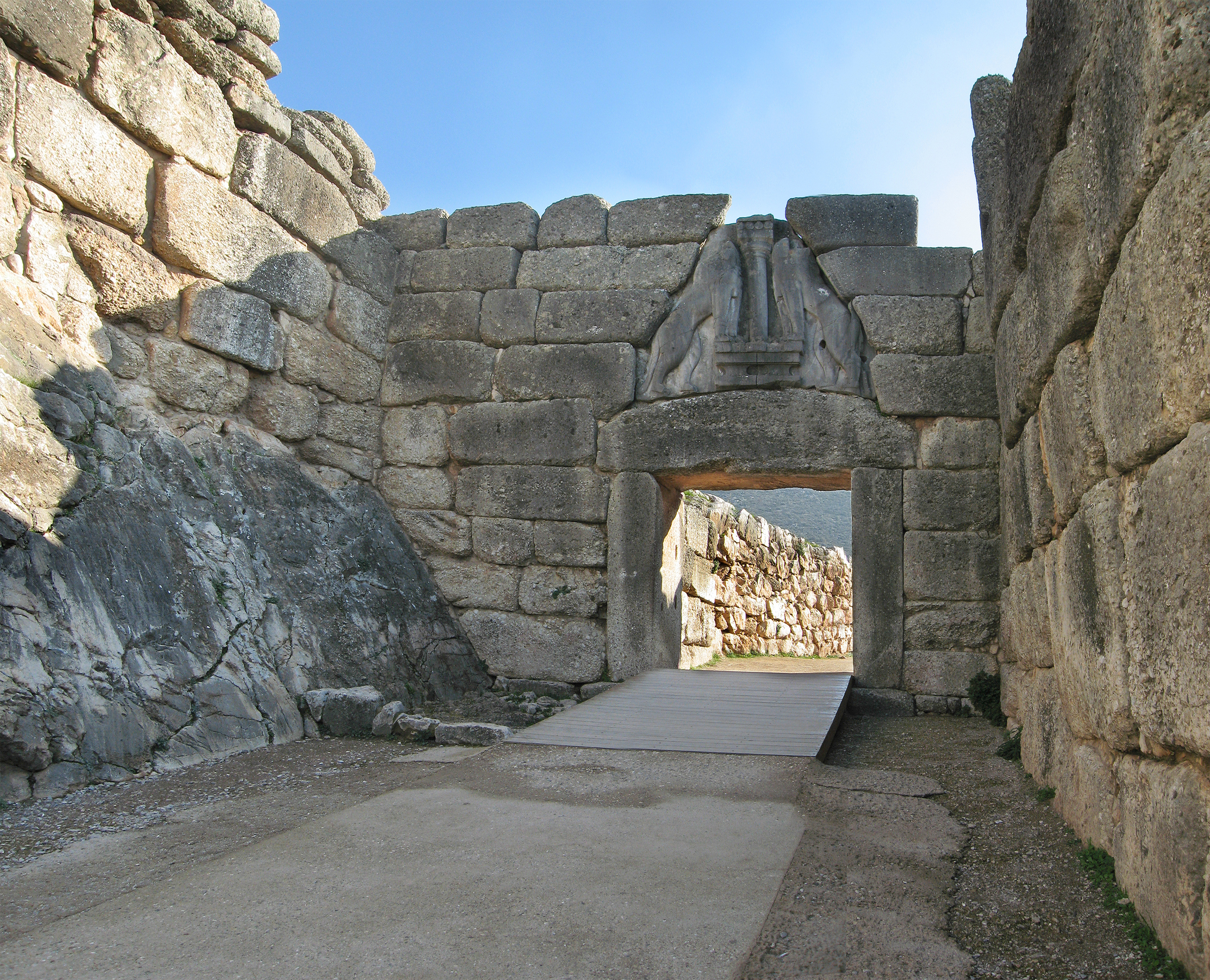
1 Mycenae Archaeology Museum (1.9 km northeast from the centre of the town), ☏ + 30 27510 76585. 08:30-15:00 all days except public holidays. The relatively new museum is laid out quite clearly. The golden exhibits are copies of Schliemann's finds; the originals are in Athens. Also worth seeing are the small finds on display, which allow conclusions to be drawn about the religious beliefs of this archaic people. (updated Sep 2021) From the car park, a path leads to the Acropolis past exposed foundations of houses and shaft tombs. Behind the entrance ticket office, a path branches off to the left, leading past the only toilet in the complex to the museum. The main path leads to a Cyclopean wall built from huge blocks of stone. 2 The Lion Gate. It forms the entrance. Its stones are huge, the lintel alone is said to weigh around 20 tons. Above it is a stone block that serves as a relief triangle for the side wall blocks. Its front is formed by two lions, whose heads were probably made of a different material in ancient times. (updated Nov 2024) 3 Grave Circle A (behind the entrance to the Acropolis, on the right). Excavated by Schliemann, with six royal shaft graves. (updated Nov 2024) 4 Grave Circle B. A 17th– to 16th-century BCE royal cemetery. (updated Nov 2024) Behind it are some former residential buildings. Other building remains have been identified as granaries, followed by craftsmen's apartments and the artists' workshop. Further up, the path is relatively barrier-free. Here, the outline and structure of the palace can be seen. To the north, the terrain slopes down; here is an outer bailey with a partially accessible cistern; a simpler gate forms a second entrance to the castle. Outside the castle walls, several more foundations are visible, so it is likely that this area of the city still holds many secrets.
Dome tombs 5 The Treasury of Atreus (on the road to the Acropolis, a few hundred meters before it on the left). The most famous and largest of the dom
順遊推薦
Olympia (Greece) is two and a half hours away by road.
城市概覽改寫自 Wikipedia,旅遊指南來自Wikivoyage (CC BY-SA)。照片來自 Wikimedia Commons.