
Italy
Italy · Europe
關於Italy
Italy (Italian: Italia) was once the core of the mighty Roman Empire, and the cradle of the Renaissance. Along with Greece, it is regarded as the "birthplace" of Western culture, and it is also home to the greatest number of UNESCO World Heritage Sites in the world, including high art and monuments.
Italy is famous for its delicious cuisine, trendy designer brands, luxury sports cars and motorcycles, diverse regional cultures and dialects, as well as for its various landscapes from the seas to the Alps and Apennines, which makes reason for its nickname Il Bel Paese (the Beautiful Country).
In the shape of a boot, the country continues to be one of the world's most influential countries. It is a member of the European Union and shares borders with France, Switzerland, Austria, and Slovenia. There are thousands of things to do in this mesmerising country, and if you want to experience what living the life feels like, you're bound to find it in Italy.
Italy旅遊指南
城市概覽
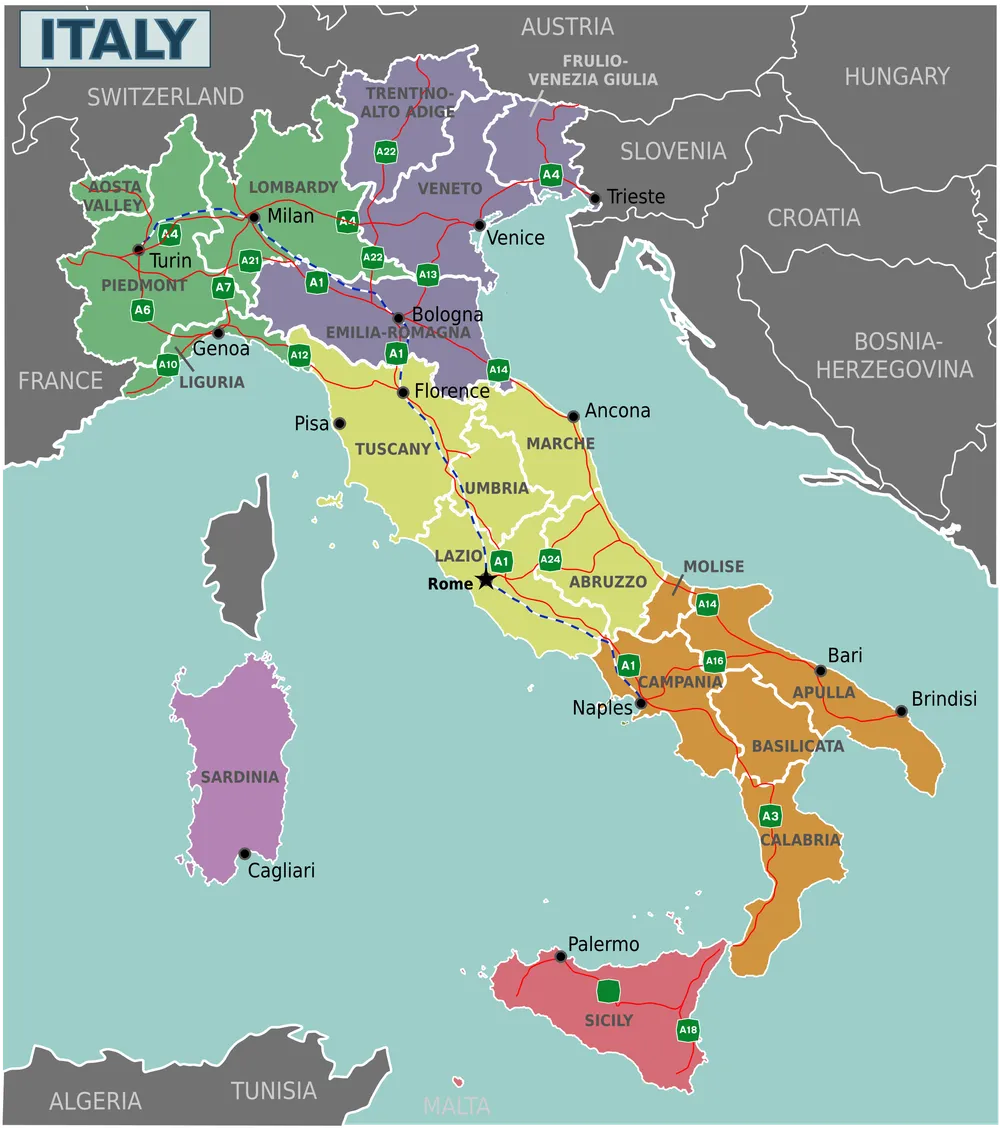
Italy, officially the Italian Republic (Repubblica italiana), is largely a peninsula situated on the Mediterranean Sea, bordering France, Switzerland, Austria, and Slovenia in the north. The boot-shaped country is surrounded by the Ligurian Sea, the Sardinian Sea and the Tyrrhenian Sea in the west, the Sicilian and Ionian Sea in the South, and Adriatic Sea in the East. Italian is the official language spoken by the majority of the population, but as you travel throughout the country, you will find there are distinct Italian dialects corresponding to the region you are in. Italy has a diverse landscape, but it is primarily mountainous, with the Alps and the Apennines. Italy has two major islands: Sardinia, off the west coast of Italy, and Sicily, just off the southern tip (the "toe") of the boot. Italy has a population of around 60 million. The capital is Rome.
History
Prehistory There have been humans on the Italian peninsula for at least 200,000 years. The Etruscan civilization lasted from prehistory to the 2nd century BC. The Etruscans flourished in the centre and north of what is now Italy, particularly in areas now represented by northern Lazio, Umbria and Tuscany. Rome was dominated by the Etruscans until the Romans sacked the nearby Etruscan city of Veii in 396 BC. In the 8th and 7th centuries BC, Greek colonies were established in Sicily and the southern part of Italy and the Etruscan culture rapidly became influenced by that of Greece. This is well illustrated at some excellent Etruscan museums; Etruscan burial sites are also well worth visiting.
The Roman Empire
Ancient Rome was at first a small village founded around the 8th century BC. In time, it grew into one of the most powerful empires the world has ever seen, surrounding the whole Mediterranean, extending from north Africa to as far north as the southern part of Scotland. The Roman Empire greatly influenced Western civilisation. Its steady decline began in the 2nd century AD, with the milit
如何抵達
Italy is a member of the Schengen Agreement. See Travelling around the Schengen Area for more information on how the scheme works, what countries are members and what the requirements are for your nationality. In summary:
There are normally no immigration controls between countries that have signed and implemented the treaty; there may be such controls temporarily, such as in connection with important events and various crises. The operators may carry out identity checks before passengers board international flights, ferries or trains, even between Schengen countries. Citizens of the EEA countries and Switzerland do not need visas to travel in the Schengen area, and may stay up to 90 days with no requirements other than having a valid ID card or passport. See European Union#EEA citizens. Normal visas granted by any Schengen member are valid in all countries that have signed and implemented the treaty (with exceptions for some overseas territories). The granting country may offer additional rights (such as longer stays or right to work) that apply only locally. In addition, citizens of San Marino may enter and reside in Italy indefinitely without a visa. Foreign military entering Italy under a Status of Forces Agreement do not require a passport and need only show their valid military identification card and travel orders. Their dependents, however, are not exempt from visa requirements. All non-EU, EEA or Swiss citizens staying in Italy for 90 days or less have to declare their presence in Italy within 8 days of arrival. If your passport was stamped on arrival in Italy, the stamp counts as such a declaration. Generally, a copy of your hotel registration will suffice if you are staying at a hotel. Otherwise, however, you will have to go to a police office to complete the form (dichiarazione di presenza). Failing to do so may result in expulsion. Travellers staying longer than 90 days do not need to complete this declaration, but must instead have an appropriate visa
當地交通
By train
Trains in Italy are generally good value, somewhat frequent, and nowadays quite reliable. Trenitalia is the main operator throughout the country, operating both high-speed and regional services, while Italo offers competition on all major high-speed routes.
Trenitalia (FSI), ☏ +39 892021. Trenitalia runs a wide range of train types: high-speed trains (Frecciarossa, Frecciargento, Frecciabianca), Intercity, regional trains (Regionali, Regionali Veloci) and international trains (Eurocity, Euronight). High-speed trains are very comfortable, travelling up to 360km/h and stopping only at major stations and connect only the main cities. They charge a supplement to the standard ticket, which includes the booking fee. Regional trains are the slowest, cheapest and least reliable, stopping at all stations. Intercity trains are somewhere between high-speed and local trains. They are generally reliable. (updated Sep 2016) Italo (NTV), ☏ +39 060708. Italo's high-speed trains serve all major cities. The service is comparable to Trenitalia if not better, and prices tend to be lower, particularly if booked in advance.
Train types On long-distance trains there are 1st and 2nd classes. A 2nd class ticket costs about 80% the price of a 1st class ticket. On high-speed trains you can also choose between basic, standard and flexible tickets. Basic tickets are of course the cheapest. During commuter hours, on major north-south routes during the holidays, or before and after large political demonstrations, trains on the lower train types are often overcrowded. Although between Milan and Naples (including Bologna, Florence and Rome), high-speed trains cut travel times in half, on other routes, such as between Rome and Genoa, Naples and Reggio Calabria, Venice and Trieste, they travel on the traditional line, with only marginally shorter travel times compared to Intercity trains. On long routes, such as Milan - Rome or Milan - Reggio di Calabria, Trenitalia operates specia
必看景點
There is so much to see in Italy that it is difficult to know where to begin. Virtually every village has some sights.
Etruscan Italy. If you have limited time and no potential to travel outside the main cities, then don't miss the amazing collection at the Etruscan Museum at Villa Giulia in Rome. Hiring a car gives access to the painted tombs and museum of Tarquinia or the enormous burial complex at Cerveteri and those are just the sites within easy reach of Rome. The Greek influence. Well-preserved Greek temples at Agrigento in the south-west of Sicily and at Paestum, just south of Naples, give a good understanding of the extent of Greek influence on Italy. Roman ruins. From the south, in Sicily, to the north of the country, Italy is full of reminders of the Roman empire. In Taormina, Sicily check out the Roman theatre, with excellent views of Mt. Etna on a clear day. Also in Sicily, don't miss the well-preserved mosaics at Piazza Armerina. Moving north to just south of Naples, Pomp
城市概覽改寫自 Wikipedia,旅遊指南來自Wikivoyage (CC BY-SA)。照片來自 Wikimedia Commons.