
Germany
Germany · Europe
關於Germany
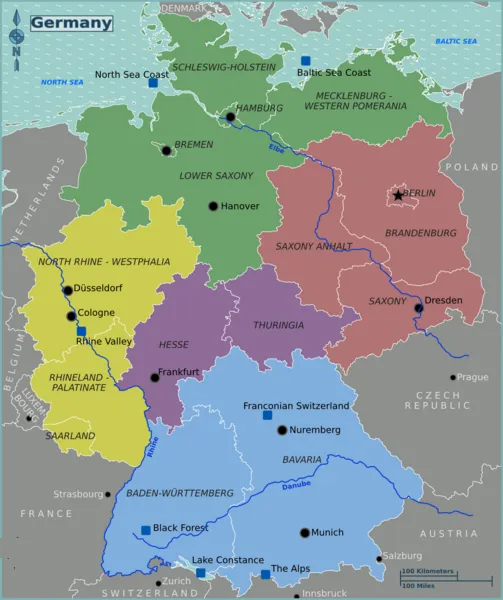
Germany (German: Deutschland) is the largest country in Central Europe. It is known for its rich cultural heritage, innovative inventions, its old-world charm and Gemütlichkeit (cosiness). Discard any perceptions of Germany as being homogeneous; a country of surprising regional diversity awaits your presence. Many tourists visit Germany to experience European history and the diverse German landscape. German culture, outdoor activities, German holidays and festivities, the countryside and rural areas, and the German cities are identified as being big draws for visitors.
Germany旅遊指南
城市概覽
An economically, politically, and culturally influential nation, Germany is the richest and most populous European Union member state.
History
Roman Empire
In the first century AD, after a series of military campaigns, the Romans conquered what is now most of western and southern Germany from the Germanic and Celtic tribes living there. The limits of the Roman empire were marked by the "Limes". The section separating the empire from the Germanic tribes (Limes Germanicus) was 568 km long, stretching from the mouth of the Rhine to the Danube near Regensburg. You can still see and walk along sections of the raised bank. In Roman times the Limes were not a rigid border: trade and occasional Roman military expeditions influenced most of what is now Germany until at least the fourth century AD. Several cities that are still important in Germany were founded by the Romans as military bases and later, settlements, including Mainz, Wiesbaden, Cologne and Bonn. Baden-Baden's springs were also much appreciated by the Romans: the remains of their baths can be visited under the aptly-named Römerplatz (Roman Square). The most impressive Roman remains in Germany can be found in Trier, the oldest German city. These include the Porta Nigra, the largest Roman city gate north of the Alps, and the Trier Amphitheatre.
The Holy Roman Empire and the Middle Ages
Charlemagne, King of the Franks, was crowned first Emperor of the Holy Roman Empire on Christmas Day 800 AD by Pope Leo III. Charlemagne is often associated with France, but his realm was vast; his capital was in Aix la Chapelle, today the German city of Aachen. Remains of Charlemagne's winter imperial palace (the Kaiserpfalz) can be seen in the town of Ingelheim. The roots of modern German history and culture date back to the post-Carolingian Holy Roman Empire. Starting in the early Middle Ages, Germany fractured into hundreds of small states, with strong regional differences that endure, for example in Bavaria. During
如何抵達
There are a number of ways to get into Germany. From neighbouring European countries, a drive with the car or a train or bus ride are perhaps the easiest and most comfortable options; visitors from further away will probably be using air travel.
Entry requirements
Germany is a member of the Schengen Agreement. See Travelling around the Schengen Area for more information on how the scheme works, what countries are members and what the requirements are for your nationality. In summary:
There are normally no immigration controls between countries that have signed and implemented the treaty; there may be such controls temporarily, such as in connection with important events and various crises. The operators may carry out identity checks before passengers board international flights, ferries or trains, even between Schengen countries. Citizens of the EEA countries and Switzerland do not need visas to travel in the Schengen area, and may stay up to 90 days with no requirements other than having a valid ID card or passport. See European Union#EEA citizens. Normal visas granted by any Schengen member are valid in all countries that have signed and implemented the treaty (with exceptions for some overseas territories). The granting country may offer additional rights (such as longer stays or right to work) that apply only locally. Recognised refugees and stateless persons in possession of a valid travel document issued by the government of any one of the above countries/territories (e.g., Canada) are exempt from obtaining a visa for Germany (but no other Schengen country, except Hungary, The Netherlands and Belgium, and for refugees, Slovakia) for a maximum stay of 90 days in a 180-day period. German citizens, including those with multiple nationalities, must enter Germany using either a German passport or German ID card (Personalausweis). Citizens of Australia, Canada, Israel, Japan, New Zealand, South Korea, the UK and the US are eligible to obtain a residence permit
當地交通
On the whole transportation is efficient and fast, though last minute tickets can be a bit on the expensive side. All modes of transportation are up to a high modern standard, including a dense network of airports, high speed rail services connecting most major cities and regional trains, one of the densest highway networks on earth (with stretches where the speed limit is shrug emoji), and intercity bus services.
By plane Given Germany's well-developed road and rail network, there are few routes where it makes sense to fly. High-speed rail services offer better overall journey times on even the longest routes, and flights are almost never cheaper than other options. The domestic options are usually "hub-feeder" services to either Frankfurt Airport or Munich Airport, but that is hardly ever faster than a train. There are few point-to-point domestic flights outside those hubs. Lufthansa or its subsidiaries are the only airlines on many domestic routes.
Lufthansa Eurowings Lufthansa's no-frills subsidiary based in Düsseldorf flies some domestic routes in Germany Condor operates some domestic routes between major airports. Local carriers offer scheduled and charter flights to the islands of Sylt, Heligoland and some of the East Frisian islands. Operators include:
Sylt Air: scheduled flights Hamburg–Sylt (summer only) OFD (short for Ostfriesischer Flugdienst; East Frisian flight service): scheduled flights to Heligoland from several places in Northern Germany as well as on the route Emden–Borkum. FLN Friesia: scheduled flights to Juist and Wangerooge.
By train
Once the pride of Germany, the country's rail network is now Europe's laughing stock. Unless you can be flexible with time, then expect long delays, cancellations and the very real prospect of being stranded in the middle of nowhere. Deutsche Bahn's on-time and operational performance are considered abysmal. This has been noted in several international publications, such as Financial Times and The Econo
必看景點
Cultural and historical attractions
When thinking of Germany, beer, lederhosen and Alpine hats quickly come to mind, but these stereotypes mostly relate to Bavarian culture and do not represent Germany as a whole. Germany is a vast and diverse country with 16 culturally unique states that have only formed a political union since 1871. Even within states there is often considerable cultural diversity. The government of Bavaria for instance likes to talk of the three "tribes" living in the state; "old Bavarians", Franconians and Swabians. Especially the former two like being lumped together about as much as English and Scots. If you're still looking for the cliches, the Romantic Road is a famous scenic route along romantic castles and picturesque villages. With its fairy tale appearance, the Neuschwanstein Castle could be considered the most iconic of German castles. The walled city of Rothenburg ob der Tauber has a beautiful mediaeval centre that seems untouched by the passage of ti
城市概覽改寫自 Wikipedia,旅遊指南來自Wikivoyage (CC BY-SA)。照片來自 Wikimedia Commons.