
Fife
United Kingdom · Europe
關於Fife
Fife (Scottish Gaelic: Fìobha) is a county in the north east of Scotland, with a population in 2019 of 371,910. It's a lowland peninsula, with the broad Firth of Forth to the south and the smaller Firth of Tay to the north, and great bridges for its gateways. Its name may derive from the Pictish kingdom of Fib. It's not related to the fife musical instrument, which derives from the German Pfeife, a pipe.
Fife旅遊指南
城市概覽
"It taks a lang spoun tae sup wi a Fifer" so the saying goes, to illustrate the independent and guarded nature of folk of Fife. Fife is a peninsula between the Forth and Tay estuaries, so it was detached from early transport routes and in Pictish times may have been a semi-independent kingdom. It became more important from the 11th century when the main royal residence moved from Scone near Perth to Dunfermline, and St Andrews grew as a pilgrimage centre then university town. Fife produced grain and was industrial from an early stage through salt-panning, quarrying and coal: the same coalfield that outcrops near Edinburgh stretches under the sea to outcrop in Fife. A string of little harbours along the Forth exported these goods, and when the ships returned unladen from the Low Countries they used roof tiles for ballast. These were re-used for local building so Fife acquired its townscape of red-pantiled villages, crow-stepped in Dutch style. Its barons were wealthy and powerful and the county was informally referred to as the "Kingdom of Fife". The big growth was in the 19th century, through deep mining for coal and other heavy industry. Ships were broken at Inverkeithing, Kirkcaldy supplied linoleum to the world, and Rosyth became a navy base. Fife miners tunnelled out under the sea, thinking one day to meet their colleagues approaching from Monktonhall, but the seams were poor and the national coal industry collapsed in the 1970s. A greenfield "New Town" was established at Glenrothes but central Fife became a rust-belt. This however preserved the picturesque East Neuk, as its railway closed and it didn't attract new housing. The Forth railway bridge opened in 1890, replacing the railway ro-ro ferry that from 1850 had carried coal trucks from Burntisland. Still the road crossing was by ferry until 1964 when the Forth Road Bridge opened (replaced in 2017 by the "Queen's Crossing"). This was connected to motorways and Fife suddenly became commuterland for Edinburgh,
如何抵達
By plane 1 Edinburgh Airport (EDI IATA) has a good range of flights across Europe, to London and elsewhere in UK; and it's west of the city so you can continue to Fife without getting embroiled in city traffic. The Stagecoach Jet 747 bus from Airport Stop G runs across the old Forth Road Bridge to Inverkeithing and Halbeath Interchange, 45 min. It costs £6.50 single and £12 for a return within 28 days, and runs daily 24 hours, every 20 min daytime. Change at Inverkeithing for trains across Fife and at Halbeath for buses, see below. Otherwise, take the airport bus or tram to Haymarket for transport north. Or with a hire car, turn west and within ten minutes you're crossing the new Forth Bridge into Fife. Glasgow Airport (GLA IATA) has good connections across Europe, but it's wrong side of Glasgow for Fife: reckon a 90-minute to two-hour drive to most parts of the county. However a direct bus X24 runs hourly from the airport via central Glasgow, Dunfermline, Halbeath and Glenrothes to St Andrews. You're unlikely to use Dundee Airport (DND IATA). It has two flights M-F from London Stansted but that's all.
By train LNER daytime trains run from London Kings Cross via Peterborough, York, Newcastle and Edinburgh to Dundee and Aberdeen, stopping at Inverkeithing, Kirkcaldy, Markinch (for Glenrothes) and Leuchars (for St Andrews). Leeds-Aberdeen trains join this route at York. From Birmingham, Manchester or Glasgow, change at Edinburgh Waverley or Haymarket. Overnight from London, take the Lowland sleeper from Euston towards midnight, arriving in Edinburgh around 7AM, and change to a daytime train to Fife. The Highland sleeper also stops at Inverkeithing, Kirkcaldy and Leuchars but ejects you onto a bleak platform at 5AM. These train thunder non-stop through the smaller stations in Fife. For those take the Scotrail trains from Edinburgh towards Inverkeithing, where they branch either to Rosyth, Dunfermline, Cowdenbeath and Glenrothes, or hug the coast through Dalgety
當地交通
Train is quickest along the Fife coast and to Rosyth and Dunfermline. Buses radiate from Dunfermline, Glenrothes and Kirkcaldy as above. Others you might use (and see town pages) are:
Bus 7 along the coast from Dunfermline to Inverkeithing, Dalgety Bay, Aberdour, Burntisland, Kinghorn, Kirkcaldy and Leven; X4 Glenrothes—Leven and X37 Glenrothes—Kirkcaldy; Bus 342 Perth—Glenrothes via Falkland Palace; Bus 99 St Andrews—Leuchars—Dundee (with night buses F Sa) and Bus 95 St Andrews—Anstruther—Leven. The main highways are M90 north-south, A92 Dunfermline—Kirkcaldy—Glenrothes—Dundee, A915 Kirkcaldy—Leven—St Andrews and A91 a northern alternative from M90 at Kinross to St Andrews. The coast highway is much slower, which (as A917) is fine for the scenic East Neuk, but (as A921 to Kirkcaldy then A955 to Leven) otherwise drags you through places that are no great shakes to look at. However the cycle route across Fife and the Fife Coastal Path parallel or share these highways.
必看景點
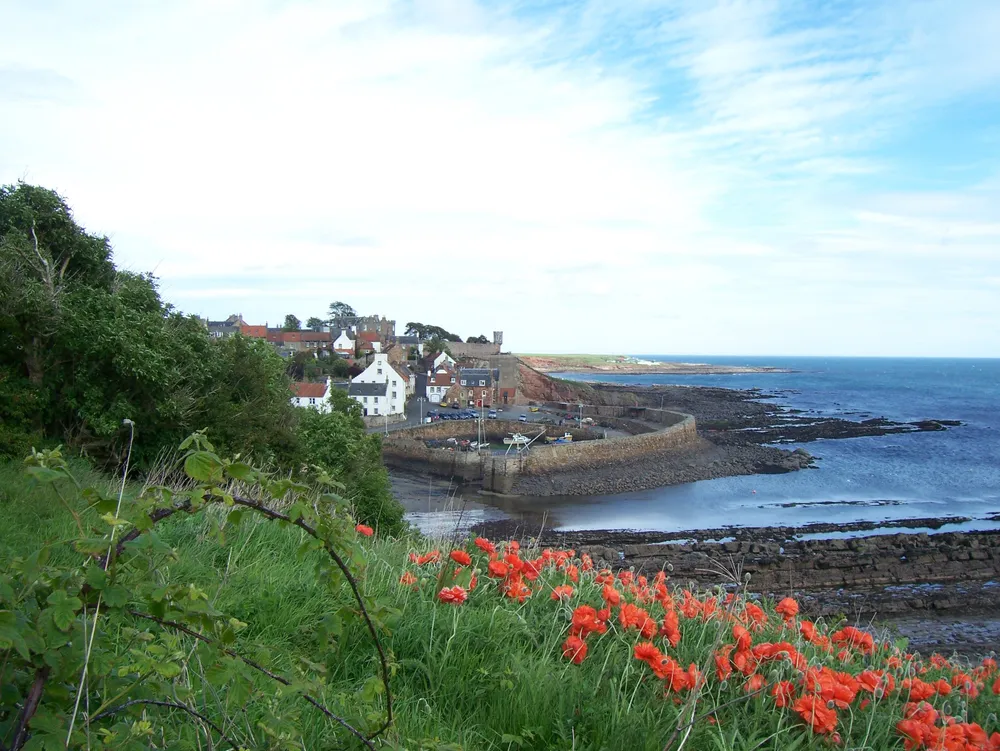
Culross is a gem, a well-restored 16th- to 17th-century village. Dunfermline has a ruined abbey and the birthplace of Andrew Carnegie. The Forth Bridges can be viewed from east or west, but to walk across start from North Queensferry. Kirkcaldy is industrial but has a good museum and art gallery. Falkland Palace was beloved by the young Mary Queen of Scots. The East Neuk are a string of picturesque fishing villages. The Secret Bunker was a control bunker for a nuclear war. St Andrews is a pleasant historic university town. Scotland's Gardens opens up private gardens once a year in summer, with all proceeds going to charity. There are about 25 participating gardens in Fife, dates staggered so there's one open most weekends.
體驗活動
Fife Coastal Path is a 117-mile trail from Kincardine Bridge through North Queensferry, Kirkcaldy, East Neuk and St Andrews to the Tay estuary. See individual towns for the local route, but check the website for occasional disruptions and diversions. You can easily walk a section one way and ride back on the bus or train. Golf: St Andrews is the big, big name: you won't get onto the Old Course unless you're a top pro or celeb, but there are several more championship courses that you can play with prior booking and a suitable fee. Other towns have plenty of courses where you only pay double-figure green fees but can lose your ball just as irretrievably. Beaches get better the further east you go — from Leven onto Lundin Links, say. Boat trips to the Isle of May usually sail from Anstruther: they may land, or just circle to view the bird life. Football: there are pro soccer teams in Dunfermline, Kelty, Kirkcaldy and Leven. Highland Games are held in June at Markinch, in July at Thornton, Burntisland and St Andrews, and in August at Inverkeithing. Fife County Agricultural Show is in Cupar in May.
美食
All the towns and villages have cheap and cheerful places, but the best settings are along the East Neuk. Fish & chips in Cowdenbeath in November is not the same experience
城市概覽改寫自 Wikipedia,旅遊指南來自Wikivoyage (CC BY-SA)。照片來自 Wikimedia Commons.