
Douglas
Ireland · Other
關於Douglas
Cork is the principal city of County Cork in southwest Ireland. Known as "the Rebel City" the "real capital of Ireland", Cork has a strong independence and Corkonians are proud of its role in Irish history. This historic merchant port has a lot of Georgian architecture and lively arts, music and food scenes.
It was already the second-largest city in Ireland when in 2019 its boundaries were extended, to have a population of 210,000. The new boundary includes the town of Blarney, but this is described on its own page; Cobh and Crosshaven downriver remained separate.
Douglas旅遊指南
城市概覽
Corcaigh is an old word for "salt-marsh" — the River Lee broke up into a wetland delta draining into the drowned valley that forms its natural outer harbour. It was tidal and navigable, and Saint Fin Barre founded a monastery on its south bank in 606 AD, the nucleus of a settlement. The Vikings in the 9th and 10th centuries and the Anglo-Normans from the 12th were also attracted by this fertile area, and sought to claim the area as their own. It was under King Henry II that Cork was granted city status in 1185. Medieval Cork was walled for defence and overcrowded, so several river channels became infilled, the basis of what is now St Patrick's Street, South Mall and Grand Parade. The main north and south channels persisted, enclosing the arrow-shaped island of the city centre. Cork's heyday was the 17th century, when sea trade was booming but ships had not yet outgrown the river; later the port moved downstream to Cobh. Prosperous suburbs such as Sunday's Well and Montenotte were built on higher ground on the north bank, while on the south bank a university campus grew up from the 19th century. The Cork Tourist Information Centre is at 125 St Patrick's St, corner of Lavitt's Quay one block west of the bus station.
如何抵達
By plane 1 Cork Airport (ORK IATA), Kinsale Rd (8 km south of centre on N27), ☏ +353 21 431 3131. The main operators are Aer Lingus and Ryanair. Flights are short-haul from the UK and Europe: the runway is too small for wide-bodied jets so there's nothing transatlantic or from the Gulf. UK destinations are London (Gatwick, Heathrow, Luton and Stansted), Birmingham, Bristol, Edinburgh, Glasgow, Liverpool, Manchester and Newcastle upon Tyne. Year-round European destinations are Amsterdam, Budapest, Gdansk, Katowice, Krakow, Lanzarote, Lisbon, Malaga, Malta, Munich, Paris CDG, Poznań, Tenerife and Wrocław. There are seasonal flights from other Med destinations and the ski resorts. The airport has a single terminal, with a long hall for departures and arrivals, and a similar long airside hall for departures. There are the usual facilities including car hire. The airport hotel is a short walk away and Travelodge is 2 km north, see Sleep. (updated Mar 2023) To the city: Buses 225 / 226 run every 30 min between the airport, Parnell Place next to Cork bus station, and the main railway station, taking 25 min to the city. Bus 225 starts from Haulbowline navy base via Ringaskiddy cruiser terminal and Carrigaline, Bus 226 starts from Kinsale. In 2023 an adult single is €2.20 by cash and €2 by Leap card. The taxi rank is outside Arrivals. A taxi to city centre might be €25 for up to four passengers. Dublin Airport (DUB IATA) may work out better, for its better range of flights and direct buses to Cork. Shannon Airport (SNN IATA) near Limerick is a good alternative for transatlantic flights. There's public transport to Cork but you'll be wanting a rental car.
By boat
In summer there are car ferries from Roscoff (15 hr) twice a week, operated by Brittany Ferries. 2 Cork Ferry Terminal is at Ringaskiddy, 15 km south east of the city on N28. Bus 223 / 225 runs here, see Get around. Cruise liners often visit: they may dock at Cobh or at Ringaskiddy, or land passengers by ten
當地交通
On foot Cork has a small city centre, and most places to stay, eat, drink and tour are within one busy km. So too are the transport hubs.
By bicycle There are many cycleways, both in-street and segregated, with some contraflow lanes. The bike share scheme has docking stations across the city centre extending west to UCC. You need to register and pay a deposit of €150. As of Nov 2020, an annual pass is €10 and a 3-day visitor pass is €3. The first 30 min of any journey is free. Cycle shops offering bike hire are Cycle Scene and The Bike Shed. Kilgrews in city centre sell and repair but don't hire.
By train Irish Rail commuter trains serve three lines out of Cork Kent station:
East then south every 30-60 min to Little Island, Glounthaune, Fota (for Wildlife Park), Carrigaloe, Rushbrooke and Cobh, taking 25 min, single fare €5. East every 30-60 min to Little Island, Glounthaune, Carrigtwohill and Midleton, for the Jameson Whiskey Distillery, 25 min, single fare €5. North hourly non-stop to Mallow, for the racecourse, 25 min. Many of these are inter-city trains to Dublin Heuston or Tralee, but you pay the same commuter fare of around €10 single.
By bus
Buses in Cork are run by Bus Éireann, with 22 routes, see map. Apart from three orbital routes that you're unlikely to use (201 north, 219 south and 225 further south), they all run cross-town, with central stops around St Patrick Street, Merchants Quay or Parnell Place main bus station. They run daily 6:30AM-11:30PM, every 10-20 min at peak times, except Bus 220 which runs 24 hours.
Bus 202 from Hollyhill and Knocknaheeney northwest to city centre then Blackrock and Mahon Point southeast. Bus 203 from Farranree and Blackpool in the north to city centre then Turners Cross and Ballyphehane south. Bus 205 from Cork Institute of Technology and University College Cork west to Kent Railway Station. Bus 208 from Curraheen and Cork University Hospital southwest to city centre then Mayfield and Lotabeg northeast. Bu
必看景點
[1]1 Crawford Art Gallery, Emmett Place T12 TNE6, ☏ +353 21 480 5042. M-Sa 10AM-5PM, Su 11AM-4PM. The permanent collection includes paintings by Jack Yeats and Sean Keating, and a series of plaster casts of classical statues, which King George IV found tedious. The gallery is expected to close for two years from Sep 2024 for rebuilding. Free. (updated Mar 2023) 2 Elizabeth Fort, Barrack St T12 C8A0, ☏ +353 21 497 5947. Tu-Sa 10AM-5PM, Su noon-5PM. The original fort built in 1601 was just timber and earth, and the citizens made short work of it. It was rebuilt from 1624 as a stout "star" fortress. It lost its defensive role in 1719 but was variously used as a barracks, a depot for convicts (mostly female) awaiting transportation to the colonies, and a police station to 2013. It's now simply a tourist area with a gallery and occasional events, and you can walk along the walls. Free. (updated Mar 2023)
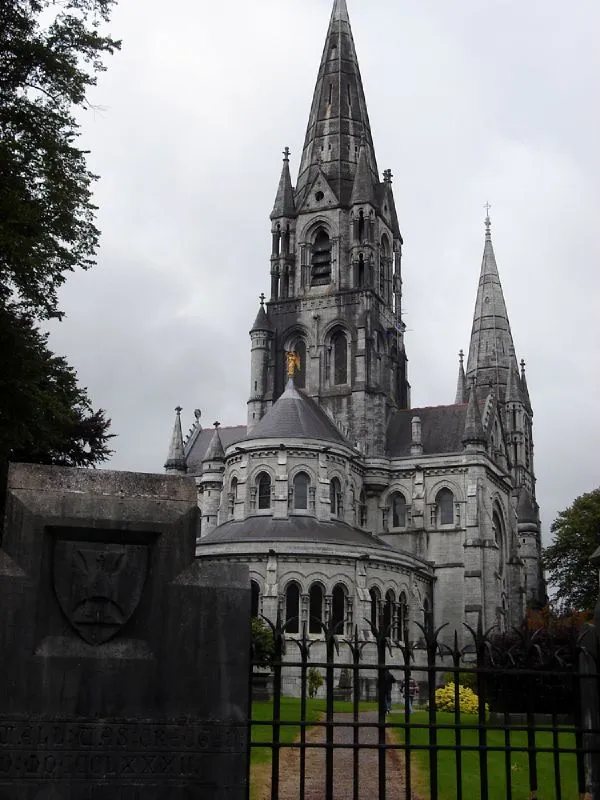
3 St Fin Barre's Cathedral, Bishop St T12 K710, ☏ +353 21 496 3387. M-Sa 9:30AM-5:30PM, Su 1-5:30PM. Saint Fin Barre (550-623 AD) was a preacher who spent his last 17 years hereabouts. A monastery dedicated to him was built in the 7th century, and there have been at least three churches on the site before the present building. This is an elaborate Church of Ireland (Anglican) cathedral built 1865-79 in Gothic Revival style. The interior is relatively small: Burgess the architect realised it would go way over budget so the focus was on creating a grand frontage, to impress the citizens and overawe the resurgent Catholics. There are three great spires, intricate carvings and gargoyles, stain glass windows, and a high ceiling over a rather stubby nave. The pipe organ adds to the cathedral's many expensive items of construction and maintenance.
城市概覽改寫自 Wikipedia,旅遊指南來自Wikivoyage (CC BY-SA)。照片來自 Wikimedia Commons.