
Benelux
Belgium · Europe
關於Benelux
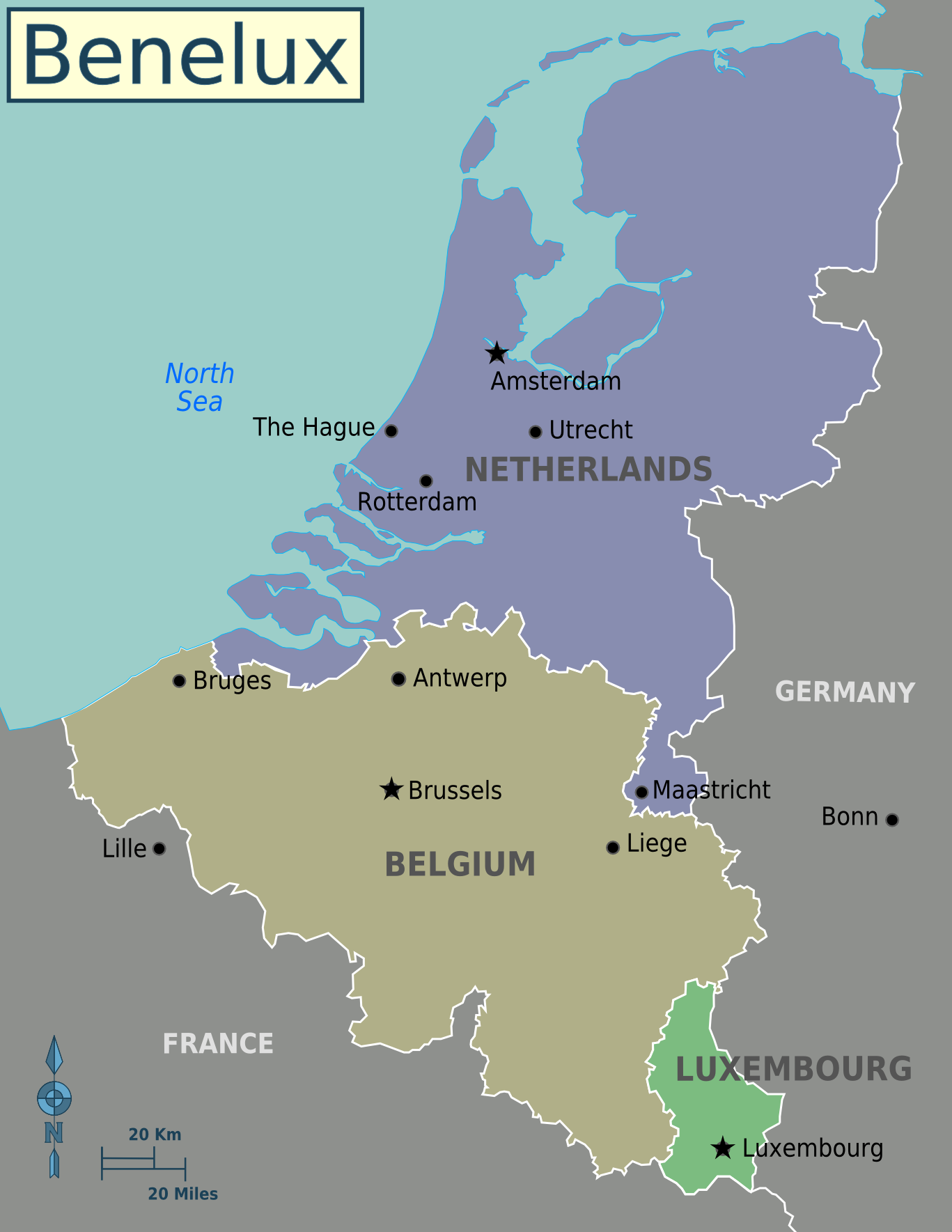
Benelux is an economic union comprising three neighbouring monarchies: Belgium, the Netherlands, and Luxembourg. The name is formed from the beginning of each country's name. It was a precursor of the European Union.
Benelux旅遊指南
城市概覽
The region is more traditionally known in English as the Low Countries because they are all part of a plain near the North Sea, and parts of the Netherlands are so low as to actually be below sea-level, requiring dykes to keep the sea water out. The three countries share a number of commonalities, starting from their topography and climates, which in turn influenced their cultures and economies, from the fish-and-potatoes nature of the cuisine to the famous renaissance art. The three countries are not same at all. On religions, the Netherlands is a Protestant (Reformed and Lutheran Church) country, while Belgium and Luxembourg are more Catholic; on languages, as well the Netherlands and the northern half of Belgium (Flanders) are Dutch-speaking, while southern Belgium is French-speaking (and a few people speak German). Yet, all being small countries wedged between the massive and nationalistic states of France and Germany, they have shared a similar tragic modern history of invasion and occupation. This shared history galvanized the countries to become major founders and joiners of international organisations in the post-war era in the hope of ending the threat of invasion. Nowadays, thanks to their reputation as honest brokers and their "neutral location" between France and Germany, these countries are the home to numerous international institutions, almost like a giant "capital district" for all of Europe. Examples include the international court in the Hague or the EU headquarters shared between Brussels and Luxembourg City. With all this international attention, these countries have developed some of the best-developed travel infrastructure in the world, including efficient airports, extensive rail networks, and a full range of hotels and restaurants from cheap and cheerful to chic and elegant. This is a perfect gateway into Continental Europe for those taking their first steps. Everything is relatively safe and easy to navigate, and many people speak pass
如何抵達
By plane Most people get into the Benelux region by plane or train. Schiphol Airport in Amsterdam and Zaventem Airport in Brussels are the largest airports in the region; Schiphol is also important as a transfer airport for further destinations in Europe. Smaller airports are present in Antwerp, Eindhoven, Groningen, Luxembourg, Maastricht, Charleroi ("Brussels South"), Liège and Rotterdam, which are mostly used by no-frills airlines.
By train High-speed rail networks connect the Benelux with France, Germany, and the United Kingdom (through the Channel Tunnel). High-speed trains operated by Thalys connect Paris with Brussels, Antwerp, Rotterdam, and Amsterdam in a little more than three hours. High-speed (and slower intercity) ICE International trains operated by Deutsche Bahn (and Nederlandse Spoorwegen) connect Frankfurt (and Cologne) with Amsterdam and Brussels, and Basel with Amsterdam. High-speed trains operated by Eurostar connect London with Brussels, Rotterdam and Amsterdam.
By bus The major companies running Intercity buses in Germany all serve stations in the Benelux as well. France liberalized its long distance bus market in 2015, and connections to major cities in the Benelux have either been announced or are planned. Some buses even take you to London, either through the Channel Tunnel or by being loaded on a car ferry.
當地交通
As this is a densely populated area in Europe you usually have the choice of several modes of transport and getting around should be a breeze, if sometimes a bit hard on the wallet.
By train
All major towns (and many minor ones) are connected to the rail network. Belgium alone has four high-speed rail lines, though they mostly serve trains coming from or going to other countries. Within the region trains are reasonably fast, cheap (in Belgium keeping rail travel affordable is officially stated public policy and their per passenger km subsidy is the highest in Europe) and have frequencies of once an hour or more often. All three rail companies (including the tiny CFL of Luxembourg) serve international routes. The Beligan railways website is available in several languages and local varieties, including for the US and most European countries. Public transport in the Netherlands can be planned utilizing the public transport journey planner 9292.nl. Train tickets for the national railway service are cheapest when bought online, through their app or by using the countrywide public transport smartcard.
By bus Flixbus runs domestic buses in the Netherlands.
By car
All countries in the Benelux have a reasonably dense highway network. In the Netherlands, there is a default speed limit of 100 km/h, which goes up to 120 km/h or 130 km/h at night, a limit of 130 km/h exists in Luxembourg, and one of 120 km/h in Belgium. Those speed limits are shown in a standardised form on every road entrance to the country in question.
By bike The Netherlands, and to a lesser extent Belgium and Luxembourg, are positively bike crazy. There are more bikes than people and every city of any size has a decent or excellent network of bike routes that is patronized by locals of all ages shapes and socioeconomic classes. The only caveat when it comes to cycling is the fact that bikes may be stolen in bigger cities. Intercity cycling is less common but still possible, due to the flat natu
必看景點
Much of the swamp land in the Low Countries has been reclaimed, resulting in some of the largest water works in the world, such as the Delta Works, and in other attractions such as the windmills of Kinderdijk in South Holland. Much has not been reclaimed, resulting in interesting biotopes, such as the Zwin on the North Sea Coast of Belgium and the area around the Wadden Sea in the North of the Netherlands.
Look at some of the region's historic cities, including Amsterdam, Antwerp, Bruges, Delft, Ghent, and Maastricht Brussels is the so-called capital of the European Union; take a wander through the European Quarter with its modern architecture The Netherlands has a bewildering amount of art museums—at least chip in the Museum Quarter in Amsterdam Cheese markets are a big thing in Holland—Alkmaar, Edam, and Gouda have them More Dutch stereotypes are to be found elsewhere; windmills in Zaanse Schans, tulips in the Keukenhof, and flat polders in the Green Heart Flanders has many beguinages and belfries—a total of 46 have been inscribed in the UNESCO World Heritage List The Delta Works, one of the most technologically advanced projects in the world, give an insight in the Dutch' centuries-long battle against the sea So, what to see in Luxembourg? Try its capital of the same name, with a splendid location high on a cliff, or Vianden, a tourist favourite with its stunning mediaeval Beaufort Castle.
體驗活動
You will find white-water canoeing in Luxembourg and the East of Belgium. There are some excellent golf courses in Luxembourg and the East of Belgium. Rent a bike and explore Amsterdam. Visit the smallest town in the wor
城市概覽改寫自 Wikipedia,旅遊指南來自Wikivoyage (CC BY-SA)。照片來自 Wikimedia Commons.