
Belgium
Belgium · Europe
關於Belgium
A low-lying country in the Benelux, Belgium (Dutch: België, French: Belgique, German: Belgien) sits at the crossroads of Western Europe. It marries the historical landmarks for which the continent is famous with spectacular modern architecture and rural idylls. Its capital, Brussels, is home to the headquarters of the European Union.
Although Belgium is a relatively wealthy country, it is also one of the most politically complex countries in the world. Differences in language and culture between Flanders (the Flemish-speaking portion) and Wallonia (the French-speaking portion) have led to several far-reaching reforms, and this continuing antagonism makes Belgian politics so complex that even ordinary Belgians aren't able to make sense of what's truly going on. Despite all this, the two halves form a country that contains some of Europe's most attractive and historical cities, and is a true 'must-see' for any visitor to the continent.
Belgium旅遊指南
城市概覽
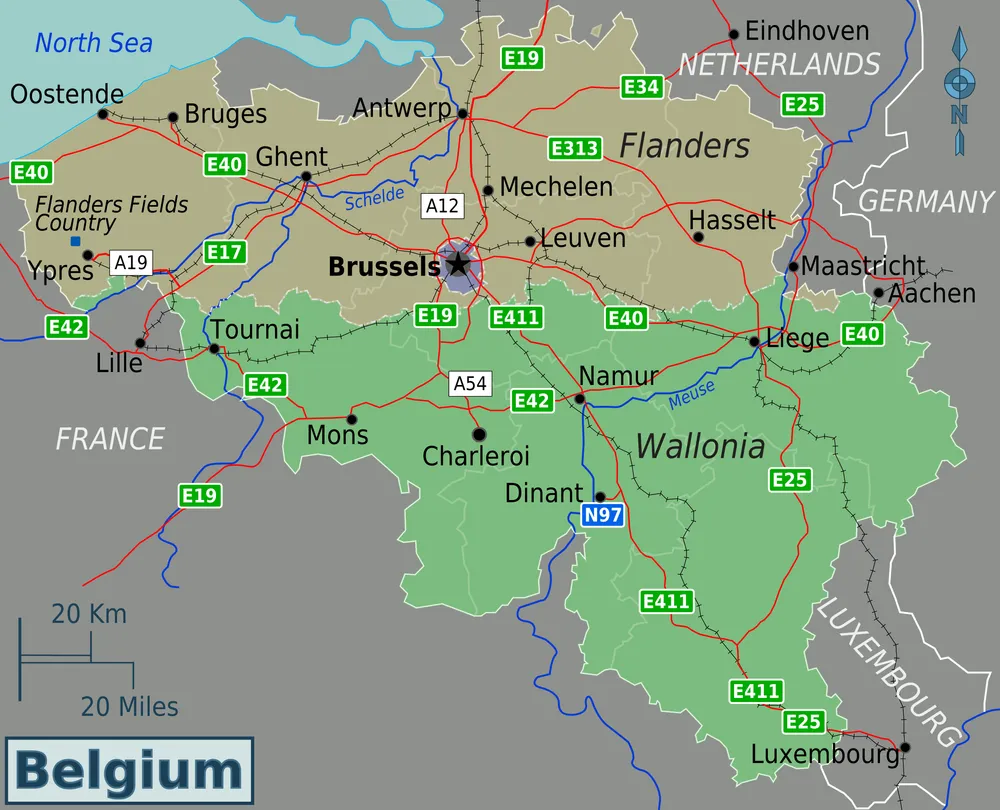
Lying on the North Sea coast, Belgium's immediate neighbours are France to the south-west, Luxembourg to the south-east, Germany to the east and the Netherlands to the north. Belgium is a densely populated country trying to balance the conflicting demands of urbanization, transportation, industry, and commercial and intensive agriculture. It imports large quantities of raw materials and exports a large volume of manufactured goods, mostly to the EU. Visit Belgium provides tourist information for the country.
History Belgium is the heir of several former Medieval powers, and you will see traces of these everywhere during your trip in this country. After the collapse of the Carolingian Empire in the 9th century, the territory that is nowadays Belgium, Netherlands, and Luxembourg, was part of Lotharingia, an ephemeral kingdom soon to be absorbed into the (German) Holy Roman Empire; however, the area of Lower Lotharingia remained intact in the feudal empire: this is the origin of the Low Countries, a general term that encompasses present-day Belgium, Netherlands, and Luxembourg.
The widely autonomous fiefdoms of the Low Countries were among the richest places in Medieval Europe and you will see traces of this past wealth in the rich buildings of Bruges, Brussels, Antwerp, Ghent, Leuven, Tournai, Mons, etc. These cities progressively fell under the control of a powerful and ambitious family: the Dukes of Burgundy. The whole realm of the dukes extended from the Low Countries to the borders of Switzerland. Using wealth, strategy, and alliances, the Dukes of Burgundy aimed at reconstituting Lotharingia. The death of the last duke, Charles the Bold, put an end to this dream. However, the treasures of the Dukes of Burgundy remain as a testimony of their rules in Belgian museums and landmarks. The powerful Habsburg family then inherited from the Low Countries. Reformation is the reason that Belgium and the Netherlands were first taken apart: the northern half of the Low Co
如何抵達
Entry requirements Belgium is a member of the Schengen Agreement. See Travelling around the Schengen Area for more information on how the scheme works, what countries are members and what the requirements are for your nationality. In summary:
There are normally no immigration controls between countries that have signed and implemented the treaty; there may be such controls temporarily, such as in connection with important events and various crises. The operators may carry out identity checks before passengers board international flights, ferries or trains, even between Schengen countries. Citizens of the EEA countries and Switzerland do not need visas to travel in the Schengen area, and may stay up to 90 days with no requirements other than having a valid ID card or passport. See European Union#EEA citizens. Normal visas granted by any Schengen member are valid in all countries that have signed and implemented the treaty (with exceptions for some overseas territories). The granting country may offer additional rights (such as longer stays or right to work) that apply only locally. In Belgium, non-EU/EFTA visa-free visitors are permitted to work without the need to obtain any further authorisation for the period of their 90-day visa-free stay. This is an exception to the general Schengen rules that does not extend to most other Schengen countries.
By plane
Brussels Airport (BRU IATA), also known as Zaventem due to the town in which it is mainly located, is Belgium's main airport. It is not in Brussels proper, but in neighbouring Flanders. The airport is the base of the national airline Brussels Airlines. Other full-service airlines use BRU, as well as budget carriers such as Ryanair, Vueling and TUIfly Belgium. There is a train (€5.10) running every 15 minutes to Brussels centre taking 25 minutes, some of them continuing to Ghent, Mons, Nivelles, and West Flanders and bus lines number 12 and 21 (€3 at the vending machine/€5 on board) every 20 to 30 minutes to
當地交通
Being such a small country (300 km as its maximum distance), you can get anywhere in a couple of hours. Public transport, when fully functioning, is fast and comfortable, and not too expensive. Between larger cities, there are frequent train connections, with buses covering smaller distances. A useful site is Smart Mobility Planner, which has a door-to-door routeplanner for the whole country, covering all forms of public transport (including train, bus, subway and tram). A look on the map shows that Brussels is a good starting point to explore Antwerp, Ghent, Bruges, Namur and Leuven on day trips. Antwerp is popular among those who want to be in a cosmopolitan place, and Ghent is tops with those who like a good mix of open-minded provincialism. Liège is beautiful, but too close to Germany to be a good base for day trips. Mechelen is considered boring by tourists, but has a very good youth hostel next to a train station with trains to everywhere else every 30 min. To do some local sightseeing, especially in Flanders, a lot of infrastructure is available for cycling. Bikes can be rented virtually everywhere. In the country side of Wallonia, mountainbikes are available, and rafting is popular along the border with Luxembourg.
By train
Belgiantrain.be journey planner. Use the official journey planner operated by the National Railway Company of Belgium to find train itineraries and prices (updated May 2016) Most of Belgium is well connected by train, run by Belgian Railways (NMBS in Dutch and SNCB in French) with most of the main routes passing through Antwerp, Namur or Brussels. This is where you'll arrive on international trains, and both can be reached by train from Brussels airport or by coach from Antwerp or Charleroi airport. Transfers are very easy. All ICE and some Eurostar tickets allow free same-day transfers by domestic trains to any other Belgian station. The trains are punctual and mostly modern and comfortable. For ticketing information, see Rail trav
必看景點
Mostly known for its key role in European Union administration, the small nation of Belgium might leave you surprised by its heritage. It boasts a number of historic cities packed with medieval and Art Nouveau architecture and famous for their long traditions in art and the Belgian monarchy. If you've seen the best of them, the Belgian countryside offers anything from sandy beaches to the ridges of the Ardennes. Brussels, the country's vibrant capital, is a modern world city with a highly international character. It combines massive post-modern buildings in its European Quarter with impressive historic monuments, such as the World Heritage listed Grand Place, surrounded by guildhouses and the Gothic town hall. There's Laken Castle and the large St. Michael and St. Gudula Cathedral, dedicated to the cities patron saints. The Royal Palace is a more recent but no less grand structure. One of the city's most famous landmarks is the Atomium, a remarkable steel structure and remnant of the
城市概覽改寫自 Wikipedia,旅遊指南來自Wikivoyage (CC BY-SA)。照片來自 Wikimedia Commons.