
Belarus
Belarus · Europe
關於Belarus
Belarus (Belarusian and Russian: Белару́сь) is a former Soviet state whose history begins in the 10th century CE. While not on most tourists' radar, Belarus preserves beautiful castles, pristine nature, and Soviet heritage. It maintains close ties and an open border with its neighbor Russia.
Commonly referred to as "Europe's last dictatorship", Belarus is a strict authoritarian country. As a tourist you should remain cautious in Belarus due to arbitrary law enforcement, extensive surveillance, political repression, and the risk of sudden border or travel restrictions or avoid visiting the country all together.
Belarus旅遊指南
城市概覽
History
Early history The territory of modern-day Belarus was once inhabited by Baltic tribes most of whom succumbed to Slavic invasions overtime. By the 9th century, the lands of present-day Belarus were inhabited by East Slavic tribes, such as the Krivichs, Dregovichs, and Radimichs as well as Baltic peoples in the northwest such as Yotvingians and Lithuanians. The East Slavic tribes gradually became part of the Kievan Rus’, a powerful medieval state with its center in Kyiv.
Grand Duchy of Lithuania and the Polish-Lithuanian Commonwealth In the 13th century, as Kievan Rus’ weakened due to Mongol invasions, Belarusian lands were gradually absorbed into the expanding Grand Duchy of Lithuania. Under Lithuanian rule, however, the conquered Belarusian regions retained a large degree of autonomy. Throughout the 13th and 14th centuries the Lithuanian state grew, encompassing the city of Smolensk (now in Russia) and the lands eastward to the neighbourhood of Moscow and southward to Kyiv and the shores of the Black Sea. During this epoch of Lithuanian domination, the Belarusian language and nationality began to take shape. In 1569 the Union of Lublin formally merged the Grand Duchy of Lithuania with the Kingdom of Poland, creating the Polish-Lithuanian Commonwealth. Belarusian lands were now under joint Polish-Lithuanian rule, with Polish influence increasing over time. Throughout the 17th and 18th centuries, ethnically Belarusian lands suffered greatly from wars and invasions, including conflicts with Muscovy (Russia) and Sweden.
Russian Empire In 1795, the whole territory of contemporary Belarus became part of the Russian Empire. The new country was by far more oppressive than Lithuania and Poland. The state machine promoted the idea of Belarusians, alongside with Ukrainians, being a constituent part of the grand Russian nation. For the first time, Jews were not free to live where they wished; they had to pay twice as much in taxes as Christians. After the 186
如何抵達
Although Belarus has an open border with Russia, third country nationals are not permitted to cross the border between Russia and Belarus overland; they are required to fly to travel directly between the two countries.
Entry requirements
Visa-free Citizens of the following countries and regions do not need a visa: Armenia, Azerbaijan, Brazil, China (including Hong Kong and Macau), Cuba, Ecuador, Georgia, Israel, Kazakhstan, Kyrgyzstan, Moldova, Mongolia, Montenegro, North Macedonia, Qatar, Russia, Serbia, Tajikistan, Turkey, Ukraine, Uzbekistan and Venezuela. In case of any change, consult the up-to-date list of visa-exempt countries. Citizens of 74 countries (see list) do not need a visa for stays in Belarus of up to 30 days, subject to a limit of 90 days per calendar year, provided they meet the following requirements:
they have medical insurance valid in Belarus. You will be asked to show its print copy by the border control officer. Unlike for the mandatory registration, this document does not have to be translated into Belarusian or Russian; one in English (and, possibly, other languages) will be sufficient. Alternatively, insurance can be purchased from a kiosk on the left hand side before passport control for €1/day (bring euros or dollars with you to purchase) they are not travelling directly from or to Russia they have cash or proof of funds of at least €25 per day of stay (not enforced for those from developed countries). Until 2022, the requirements also included that travellers from these countries enter and they leave the country via flights to and from Minsk National Airport. This requirement has been cancelled. However, since most of the border crossings with Poland, Lithuania, and Latvia have been closed anyway, flying is still by far the most practical way to get in if you're not a Russian citizen. Visa-free entry is not granted to holders of diplomatic, service or special passports and to those flying between Minsk and Russia. These flights
當地交通
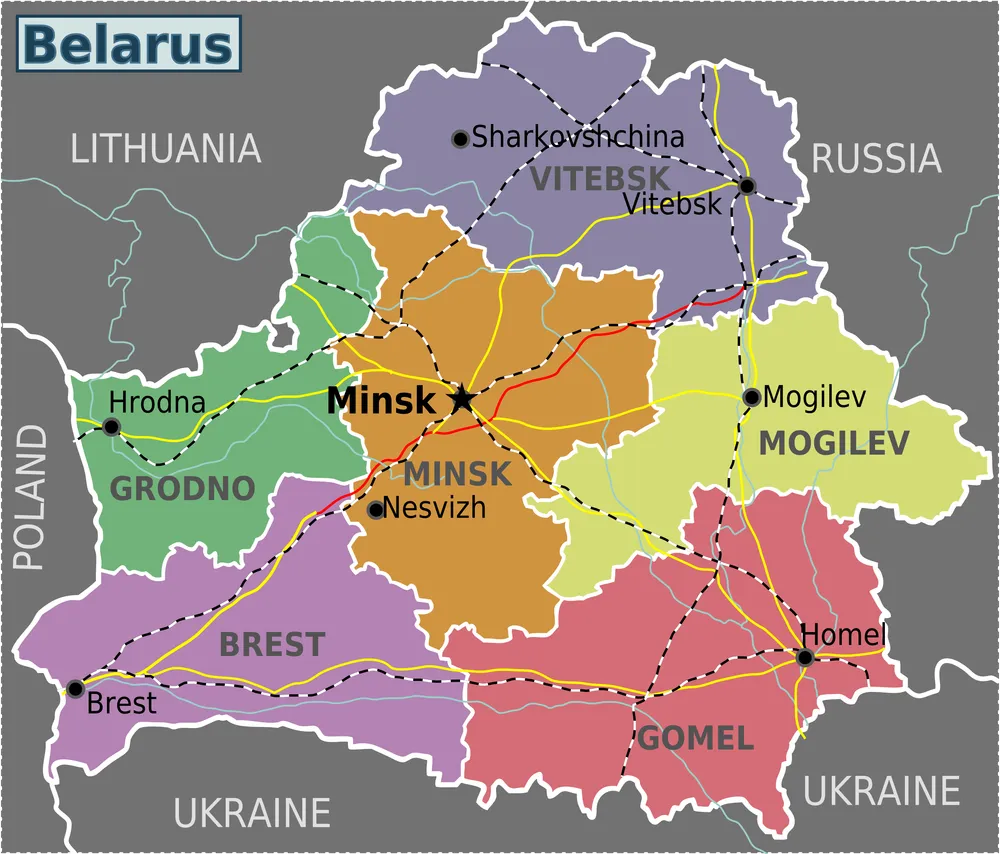
With an area of 207,595 km2 (80,153 sq mi), travelling around Belarus should not take a lot of time. A car ride to Brest from Minsk should take you about 4 hours, depending on traffic conditions.
By car Traffic in Belarus is reasonably quiet, but you should exercise caution when driving your own car. Particular attention should be paid to light traffic and pedestrians, most of whom use the roads without reflectors. The infrastructure in Belarus was well developed after World War II. The condition of roads varies in different parts of the country. Main roads and roads in the metropolitan area are in fairly good condition. In winter, it is advisable to take the necessary precautions. All year round, you should be prepared for heavy fog in places. Petrol (gasoline) is relatively cheap by European standards; 1 litre costs 2.46 BYN (€0.90) (January 2023), with the price fixed by the government at all fuel stations on a daily basis. You can rent cars in Minsk at the airport or city from the major international rental chains or smaller local companies. Major motorways are toll roads in Belarus. Before the travel, check the list of toll roads. There are no toll stations. The toll for use of Belarusian roads within the BelToll system can be paid on the basis of a Pre-Paid Contract or a Post-Pay Contract. In the event of a road accident, you should wait for the police to arrive. In the case of accidents, it can be difficult to get proper treatment. The authorities often only speak Russian and it can take weeks to sort things out.
By train Travelling by train around the country will get you to a lot of desired destinations relatively cheap and fast. Timetables for all means of transport can be found here and for trains of course on the site of the Belarusian railway. Also, you will get a chance to capture a glimpse of Belarusian nature, as the forests and plains often start right on the edges of the cities. The country is mostly flat. Train tickets can be bought in adva
必看景點
The appeal of Belarus are little known, but the off the beaten track character of this unfamiliar country is exactly what makes it special to the people that visit. Much of the historic heritage was lost to World War II violence or to post-war communist planning, but there's more to see than one might expect at first glance. Take Minsk, the country's surprisingly modern and distinctively Eastern European capital, bustling with nightclubs and modern restaurants but simultaneously a monument of Communist architecture and city development, as it had to be completely reconstructed after the war. It's home to the fine Belarus State Museum, Independence Square (where democratic protests make world news every so many years) and the former KGB Headquarters but also the humbling Zaslavsky Jewish Monument. Far more western is the border city of Brest, where you'll find the 19th-century Brest Fortress, the site of a long and severe Operation Barbarossa battle and a monument of the Soviet resistan
城市概覽改寫自 Wikipedia,旅遊指南來自Wikivoyage (CC BY-SA)。照片來自 Wikimedia Commons.