
A Coruña
Spain · Europe
關於A Coruña
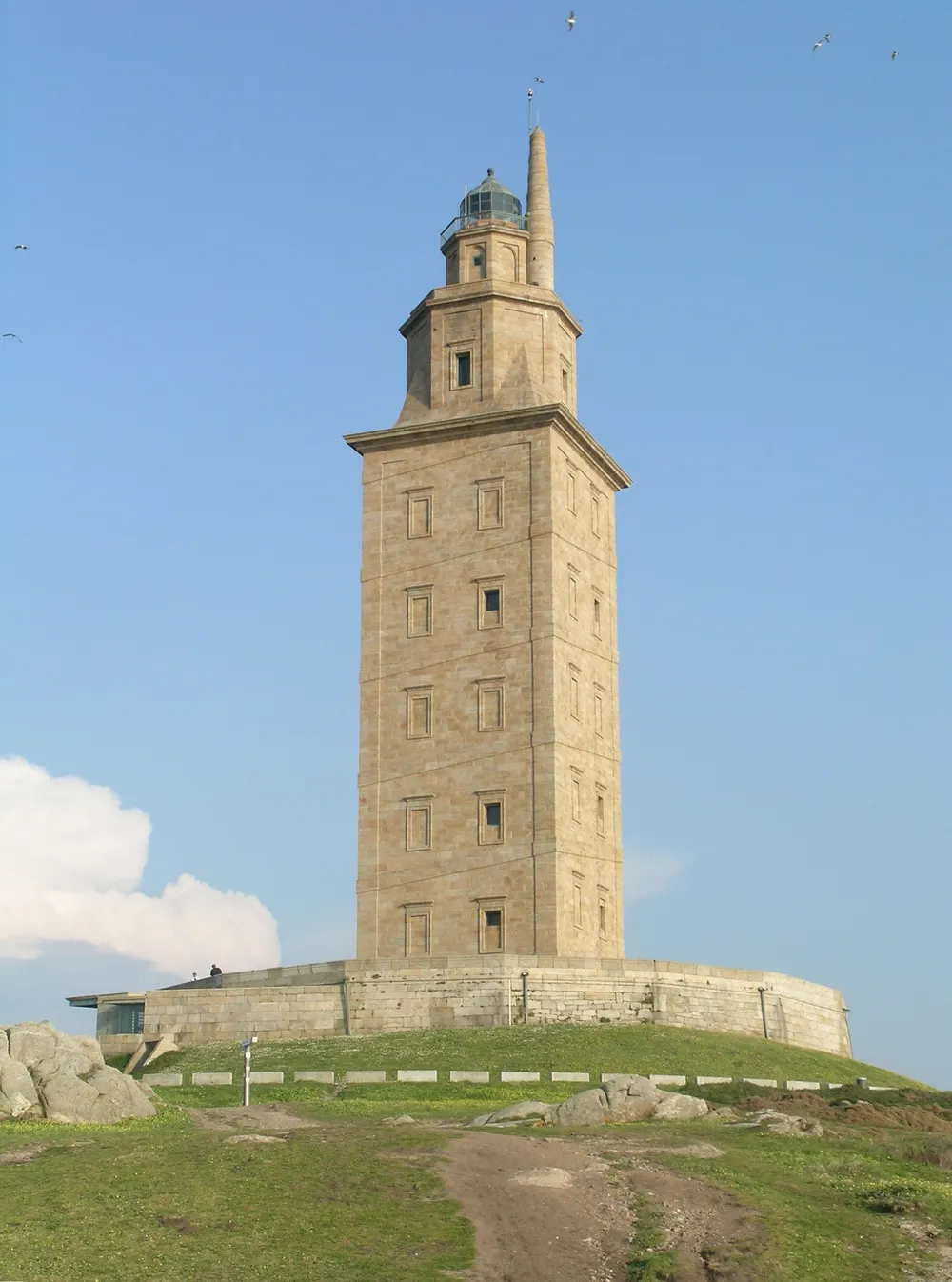
A Coruña (Spanish: La Coruña) is a large port in Galicia in northwest Spain. Its sights reflect its heritage as a fortified harbour much battered by other nations. The city is the site of the Roman Tower of Hercules, a lighthouse which has been in continuous operation since possibly the 2nd century AD. The Old City has streets and squares that revive the city's history and noble mansions and residences. In July, a Medieval Fair takes place in the streets of the Old City. The city has several museums, such as the Castle of San Antón Archaeological Museum, Fine Arts Museum and the network of scientific museums. The city had a population of 249,000 in 2024.
A Coruña旅遊指南
城市概覽
"A Coruña" may mean crown or colony. The oldest known human settlement was from 3rd century BC at Castro de Elviña a few km south, but perhaps there was something similar on the site of the old town that has been obliterated. This Cidade Vella was at the south end of a tombola island that became welded to the mainland by build-up of material along an isthmus. The town spread north along the island / peninsula towards the lighthouse and west along the isthmus, with a port on its sheltered side, but this was checked for several centuries by the collapse of the Roman Empire and raids by the Arabs and Vikings. It only resumed its growth in early modern times, trading in textiles and with shipping to the Caribbean and Americas. As a port on a rugged coastline, A Coruña was involved in the conflicts with other European powers. After the Spanish Armada of 1588 was routed, the English sought to capitalise on Spanish weakness and launched a counter-Armada. This was a humiliating calamity, with their assault on A Coruña repulsed by lightly armed townsfolk. It left England, Spain, France and Holland all about equal in maritime power, and it would take another 150 years before "Britannia ruled the waves". During the Peninsula War against Napoleon, Britain and Spain initially forced back the French, but in 1808 the Spanish front collapsed and the British fled cross-country to try to evacuate via A Coruña. Their rescue fleet hadn't arrived and on 16 January 1809 they fought off the French advance at Elviña south edge of town, and made good their escape. 19th and 20th century A Coruña industrialised, eclipsing the nearby port of Ferrol and sprawling to the west and south. Many of its tourist visitors arrive by cruise liner, though they're swiftly whisked away on buses to Santiago. Climate is dominated by the Atlantic, mild and wet in winter and cool in summer. Early summer is a good time to come. Visitor information is at Praza de María Pita 6 in the main town square, open M-F
如何抵達
By road A Coruña is 600 km northwest of Madrid. Follow the A-6 and reckon 5 hr 30 min.
By plane 1 A Coruña Airport (LCG IATA), Av Hermida, Culleredo, ☏ +34 91 321 1000. This has daily flights from Madrid (by Iberia) and Barcelona (by Vueling), and occasionally from Seville and London Gatwick. To town is 8 km north: Bus A4 runs to city centre every 30 min 05:00 to midnight. It makes multiple stops including the railway station, 30 min. (updated Feb 2025) Santiago de Compostela (SCQ IATA) has more tourism and therefore more flights from across Europe. It's 50 km south of A Coruña: one bus from Santiago every two hours stops here on its way to A Coruña, otherwise take the frequent bus into Santiago city centre for onward transport. Madrid-Barajas (MAD IATA) has a great range of flights. Some buses to A Coruña start from here.
By train 2 A Coruña-San Cristóbal, Av Ferrocarril 2. This railway terminus has connections from Madrid Charmartin every couple of hours: three trains per day are direct, taking 3 hr 40 min via Zamora, Ourense and Santiago de Compostela, otherwise change at Ourense. Trains from Vigo Guixar run every couple of hours via Pontevedra, Padron and Santiago. One train a day is direct from Barcelona Sants via Zaragoza, Pamplona, Vitoria/Gasteiz, Burgos, Palencia, León , Astorga, Bembibre, Ponferrada, Ourense and Santiago. Six local trains a day take 80 min from Ferrol. Two trains a day take two hours from Lugo, otherwise change at Ourense. (updated Feb 2025)
By bus ALSA buses run four times a day from Madrid South station, taking 9 hours via Madrid Moncloa, Astorga, Bembibre, Ponferrada and Lugo. Some start from Madrid Barajas Airport. Arriva buses from Santiago are every 30 min and take an hour, some via Santiago airport. They may start from Muros or Vigo. Buses from Ferrol are every 30 min and take just over an hour. Five buses a day take two hours from Fisterra. One bus a day from Valladolid takes 7 hr 30 min via León and Astorga. One
當地交通
Walk, most sights are within a short distance. Paseo Marítimo the seafront promenade wraps right around town and peninsula and out west to Monte de San Pedro. Tranvías Coruña is the city bus operator. Taxis are white, and available to hire when their green roof light is on.
必看景點
A total solar eclipse on Wednesday 12 Aug 2026, starting at 20:27 and lasting just over a minute. The chances of a clear sky are only 45%, and you need to find a spot with a clear view to the northwest horizon, where the sun will be setting. Coast is best.
Cidade Vella
1 Castelo de San Antón, Paseo Marítimo Alcalde Francisco Vázquez 2, ☏ +34 98 118 9850. Tu-Sa 10:00-19:30, Su 10:00-14:30. 16th century castle on an island, now connected by a broad avenue. Within is a museum of castle history and weaponry. Adult €2, conc or child €1. (updated Feb 2025) 2 Military Museum, Praza de Carlos I, ☏ +34 98 120 5300. M-Sa 10:00-14:00, 17:00-19:30, Su 10:00-14:00. Displaying weapons, uniforms, maps and so on. (updated Feb 2025) Xardín de San Carlos is a small garden in the ramparts just south of the Military Museum. Here lies the tomb of Lt-General Sir John Moore (1761-1809), hit by cannon fire in the Battle of Corunna. The park has lost many of its mature trees to disease but is still a popular wedding photo spot. 3 Church of Santiago, Rúa do Parrote 1, ☏ +34 98 120 5696. Daily 11:30-13:30, 18:30-19:30,. Built late 12th century in Romanesque style, much modified down the years. Free. (updated Feb 2025) Emilia Pardo Bazán Museum, Rúa Tabernas 11 (west side of Church of Santiago). Temporarily closed. Emilia Pardo Bazán (1851-1921) was an acclaimed writer, playwright, translator and advocate for women's rights. The museum in her early home has been closed for refurbishment since 2022, the re-opening date is unknown (updated Feb 2025) Praza de Azcárraga is a bosky square 50 m northeast of Church of Santiago. Colexiata de Santa María was built in the 12th century in Romanesque style. It's a further 100 m northeast, at Rúa Damas 24. Museum of Sacred Art is north flank of Colexiata de Santa María at Rúa Porta de Aires 23. It's open Tu-F 09:00-13:00, 15:30-17:30, Sa 10:00-13:00.
4 Maria Pita House, Rúa de Herrerías 28, ☏ +34 98 118 9853. Tu-Sa 10:00-13:00, 17:00-20:00. In 1589
體驗活動
Beaches: Orzán and Riazor west side of the peninsula are sandy. They're exposed to the Atlantic, with water distinctly cooler than the Med, so you might want a wetsuit for water sports. Surfing is on the northwest-facing Playa del Orzán. Surf camps are Brava Surf and Base Surf Camp. Fundación Barrié is an art exhibition and performance space at Rúa Cantón Grande 9. Teatro Colón is on Av Marina by the port. Teatro Rosalía de Castro is at Rúa Riego de Agua 37. Filomatic is a music venue at Rúa San José 21. Mardi Gras is a music venue at Terrassa la Torre 8. Coliseum is a big auditorium at Rúa Francisco Pérez Carballo 2, south end of town. Football: RC Deportivo La Coruña were promoted in 2026 and play soccer in La Liga
城市概覽改寫自 Wikipedia,旅遊指南來自Wikivoyage (CC BY-SA)。照片來自 Wikimedia Commons.