
Webb and VLT Directly Image Exoplanet Beta Pictoris d to Reveal Evolution
The astronomical community has achieved a major breakthrough. A research team, utilizing NASA’s James Webb Space Telescope (JWST) in conjunction with the E
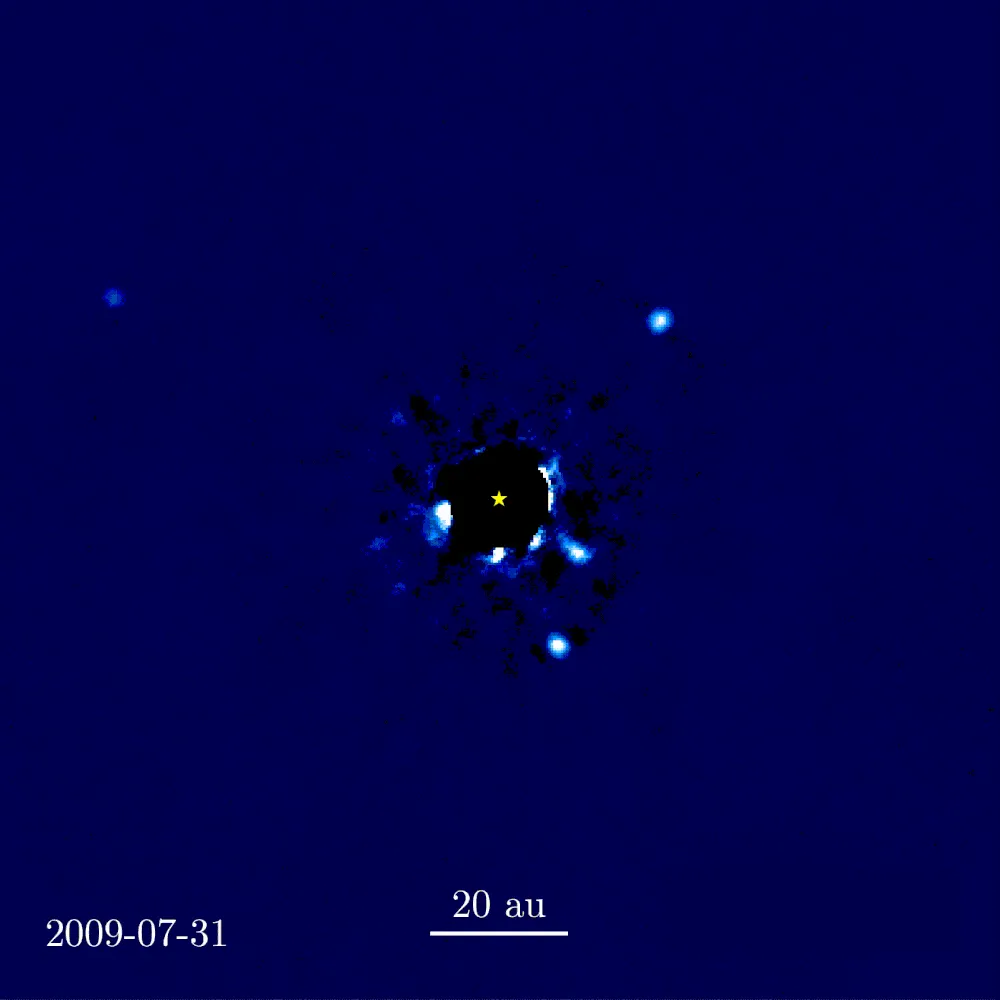
The astronomical community has achieved a major breakthrough. A research team, utilizing NASA’s James Webb Space Telescope (JWST) in conjunction with the European Southern Observatory’s (ESO) Very Large Telescope (VLT), has successfully performed direct imaging of the exoplanet "Beta Pictoris d," located approximately 63 light-years from Earth. The findings, officially published in *The Astrophysical Journal*, not only confirm the planet's existence but, through high-resolution imaging data, reveal physical characteristics that make it appear dimmer than its sibling planet, "Beta Pictoris b." This discovery provides critical clues for understanding the evolution of planetary systems.
Exoplanets are planets that orbit stars outside our solar system. Since the first confirmation of planets orbiting a pulsar in 1992, astronomers have discovered over 6,300 exoplanets in the vast universe. For a long time, the primary detection methods relied on the "transit method" or "Doppler spectroscopy." However, these indirect observational techniques suffer from significant detection biases, often limited by planetary size and distance from the host star, which skews findings toward massive planets orbiting very close to their stars. This direct imaging of the Beta Pictoris system overcomes the limitations of traditional techniques, allowing scientists to capture faint planetary signals directly, which is vital for constructing complete dynamical models of planetary systems.
The Beta Pictoris system has long been a focal point for the astronomical community as a "laboratory" for studying planet formation. The system is exceptionally young, and residual gas and dust in the circumstellar disk continue to shape its planetary architecture. Through these observations, researchers found that planet "d" is not only dimmer than its neighbor "b," but the differences in their mass, orbits, and formation processes reflect the diversity of material distribution within the protoplanetary disk. This study is more than an observation of a single planet; it is a profound exploration of how planetary systems are born, grow, and evolve from stardust, helping scientists estimate the probability distribution of tens of billions of potentially habitable planets in the Milky Way.
For Taiwan, although such astronomical observations primarily belong to the realm of basic science and do not directly overlap with its industrial supply chain, the underlying technological value is significant. The precision optical components, high-sensitivity sensors, and massive data analysis algorithms employed by the James Webb Space Telescope are hallmarks of modern cutting-edge technology. In recent years, Taiwan has actively invested in the development of the "Formosat" series of satellites and related supply chains, particularly in precision machinery, optical lens manufacturing, and space-grade electronic components. By tracking the development of top-tier international astronomical observation technology, Taiwan’s industrial and academic sectors can not only gain experience in signal processing and precision remote sensing but also evaluate domestic competitiveness in aerospace optics and data processing, laying a technical foundation for participation in future international space science collaborations.
Produced by our editorial team, with AI assistance in editing.
