
SpaceX's Starship Achieves Major Breakthrough in 13th Flight Test with Satellite Deployment, Water Landing Success.
SpaceX, a US space exploration technology company, has achieved a major breakthrough with its "Starship" rocket's 13th test flight mission at its Texas-bas
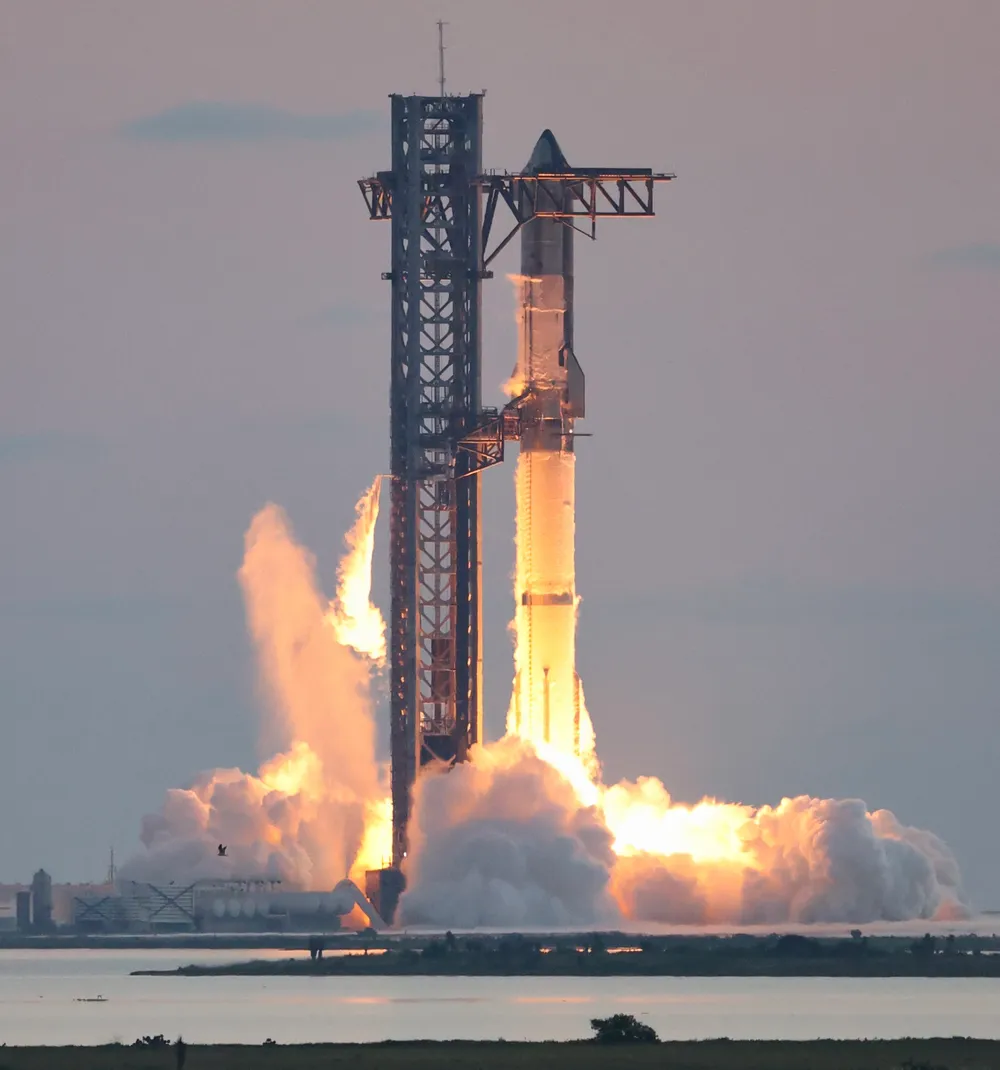
SpaceX, a US space exploration technology company, has achieved a major breakthrough with its "Starship" rocket's 13th test flight mission at its Texas-based Starbase facility. This recent test flight not only successfully deployed a practical Starlink satellite into orbit for the first time, but the Starship spacecraft also successfully touched down in a designated area of the Indian Ocean after experiencing high temperatures during re-entry into the atmosphere, paving the way for a new milestone in the development of heavy lifting vehicles.
Comprising the "Super Heavy" first stage booster and the "Starship" second stage spacecraft, the Starship system currently under development is the world's largest fully reusable heavy-lift launch vehicle system. Both segments of the rocket utilize liquid methane and liquid oxygen as propellants. SpaceX's ultimate goal is to enable both segments of the rocket to return to the launch site after completing a mission and be vertically recovered and rapidly refurbished using the launch tower's mechanical arm, thereby significantly reducing the cost of space transportation and eventually replacing the current Falcon 9 and Falcon Heavy rocket series.
Since the development project began, the Starship's testing process has not been smooth sailing, with multiple explosions and technical corrections along the way. However, as the number of flights increases, SpaceX has continued to optimize flight control, thermal brick configuration, and engine restart technology based on real-world data. This latest 13th test flight's success, particularly the first-time verification of satellite payload deployment capabilities and damage-free ocean recovery, marks a new stage for the Starship system, which is designed to be the world's highest payload capacity and fully reusable launch system, transitioning from a purely test flight vehicle to a commercially viable and operational verification phase.
In line with SpaceX's long-term planning, the Starship is set to not only deploy a large number of next-generation Starlink satellites but has also been selected by NASA as a key spacecraft for the Artemis lunar landing program, with plans to carry out manned missions to the moon and further afield to Mars. However, achieving these cross-generational goals will require overcoming frequent in-orbit propellant replenishment and other technical challenges, as well as ensuring system stability while pursuing high-frequency launches, a pressing concern in the international space community.
For Taiwan, the rapid progress of SpaceX in commercializing the Starship and deploying a large number of low-Earth orbit satellites is reshaping the global satellite communications and space industry landscape. Taiwan's long-established semiconductor, precision machinery, and network device suppliers have played an important role as key component providers in the international space industry. The success of the Starship's testing and commercialization not only foretells the greater proliferation of low-Earth orbit satellite communication services but also directly impacts Taiwan's related technology industries in terms of future orders and technological upgrades in the next-generation global space economy.
Produced by our editorial team, with AI assistance in editing.