
Rare Martian meteorite Teghaza 001 dated to 4.1 billion years old
Researchers have announced that a rare meteorite discovered in the Sahara Desert of Mali in 2022, designated Teghaza 001, has been dated to approximately 4
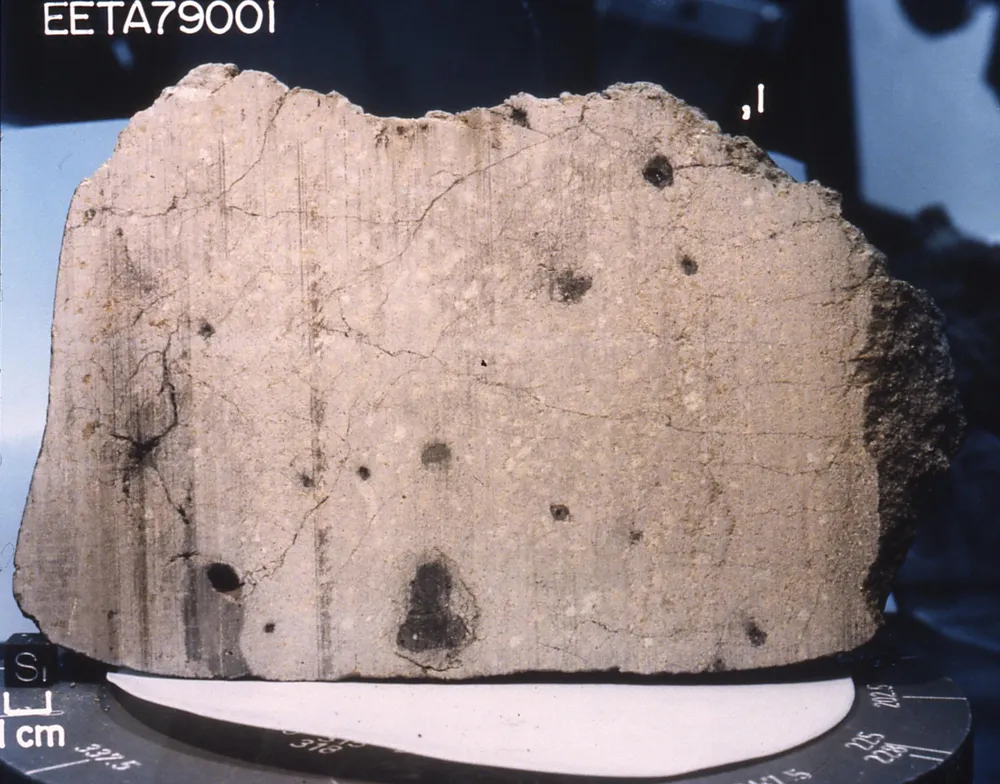
Researchers have announced that a rare meteorite discovered in the Sahara Desert of Mali in 2022, designated Teghaza 001, has been dated to approximately 4.1 billion years old. The finding places this piece of planetary debris among the oldest known fragments of Martian crust ever recovered on Earth, offering a pristine window into the early geological history of the Red Planet during an epoch when liquid water may have been abundant on its surface.
Teghaza 001 belongs to an exceedingly rare class of extraterrestrial rocks. Out of the more than 72,000 meteorites officially classified by scientists worldwide, fewer than 300 have been identified as originating from Mars. These samples are formed when massive asteroid or comet impacts blast rock off the Martian surface, sending the debris into an interplanetary trajectory that eventually intersects with Earth's orbit.
Scientists confirm the Martian origin of these meteorites by comparing their trapped gas bubbles, mineralogy, and isotopic signatures against data gathered directly from the Martian atmosphere and surface by decades of spacecraft, orbiters, and roving laboratories. Martian meteorites are broadly categorized into three main groups—shergottites, nakhlites, and chassignites, collectively known as SNC meteorites—alongside a small number of ungrouped specimens that defy standard classification.
The dating of Teghaza 001 to 4.1 billion years ago is particularly significant because it corresponds to the planet's Noachian period. During this ancient geological era, Mars possessed a dense atmosphere and a volatile-rich surface capable of sustaining widespread aqueous activity. By analyzing such ancient, pristine fragments in terrestrial laboratories using advanced mass spectrometry, planetary scientists can bypass the technological limitations of remote robotic exploration and reconstruct the thermal, chemical, and magnetic evolution of early Mars.
While space exploration often feels detached from terrestrial affairs, the scientific study of meteorites like Teghaza 001 underpins the global framework of planetary defense, advanced materials analysis, and deep-space telemetry. As space agencies across the globe, including those in the Indo-Pacific, increasingly invest in lunar and Martian exploration programs, analyzing these natural probes provides critical baseline data for future sample-return missions and the search for ancient extraterrestrial biosignatures.
Produced by our editorial team, with AI assistance in editing.
