BepiColombo Begins Final Cruise Maneuvers Ahead of Mercury Orbit Insertion
The European Space Agency’s Mercury Planetary Orbiter and Japan’s Mio Mercury Magnetospheric Orbiter have entered the final phase of their eight‑year journ
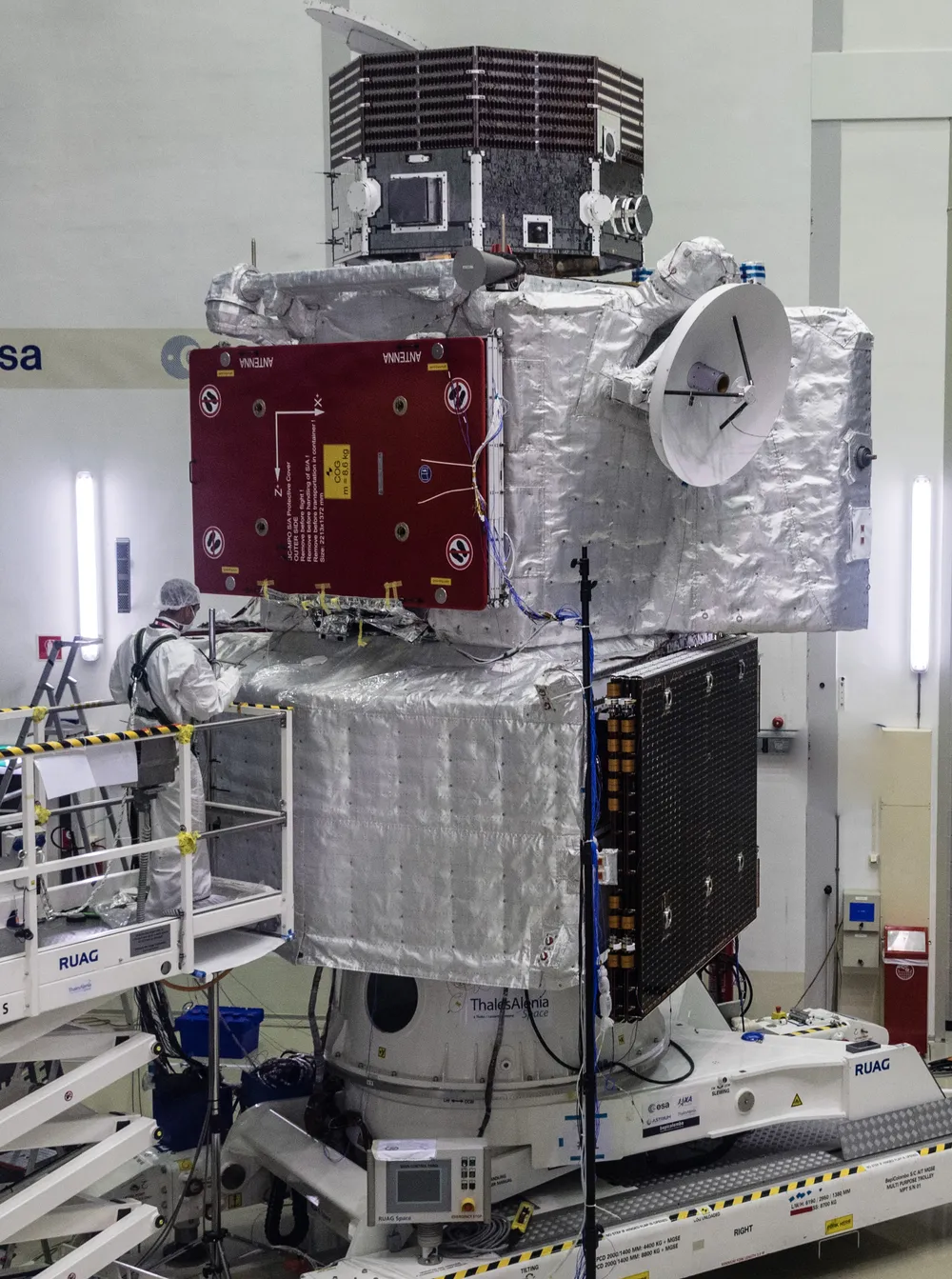
The European Space Agency’s Mercury Planetary Orbiter and Japan’s Mio Mercury Magnetospheric Orbiter have entered the final phase of their eight‑year journey, beginning the sequence of maneuvers that will place both spacecraft into orbit around Mercury. The “final mission”—a series of burns that will separate the two orbiters and jettison the remaining transfer hardware—commences on 1 September 2026, roughly a year before the planned Mercury orbit insertion in December 2027. The operation marks the culmination of a complex cruise that has taken the combined BepiColombo stack from an Ariane 5 launchpad in French Guiana, past an Earth‑gravity assist in 2020, and through a series of solar‑powered electric thrusts that have gradually lowered its trajectory toward the innermost planet.
BepiColombo is a joint venture between ESA and the Japan Aerospace Exploration Agency (JAXA), reflecting a partnership that began in 2010 when the two agencies signed a cooperation agreement to share scientific goals, engineering responsibilities, and mission costs. ESA built and operates the Mercury Planetary Orbiter (MPO), which will map Mercury’s surface, study its geology and exosphere, and carry a suite of instruments to probe the planet’s composition. JAXA contributed the Mio (formerly the Mercury Magnetospheric Orbiter, MMO), a smaller spacecraft focused on measuring Mercury’s magnetic field and magnetosphere. Both orbiters were launched together on an Ariane 5 rocket on 20 October 2018, riding atop a Mercury Transfer Module (MTM) that supplied solar electric propulsion for the cruise phase and a Sunshield and Interface structure (MOSIF) that protected Mio from intense solar radiation until deployment.
The mission’s architecture required a “stacked” configuration during most of the cruise, with MPO on top, Mio attached beneath, and the MTM and MOSIF forming the lower layers. As the spacecraft approached Mercury, the MTM was jettisoned to reduce mass before the critical orbit‑insertion burn. The upcoming final mission will see MOSIF detached from MPO, allowing Mio to separate and rotate into its own orbit. ESA and JAXA have coordinated closely on the timing and sequencing of these events, each agency retaining responsibility for its own spacecraft while sharing telemetry, navigation data, and contingency planning. Both agencies have emphasized the scientific payoff: a comprehensive view of Mercury’s magnetic dynamo, its ultra‑thin exosphere, and the planet’s interior structure, which together could illuminate how terrestrial planets form and evolve.
Funding and technical risk have been central themes throughout the project. The combined cost, estimated at €1.65 billion (US$1.86 billion) in 2017, was split roughly equally between ESA’s member states and JAXA, with contributions also coming from national space agencies and industrial partners. The long cruise demanded reliable solar‑electric propulsion and robust thermal protection, leading to several design revisions and schedule adjustments, notably the postponement of the original 2023 orbit‑insertion window to 2027. Both agencies have highlighted the mission’s role in sustaining Europe’s and Japan’s independent deep‑space capabilities, positioning them as partners rather than competitors in a domain increasingly dominated by the United States, China, and emerging private actors.
The final maneuver, while technical in nature, carries broader implications for the global space sector. Taiwan’s semiconductor industry, a cornerstone of modern spacecraft electronics, supplies many of the high‑frequency, radiation‑hard components used in ESA and JAXA missions. Successful completion of BepiColombo’s orbit‑insertion will showcase the reliability of such components under extreme conditions, reinforcing confidence in supply chains that include Taiwanese manufacturers. Moreover, the mission’s data on Mercury’s magnetic environment will inform future solar‑proximity missions, potentially shaping the design of next‑generation probes that could involve collaborative ventures with Taiwanese aerospace firms. As the world watches BepiColombo’s final steps toward Mercury, the operation underscores how multinational cooperation and interlinked industrial ecosystems can achieve scientific milestones that no single nation could easily attain alone.
Produced by our editorial team, with AI assistance in editing.