
Alexandru Ioan Cuza University
Romania · Europe
About
The Alexandru Ioan Cuza University (Romanian: Universitatea "Alexandru Ioan Cuza"; acronym: UAIC) is a public university located in Iași, Romania. Founded by an 1860 decree of Prince Alexandru Ioan Cuza, under whom the former Academia Mihăileană was converted to a university, the University of Iași, as it was named at first, is one of the oldest universities of Romania, and one of its advanced research and education institutions. It is one of the five members of the Universitaria Consortium (the group of elite Romanian universities). The Alexandru Ioan Cuza University offers study programmes in Romanian, English, and French. In 2008, for the third year in a row, it was placed first in the national research ranking compiled on the basis of Shanghai criteria. The university is a member of some of the most important university networks and associations: the Coimbra Group (CG), Utrecht Network, European University Association (EUA), International Association of Universities (IAU), University Agency of Francophony (AUF), and the Network of Francophone Universities (RUFAC).
Iași has a long tradition in higher education, the first institute that functioned on the territory of Romania was Academia Vasiliană founded in 1640 by the Moldavian Prince Vasile Lupu, followed, in 1707, by Princely Academy of Iași. The Princely Academy (renamed, in 1812, The Academy of Filology and Science) matched up to the standards of the other European Academies of the time and the Romanian language gained importance over the Greek language. The foundation, in 1835, of the Academia Mihăileană is considered a landmark in the history of Romanian higher education. The Academia Mihăileană was created under the auspices of Prince Mihail Sturdza (hence its name), striving for progress and for "meeting the standards of the enlightened Europe". Three faculties were set up: the Faculty of Law, the Faculty of Philosophy and the Faculty of Theology and the curriculum resembled to a great extent that of Austrian and German academies. After the Unification of the Romanian Principalities of Moldavia and Wallachia by the Prince Alexandru Ioan Cuza, the inauguration, at 26 October 1860, of the University of Iași, the first Romanian modern university, was to be a stepping stone to modern higher education in Romania. By 1879, the University of Iași had four faculties: Law, Letters and Philosophy, Sciences, and Medicine. In 1892, the Faculty of Sciences added the Department of Organic and Inorganic Chemistry, followed by the Department of Agricultural Chemistry, in 1906, and the School of the Industrial Electricity, in 1910. In March 1937, the technical higher education departments and the Faculty of Agricultural Sciences were transferred to the newly established Gheorghe Asachi Polytechnic School, and in 1948, the Medical School became the independent Institute of Medicine and Pharmacy of Iași.
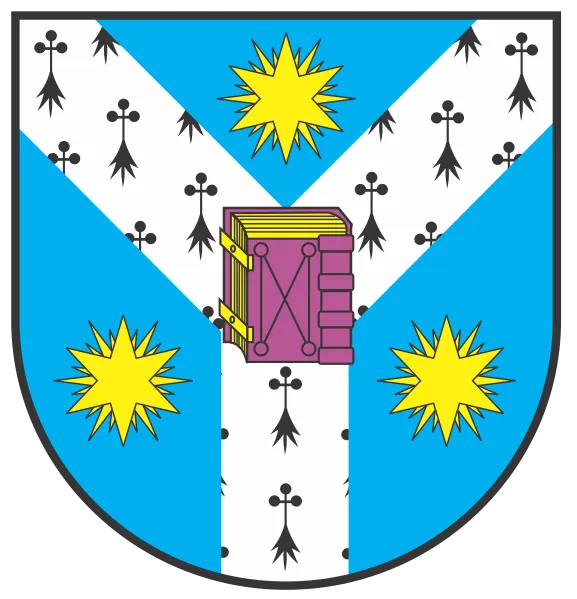
Its coat of arms with the Y-shaped heraldic pall symbolizes the three initiatives which led to the foundation of the university: the Academia Vasiliană, the Academia Mihăileană, the University of Iași. The central element is the Bible, the classic emblem of higher education. The three shiny stars stand for the three faculties of the university at its foundation moment, Philosophy, Law and Theology, on blue and argent background, the same colors used on the Cuza family shield.
The university grounds lie on Copou Hill in the northern part of the city. The main university building, known as the University Palace, was erected between 1893 and 1897, and extended in 1933–1937, on the site of the first Iași National Theatre which had burned down in 1888. The Hall of the university, known as The Hall of the Lost Footsteps, served as a parliamentary debating chamber between 1917 and 1918 when, during the Great War, Iași was the capital of Romania. In 1968–1978, the painter Sabin Bălașa created a series of strongly romanticized frescoes for the arcades. The University Palace is shared with the Gheorghe Asachi Technical University.
Adapted from Wikipedia (CC BY-SA). Photography via Wikimedia Commons.