
Weather
Travel topic
Weather can motivate a journey, but also put it at risk.
General precaution
The best advice for travellers is to first research the climate of your destination; if any risk of severe weather is the norm for the time period that you travel, you are advised to prepare for unpredictability regarding the weather. This has become more important in the 21st century, as the climate change has upset weather patterns. The predicted weather on your travel plan may only come out at the earliest 2 weeks before your travel and becomes more accurate only as the day gets closer, so you should plan ahead while at the same time be flexible, especially on where to go and what to wear.
As weather can change somewhat on a day-to-day or even hour-to-hour basis, check the weather forecast for your destination before and during your travel to be aware of any forthcoming weather threats on your destination, using either local TV and radio or your smartphone app. While television weather forecasts may be shown in different languages, their weather symbols (those that indicate for example sunny, rainy, or partly cloudy weather) are usually comprehensible. There are also radio stations which just transmit weather forecasts; Canada and USA reserve seven frequencies (162.4 to 162.55MHz in 0.025MHz steps) for weather radio, there's also one channel reserved on marine VHF radio for marine weather. Most of the world uses Celsius and millimeter as their temperature and precipitation intensity, respectively, while the USA uses Fahrenheit and inches. A few countries with close ties to the U.S. (Bahamas, Cayman Islands, Liberia, Palau, The Federated States of Micronesia and Marshall Islands) also use Fahrenheit. See metric and imperial equivalents for details and conversions between these measurement systems. One inch of precipitation equals to 25mm (2.5cm) of liquid in the rain gauge, higher amounts mean that more rain is falling and severe weather may be happening. Many weather forecasts also use the overly complicated unit "liters per square meter", which they seem to think sounds more intuitive than "millimeter", but the two units are exactly the same with the former just being a roundabout way to express the latter. Marine and aeronautical forecasts are likely to us
Geography
The world can be divided between climate zones, with local variations due to landforms. Coastal regions have modest temperature variations, but tend to have more wind and precipitation than inland regions. Mountains and highlands are usually colder than lower lands, and can have more wind and precipitation.
Cyclone
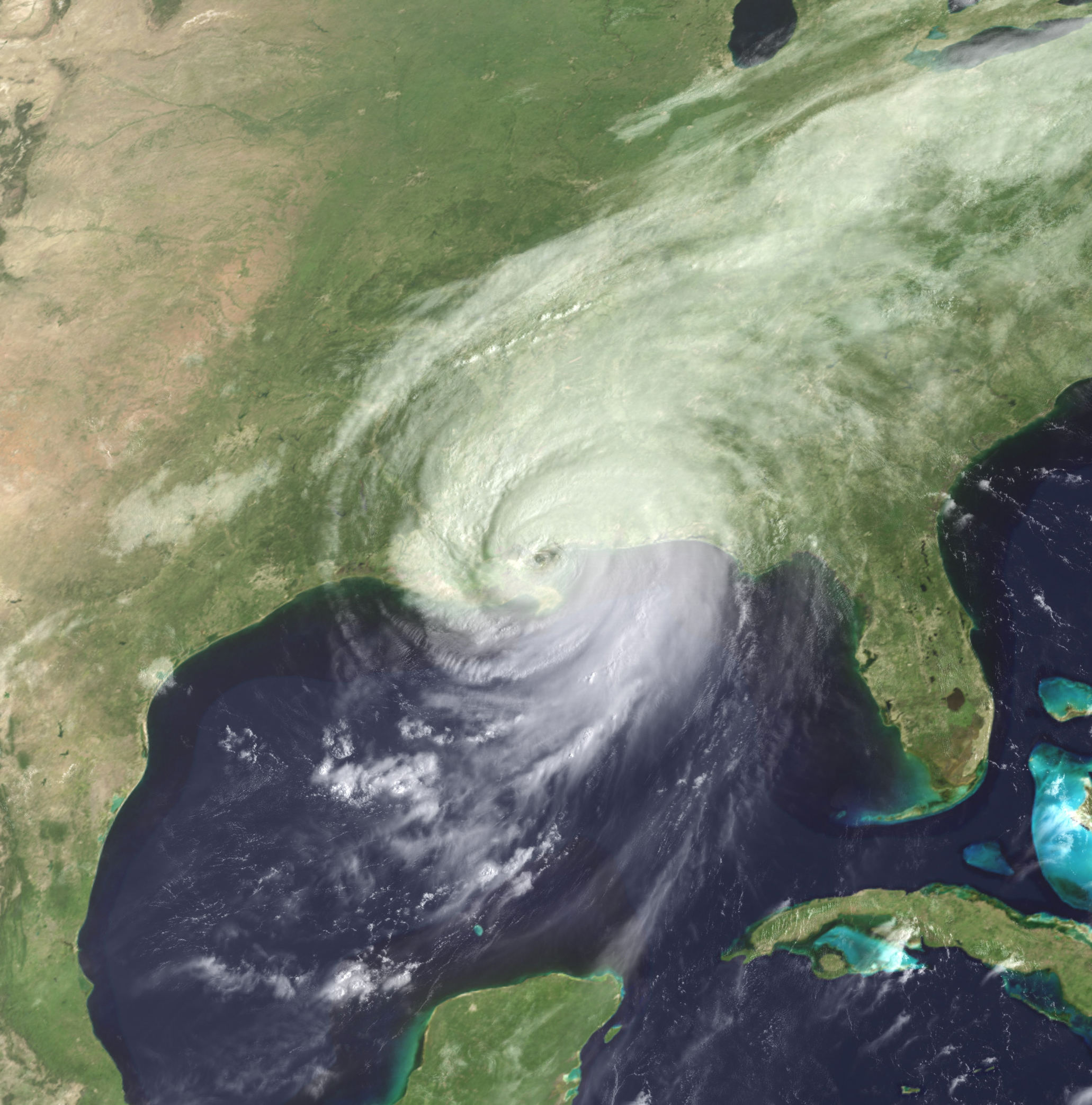
A cyclone, also known as a hurricane (in the Americas) or typhoon (in Asia and Oceania), is an organized rotating precipitation system packed with damaging winds and heavy rain. Effects include but are not limited to: windstorm, very heavy rain which can lead to widespread flooding and mudslides, thunderstorms, and high waves. They occur mainly in tropical and subtropical regions, but there are also extratropical cyclones that occur far from the equator, often as remnants of a tropical cyclone. Cyclone wind speeds vary from tropical storm winds to category 5 storms, which can have winds above 170 miles per hour (76 m/s). Generally, cyclones lose energy once they hit land, but they can still cause great damage along coastlines and, in some cases, inland areas. Cyclones form in the oceans and usually travel west until they reach land.
Thunderstorm
Thunderstorms are storms with lightning and the associated thunder, but dangers include heavy rain, strong gusty wind and possibly hail. While most lightning strikes from inside or between clouds, some does hit the ground and causes a wide range of effects from electric damage to fires and death of persons hit. A sometimes dangerous occurrence in a thunderstorm is hail. Hail occurs when solid balls of ice (hailstones) fall to the ground during a thunderstorm; while hail is not usually dangerous due to its small size, hailstones can sometimes reach the size of golf balls, and if they reach this size they can shatter car windshields and knock people unconscious. When there is a threat of hail, get yourself and all of your belongings indoors as soon as possible, and do not go near windows or openings while inside that indoor space.
Tornado
In some places, particularly in the Great Plains region of the United States, you can get tornadoes in a thunderstorm. Tornadoes are extreme winds that spin in a small area, and blow everything near them inward and upward. Tornadoes typically come with little warning, and they are powerful enough to destroy houses. Tornadoes are easy to spot during the day but harder to spot during the night. However, if you notice a funnel reaching downward from a dark cloud or you see objects flying, you are probably about to see a tornado. Also, hail often occurs before a tornado. If you know there is a high chance of tornadoes but it is nighttime and you can't see any, follow the weather forecasts on TV or radio. Sometimes, sirens will give warning of a tornado in the vicinity, in which case you need to seek shelter immediately. The best places to be when inside are in interior rooms (such as hallways or windowless basements) with as few doors as possible and no windows and as few large pieces of furniture as possible, such as dressers, bookshelves, or credenzas, as these may fall on you. Note that no room is entirely safe as tornadoes have the power to rip off roofs and in some cases floors. If outside, get inside as quickly as possible, driving to the nearest viable option if necessary, avoid trees, loose items (like farming equipment),
Fog
Surprisingly, fog is the most lethal kind of weather in some parts of the world. The deaths are usually caused by traffic accidents that become much more likely when visibility is reduced. In the same way, fog can be lethal in places where you must find your way or watch your step, for instance mountain environments. Fog is most common in the early morning just before sunrise, though there are places where fog is most common during other parts of the day. When driving a car in fog, go slow. If fog is very thick, you might need to wait it out. Sometimes there is fog only in valleys or by bodies of water; when driving downhill visibility can be abruptly reduced unless you are alert. With a boat, mooring in a safe place is the best option, but if that is not possible you have to quickly note your position and keep track of your movement, especially if you do not have a GPS. Remember your fog signals, avoid shipping lanes and choose a route that is safe in these circumstances. GPS does not show other vessels; even a radar shows only some of them. There are variants of fog that are extra nasty. Smog is smoke plus fog, generally found in areas with heavy industry or where coal is used for domestic heating as in parts of northern China. It can be particularly bad if there is an inversion in the atmosphere, for example around Los Angeles cold air coming in off the Pacific sometimes forms a layer that seals off the air below it so that smoke cannot escape. Vog is volcanic smog, water droplets with dissolved gasses from an eruption, sometimes with dust as well. The main gas is sulphur dioxide which combines with water to form a strong acid, so vog is seriously irritating to eyes and throat; with heavy exposure or for vulnerable people, it can even be fatal.
Floods
Sometimes, large amounts of rain occur within short amounts of time, causing floods that rise very quickly. These can be extremely dangerous and are called flash floods. As a general rule, if weather forecasts predict very heavy rains in the near future, or a flash flood has already started, get to high ground as soon as possible. Also, avoid rivers or camping in narrow canyons during the times of the year when heavy rainstorms or thunderstorms are likely, since these can flood very quickly. There are risks involved also in more slow flooding. You have some time to prepare, but if the roads around you are flooded you may not be able to leave. Driving in flood wa
Adapted from Wikivoyage (CC BY-SA)