
Thai phrasebook
Phrasebook
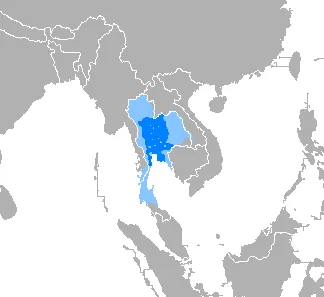
Thai (ภาษาไทย phaasǎa Thai) is the official language of Thailand, and also spoken by the Thai diaspora around the world.
Pronunciation guide
Thai is a tonal language of five tones: Mid, Low, Falling, High, and Rising. Meanings may change critically based on tone, yet Thais are fairly used to hearing foreigners mangle their language and can often work out the correct tone based on context. Try not to inflect your sentences; particularly, any questions should be pronounced as flat statements, without the rising intonation ("...yes?") typical of English questions. The Thai written language is essentially alphabetic, but notoriously difficult to read due to a profusion of 44 consonants (many redundant), complicated tone and vowel signage around consonants, and a complete lack of spaces between words. It is an Indic script related to the Burmese, Lao and Khmer scripts, as well as to those of most Indian languages. Like other Indic scripts, the Thai script is an abugida, meaning that each letter represents a consonant, and vowels are indicated by modifications to the consonant letter (e.g. with a diacritic mark) or lack thereof.
Vowels Thai has a complicated set of vowels and diphthongs that distinguishes between vowel length (short and long) and vowel position (front and back). In Thai script, vowel signs are always written around consonants and the letter ก (k) is used here to demonstrate. This list follows the Royal Thai General System of Transcription (except that some long vowels are doubled).
ka กะ like 'a' in "car" (short vowel) kaa กา like 'a' in "father" (longer than "a") kae แก like 'a' in "man" (short vowel: "แกะ") ke เก like 'e' in "bed" (short vowel: "เกะ") ki กิ like 'y' in "greedy" kii กี like 'ee' in "see" (longer than "i") ko กอ like 'o' in "torn" (short vowel: "เกาะ") ko โก like 'oa' in "moan" (short vowel: "โกะ") koe เกอ like 'i' in "sir" (short vowel: "เกอะ") ku กุ like 'oo' in "hoop" kuu กู like 'ue' in "blue" (longer than "u") kue กือ frontal version of "u" (akin to German "ü", French "du", not found in English) (short vowel: "กึ") kam กำ like 'um' in "dummy" kai ใก/ไก like 'i' in "kind" kia เกีย like 'eer' in "beer" (but don't pronounce "r") kua กัว similar to 'ou' in "tour" (but don't pronounce "r") kuea เกือ like "ue" followed by a short "a" kao เกา like 'ow' in "cow"
Consona
Grammar
Basic Thai grammar is fairly straightforward. Word order is subject-verb-object, as in English. Nouns and verbs do not change, and there are no plurals or grammatical genders. Instead, a wide array of particles and markers are employed to indicate past tense, negation, etc.
phom kin khao ผมกินข้าว "I eat rice" Adjectives are placed after the noun, not before.
phom kin khao suai ผมกินข้าวสวย "I eat rice cooked" (I eat cooked rice) The negation marker ไม่ mai goes before the verb.
phom mai kin khao ผมไม่กินข้าว "I not eat rice" (I will not eat/am not eating rice) The past tense marker แล้ว laew goes after the verb and its object (if any).
phom kin khao laew ผมกินข้าวแล้ว "I eat rice already" (I ate rice) Pronouns are often omitted if it's clear from the context who is doing what.
Phrase list
Note that the polite suffix ครับ khráp (for men) and ค่ะ khâ (for women) can and should be attached to all phrases when talking with strangers. The suffix depends solely on your gender. Also note that the pronoun for "I" is ผม phǒm for men and ดิฉัน di-chǎn for women. When addressing people, คุณ khun is a safe, respectful all-purpose equivalent to "Mr/Ms/Mrs". People you're familiar with can be addressed as พี่ phii (if they are elders) or น้อง nong (if they are younger). These are always used with first names, so your business partner Supachai Sakulwattana is khun Supachai and your secretary Nipaporn Khampolsiri is nong Nipaporn. Surnames are generally not used to address people in Thailand. All Thais also have short nicknames, but these are only used informally. The closer two friends are, the less often you will hear ครับ khráp and ค่ะ khâ being spoken. This is especially prominent in the lower and middle classes, but is a general trend. This can be compared to western languages, where adding "Sir" at the end of each sentence when speaking to somebody in authority is becoming less and less common, and already entirely removed in many languages. On another note, there is a trend among the upper and middle classes, especially among younger men, to call each other phii, no matter the age difference. This is part of greater age equality in Thailand.
Greeting and leave-taking Hello. (informal) สวัสดี (sa-wat-dii) Hello. (polite, speaker is male) สวัสดีครับ (sa-wat-dii, khráp) Hello. (polite, speaker is female) สวัสดีค่ะ (sa-wat-dii, khâ) Hello. (answering the phone) ฮัลโหล[ครับ/ค่ะ (haloh, khráp/khâ) How are you? สบายดีหรือ (sabaai-dii rue?) Fine. สบายดี (sabaai-dii) Fine, and you? สบายดี แล้วคุณล่ะ[ครับ/ค่ะ (sabaai-dii láe khun lá, khráp/khâ) Goodbye. ลาก่อน (laa kon) Goodbye (informal). สวัสดี[ครับ/ค่ะ (sa-wat-dii [khráp/khâ]) Happy New Year (1 Jan) : สวัสดีปีใหม่ (sa-wat-dii pii mai) Happy New Year (1 Jan) สุขสันต์วันปีใหม่ (suk san wan pii mai) Happy Valentine's Day สุขสันต์วันแห่งความรัก (suk san wan haeng khwam rak) Happy Songkran Day สุขสันต์วันสงกรานต์ (suk san wan songkran)
Basics
What is your name? คุณชื่ออะไร (khun chue arai?) My name is ______
Adapted from Wikivoyage (CC BY-SA)