
Sex segregation
Travel topic
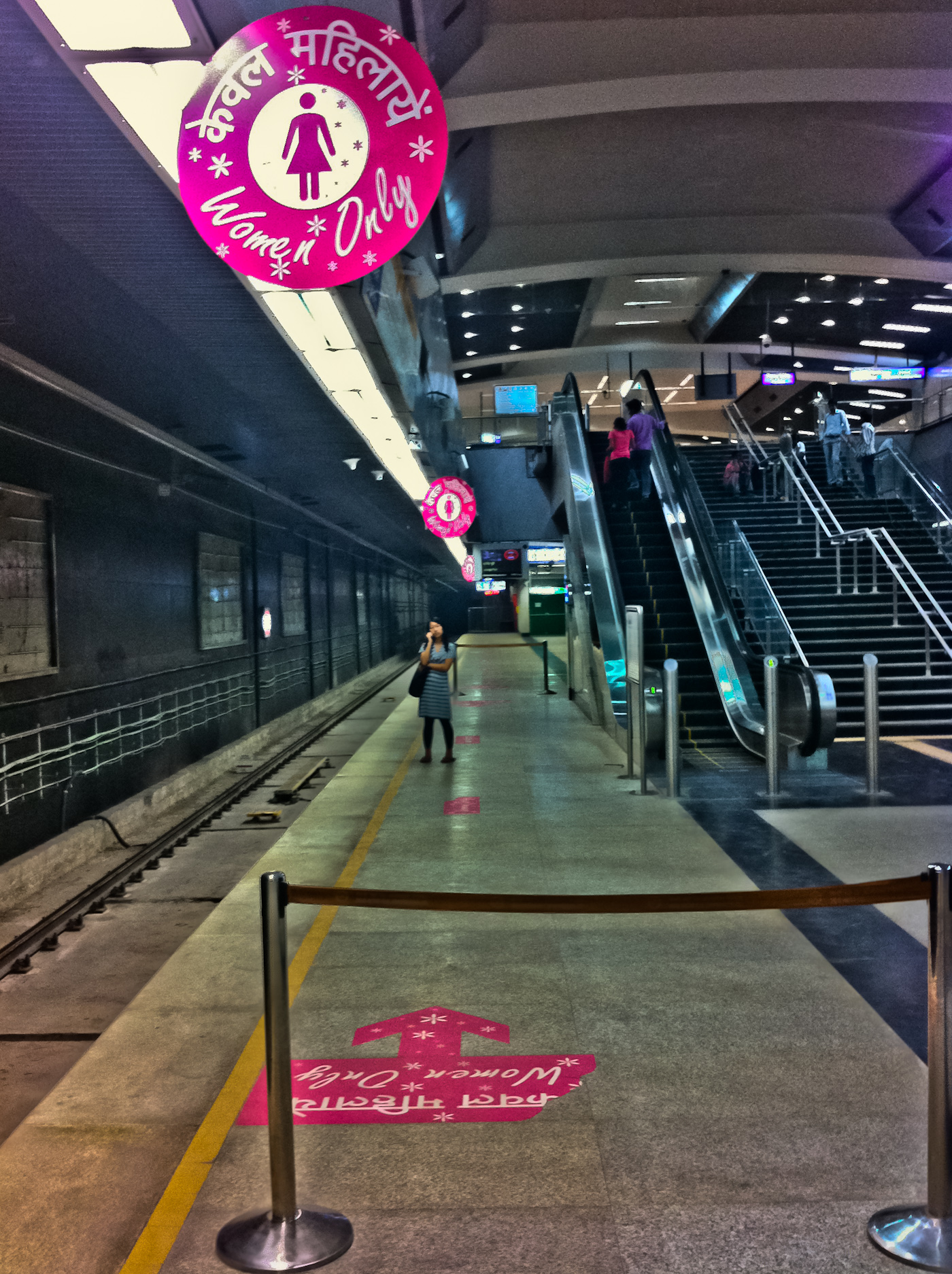
Sex segregation refers to the physical and spatial separation of people by sex in public or private places. Sex segregation is a global phenomenon; sex segregation or integration that is considered harmless or normal in one country can be considered radical or illegal in others.
Understand
In most countries there are generally understood rules on the interaction between men and women: how are you allowed to touch or look at a stranger of the opposite sex, are you allowed to use the same facilities? These sometimes unspoken but well-known rules can differ significantly from place to place, and signals can be misinterpreted. Rules for men and women are partly followed also by boys and girls. The relevant age limits vary by culture and context. Babies and toddlers are seldom considered, while adolescents are usually treated like adults. In Muslim majority countries, such unspoken gender rules typically do not apply to mahrams, i.e. family members one cannot marry due to consangamory restrictions. A traveller may commit faux pas in any culture different from their own; there may be surprising rules on segregation and interaction regardless of the overall level of segregation. In a country with little segregation, a woman could be totally fine with hugging a man she was introduced to the same day or dancing cheek to cheek with an until-the-dance stranger – but she could still be very much offended by the same man touching her in any but the accepted ways. Some women in such countries may even be uneasy with a male stranger sitting next to them in the bus, or sharing an elevator with no other people nearby. Be attentive to their signals, so as not to be intrusive. Also, a man forbidden from looking at women by his culture can get very uneasy when approached by a woman who does not follow the familiar patterns of behaviour. As a male traveller, you should probably just accept that you cannot interact with women in certain cultures. Asking a woman for directions may put her in an awkward situation: hospitality rules may require that she helps you, while talking to a male stranger can be interpreted as forbidden mingling. Looking at a women can have similar issues: already by involuntarily attracting your attention, she may be seen as less moral. Familiarise yourself with local norms and be very keen-eared to signals of people around you. There may be a discrepancy between the legal or community-enforced rules and what people in general or some people thin
Other countries
In less segregated countries, it is not uncommon for a formally single-sex association to have some members of the opposite sex or invite groups with opposite-sex members to some events. For example, a girl guide troop may camp together with a boy scout troop, and some boys and girls may share tents during the camp while being expected to respect each others' privacy and keep their hands to themselves. In some states of Germany, a percentage of parking lots in favourable positions (guarded, near the exit) must be reserved for women, for their safety. In Sweden another approach has been taken: feminist snow removal was introduced in some municipalities, which meant that instead of first clearing the main streets to allow car traffic to flow, the first streets cleared were the minor ones, those used to lead children to daycare and to do daily grocery shopping. There are still single-sex schools in many countries where sex-segregation isn't commonly practised, although co-education has become the rule. The curriculum is usually the same in boys' and girls' schools in these countries. Some subjects, such as gymnastics or sexual health, may be taught separately, although coeducation in these subjects is common, too. Some more sex-segregated education is (controversially) proposed even in places like Sweden: would segregated lessons free girls from always playing a traditional female role, which might not suit all of them and might hamper their learning? Similarly for boys.
Brazil
In 2006, the Legislative Assembly of the State of Rio de Janeiro approved a law which enacted segregated areas on public transport for women, commonly known as “pink carriages.”
China
Women's mosques can be found in the provinces of Henan, Shanxi, Shaanxi and Hebei. As Islam has principles of segregating the sexes, many places of worship divide prayer space into two in the main building, but in a few countries such as China, separate buildings were constructed. At the end of the Ming dynasty and early Qing dynasty, Hui women had begun to form their own mosques. The oldest surviving women's mosque in China is Wangjia Hutong Women's Mosque of Kaifeng, which dates to 1820. As a result o
Some historic buildings
Some historic sex-segregated buildings as tourist attractions are:
Ladies Rest Room, Lewisburg (Tennessee) Andaruni of Tabatabai House, Kashan Andaruni of Qavam House, Shiraz Andaruni of Amir Nezam House, Tabriz Sabarimala Temple, Kerala For enthusiasts of heritage tourism there are many attractions in Japan. In Japanese architecture, the Ōoku (大奥, "great interior") refers to the women's quarters of Edo Castles, the section where the women connected to the reigning shōgun resided. The zenana of Akbar the Great (1542–1605), Fatehpur Sikri. The zenana of Akbar the Great was a resident for more than five thousand women forbidden for men Boudoir of Cannenburgh Castle (1543), Vaassen, Netherlands Boudoir of George Stephen House (1883), Montreal, Canada
Adapted from Wikivoyage (CC BY-SA)