
Northern Sámi phrasebook
Phrasebook
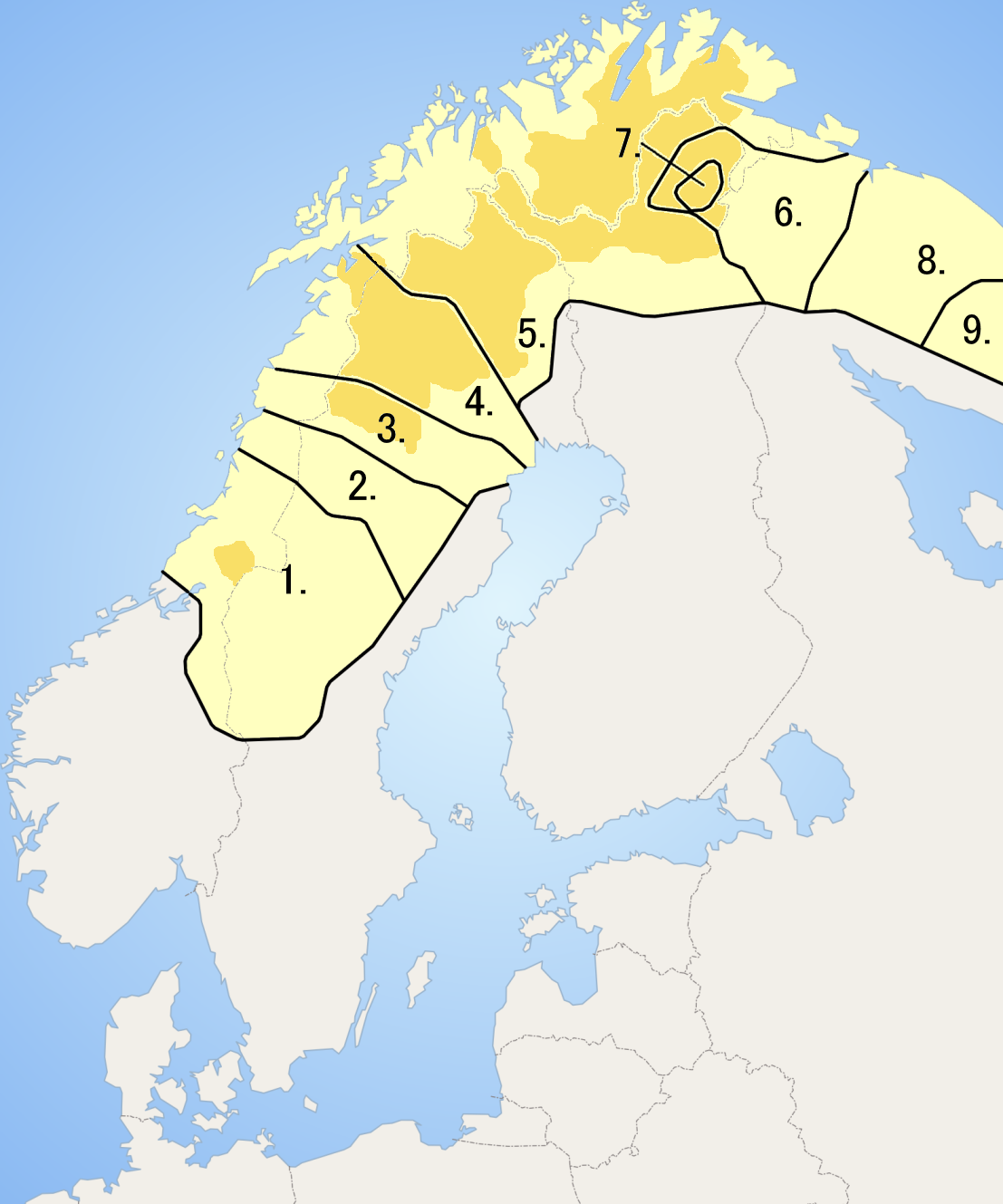
Northern Sámi (davvisámegiella), the Sámi language used in this phrasebook, is the most widely-spoken of the Sámi languages. It is spoken mainly in northern Norway, northern Sweden and much of the Sámi area in Finland. It is used often in towns such as Kiruna (Giron), Utsjoki (Ohcejohka), Kautokeino (Guovdageaidnu) and Karasjok (Kárášjohka). It also acts as a lingua franca among many Sámi who speak other Sámi languages.
Pronunciation guide
Like Finnish or Estonian, Sámi is written quite phonetically, with a certain letter mostly pronounced the same way and doubled letters meaning longer sounds. Northern Sámi uses the Latin alphabet with some extra letters, some of which are not found in Swedish, Norwegian or Finnish. The current writing system is from 1979, modified in 1985. Below are the vowels and consonants, with name of the letter (spelt in Sami) and normal pronunciation with IPA codes. The standard(ish) pronunciation used in textbooks follow Kautokeino dialect but in practice the learners will obtain their teacher's dialect. Stress is always on the first syllable. In longer words certain syllables get secondary stress which gives spoken Sámi a distinctive, nodding melody.
Vowels A Á E I O U
The letter á tends to be pronounced as a long, vivid a in the western dialects and like æ in the eastern dialects. There are short and long vowels in the language, but as they do not change the meaning of words these are never expressed in the written language, and the exact pronunciation depends on the speaker's dialect.
Consonants B C Č D Đ F G H J K L M N Ŋ P R S Š T Ŧ V Z Ž (NB: Đ đ in Sámi is a different letter from the Icelandic Ð ð and African Ɖ ɖ, although sometimes similarly looking.) The letter i is pronounced as a j if it is preceded by a vowel, whereupon it is considered a consonant. Letters đ, ŋ, ŧ, z, or ž never appear as the first letter in a Sámi word. Letters p, k, and t appear at the beginning of the word only in some, mostly Norwegian or Swedish, loanwords. In such cases they are strongly aspirated. For many of these words a more native-sounding version starting with b, g or d (e.g. kirku ~ girku, church) is also in use.
Exceptions: the letter t is pronounced as /ht/ if it is at the end of a sentence, and as /h/ if it is at the end of a word somewhere in the middle of a sentence. Letter d is pronounced as đ if it is between the second and third syllables. In addition, the letter combinations dj, lj, and nj are palatalized d, l, and n, respectively. Combinations hj, hl, hn, hm, and hr denote very rare unvoiced consonant sounds. In total there are a
Grammar
Being a member of the Uralic language family, Sámi grammar is quite different from that of any Indo-European language, such as English, Norwegian or Russian. On the other hand, if you are already familiar with Finnish, Estonian or Hungarian grammar you'll find learning any Sámi-group language quite reasonable and cosy. In Northern Sámi, nouns can be declined in six or seven different cases, the exact number depending on whether the genitive and the accusative are considered the same or not (they have different uses, but the forms differ only in a few words). Cases handle things like living in the North, going to the town or working with a friend. Cases are coded into suffixes (i.e. word endings) but they often cause some changes to the 'central consonants' and sometimes even vowels in the word itself. This phenomenon is known as consonant gradation and exhibits perhaps its most extensive form in Sámi languages. If you are studying the language by reading poems or song lyrics you'll encounter possessive suffixes, one of the iconic features of the Uralic language family. However, using them in normal speech is nowadays uncommon. Many adjectives have a separate attribute form which you must use if the adjective is an attribute to the noun. There are no rules on how the attribute form is formed from the adjective; you just have to learn them together with the adjective. When used as predicative the adjective follows the noun's case and number. Verbs have four tenses: present, preterite, perfect, and pluperfect. Perfect and pluperfect are formed in a similar way to English but using "to be" instead of "have". In fact, this is not a coincidence: it is a relic from close contact between Germanic language speakers and Finno-Samic tribes some 3000-3500 years ago! Verbs express also four moods: indicative, imperative, conditional, and potential. The optative mood, mentioned in some sources, is extremely rarely used form of the imperative. In modern-day speech, the potential mood (i.e. something is considered likely) is often used to indicate future tense (logical, as the events in future are always uncertain!) The word "no" is a verb and inflects with the person and mood
Phrase list
Basics Hello. Bures. ( ) Hello. (informal) Bures bures. ( ) Hello again Buorat ain ( ) How are you? Mo dat manná? ( ?) Fine, thank you. Dat manná bures, giitu. ( ) What is your name? Mii du namma lea? ( ?) My name is ______ . Mu namma lea ______ . ( _____ .) Nice to meet you. Somá deaivvadit. ( ) Please. Leage buorre. ( ) Thank you. Giitu. ( ) Thank you for everything (when leaving) Giitu buot buriid ovddas ( ) You're welcome. Leage buorre. ( ):. () Yes. Juo/Jo. ( ) No. Ii. ( ), in spoken language very often: a-a ( ) Excuse me. (getting attention) Ándagassii. ( ) / Gula... ( ) Excuse me. (begging pardon) Ándagassii. ( ) I'm sorry. Ándagassii. ( ) Goodbye Báze dearvan (to one person when leaving). ( ) Goodbye Báhcci dearvan (to two people when leaving) ( ) Goodbye Báhcet dearvan (to more than two people when leaving) ( ) See you! Oaidnaleabmai!( ) I don't speak Saami [well]. Mun in hála sámegiela. ( [ ]) Do you speak English? Hálatgo eaŋgalasgiela? ( ?) Do you speak Finnish/Swedish/Norwegian? Hálatgo suomagiela/ruoŧagiela/dárogiela ( ?) Is there someone here who speaks English? Hállágo giige dáppe eaŋgalasgiela? ( ?) Help! Veahket! ( !) Look out! Fárut! ( !) Good morning. Buorre iđit. ( ) Good afternoon Buorre beaivvi. ( ) Good evening. Buorre eahket. ( ) (Reply to any greeting above; To you also.) Ipmel atti. ( ) Good night. Buorre idjá. ( ) Good night (to sleep) Buorre idjá. ( ) I don't understand. Mon in ádde / ipmir. ( ) Where is the toilet? Gos hivsset lea? ( ?)
Problems
_____ doesn't work. _____ ii doaimma. Leave me alone! Atte mu leat ráfis! Don't touch me! Ale guoskka! I will call the police. Riŋgen poliissa. Police! Poliisa! / Boles! Stop! Thief! Bisán! Suola! I need your help. Darbbašan du veahkki. It's an emergency. Mus lea heahtti. I'm lost. Lean láhppon. I lost my bag. Mu lávka láhppui. I lost my wallet. Mu bursa láhppui. I'm sick / I've fallen ill. Lean buozus. I've been injured. Lean roasmmohuvvan. I need a doctor. Dárbbašan doaktára. Can I use your phone? Sáhtango riŋget? I need some mosquito repellant / a mosquito net Dárbbašan čuoikavuoiddas / čuoikaluvra
Numbers ½ - beal 0 - nolla 1 - okta 2 - guokte 3 - golbma 4 - njeallje 5 - vihtt
Adapted from Wikivoyage (CC BY-SA)