
Fine dining
Travel topic
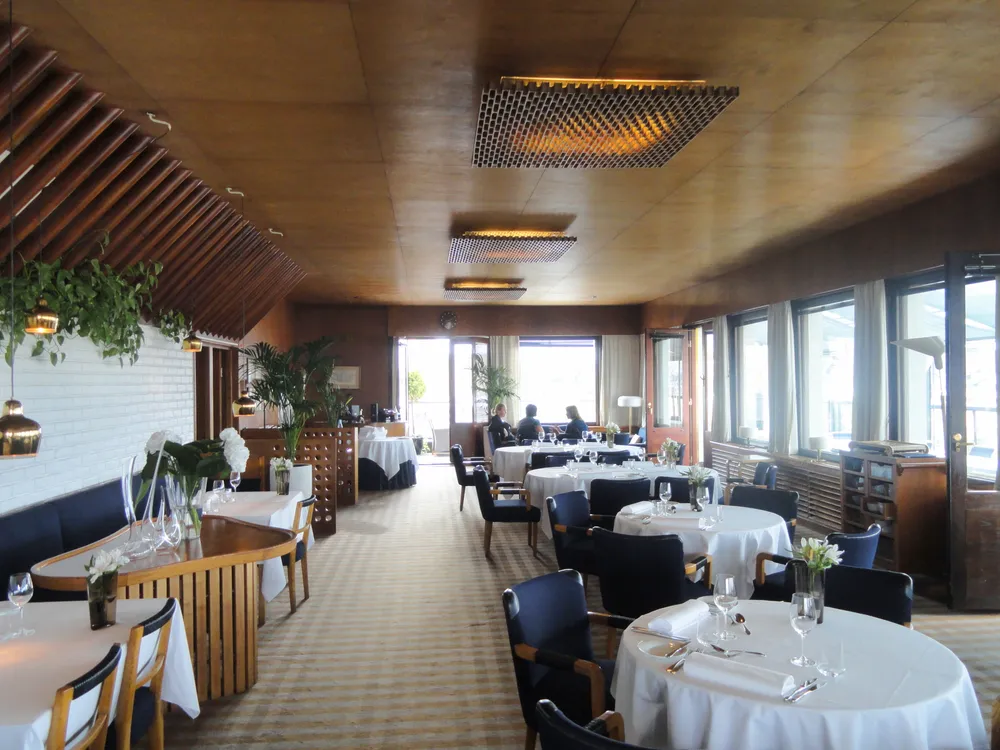
Fine dining is a particularly refined form of dining that focuses on the experience of dining: attentive table service, luxurious decor, premium ingredients, and an extensive wine list. The white tablecloth has become a symbol of fine dining, and these establishments are sometimes called white-tablecloth restaurants.
Understand
Despite what it may seem, fine dining is not synonymous with good food. Instead, it refers to a special form of dining experience that offers good food alongside stellar ambience and service. To maintain the ambience and show respect to the workers, many fine dining restaurants have a dress code, although the requirement to wear a suit and tie is much less common than in the 1960s. Fine dining restaurants often employ more creative chefs that create intricate dishes, but it's also common to be served surprisingly simple dishes meant to showcase the natural flavours of the ingredients. Many chefs of fine-dining establishments are international celebrities. They might be considered for guests prepared for a good dining experience, such as wedding guests, honeymooners and business travellers. Most high-end hotels, especially grand old hotels, have a fine dining restaurant. Some luxury tourist trains also serve fine dining meals on board, with some notable ones being Canada's Rocky Mountaineer, Australia's Ghan and Indian Pacific, India's Palace of Wheels and Maharajas' Express and South Africa's Blue Train and Rovos Rail. Both luxury dishes and more regular meals are expensive. In a high-income country such as the United States, a fine dining restaurant could charge $200 or more for a gastronomic menu with drinks, and $100 or more for a steak menu with house wine (which would be $40 or more in a chain restaurant), and if you're ordering wine à la carte, the sky's the limit. While fine dining can be nominally cheaper in low-income countries, it is much more expensive than casual dining. In Thailand, a fine dining menu can cost around 3,000 baht, while 300 baht would get you a full menu in a street-corner restaurant, and a simple meal at a local foodstall can go as low as 50 baht. While this isn't a hard and fast rule, fine dining restaurants will usually be table d'hôte, which means that you'll have to choose one of a few offered multi-course meals with fairly little choice in what's actually served to you. This can be anywhere from 3 to over 20 courses, although most places won't have any offerings with more than 15 courses. Besides these multi-course meals, many
Special ingredients
One of the things that differentiates high-end food from less expensive food that may also be delicious is the use of luxury ingredients, whether they are per se rare and delicious ones, difficult to prepare properly, or especially good, rare or fresh examples of more common classes of ingredients. They could be found in delis and market halls; see legacy food markets. Here follow some special items you may see on menus in some of the world's most reputable fine-dining restaurants:
Meat and poultry Pâté de foie gras is literally a pâté of fat liver, usually from a duck or sometimes a goose. If fat liver doesn't sound appetizing to you, try some anyway. It's uniquely rich and quite different from ordinary liver. However, some people have ethical objections to eating foie gras because the birds become fat by being force-fed, and the dish has been prohibited in some jurisdictions. Wagyu (和牛 wagyū) is a type of Japanese beef that has significant marbling with fat, with the highest A5 grade resulting in a "melt-in-your-mouth" texture. Perhaps the most internationally celebrated variant is Kobe beef (神戸牛 kōbe gyū), though there are numerous other celebrated variants that are found only in Japan and not exported such as Matsusaka beef (松阪牛 matsusaka gyū) and Omi beef (近江牛 ōmi gyū). Hanwoo (한우) is South Korea's answer to wagyu, and is the most sought after type of beef for Korean barbecue. Hoengseong County near the city of Wonju in Gangwon province is said to produce the best hanwoo beef.
Hams Various premium types of ham are traditionally produced in different regions of Europe, the United States and China, and these often feature as ingredients in fine dining.
Jamón ibérico, or Iberian ham, is a premium Spanish cured ham using a special breed of pig that is raised on a special diet. It is usually sliced off the bone and eaten raw, though it often also features as an ingredient in the appetizer courses of Western fine dining meals. The bone of the ham also often features as a soup base. The towns of Guijuelo near Salamanca and Jabugo in Huelva province are the best known in Spain for producing this delicacy, which is the most expensive type of ham in the world.
Drink
In European cuisines, wine has the highest regard among beverages, and many fine dining menus have a wine selected for each course. As mentioned above, a vintage wine can be the most expensive item on the menu. Dessert is usually accompanied by a sweet dessert wine, or distilled beverages such as rum, liqueur or cognac. Options without alcohol can be de-alcoholized wine or soft drinks. Beer is rarely served with fine dining, but can be considered to drink with an appetizer. A choice or tea or coffee is typically offered with dessert, or as a final dish with confectionery. In most of East Asia, tea is served with many kinds of meals, including fine dining. In traditional Japanese dining, sake can be served with a dish. Water served to fine dining can be a prestige brand of bottled water, unless you are in a place with excellent tap water, such as the Nordic countries.
Destinations
Europe
Fine dining in Europe originally stems from the culture of French cuisine, the royal courts and the aristocracy of Europe. The bourgeoisie copied this behaviour. With industrialisation the middle class followed and adapted fine dining to their status in society and their financial strength. Tableware in sterling silver, porcelain and crystal became means of fine dining for the well-off, and was also a practical investment, sometimes given as wedding presents in complete sets. During the 20th century fine dining was made affordable for the masses introducing mass-produced tableware of less expensive materials. Table manners are associated with fine dining. Historically, children dined at a separate table or even in a separate room with a nanny. Children are now welcomed at the table, but are expected to adhere to table manners as well. French table manners have now been adopted as the standard across all of Christian Europe from Iberia to the Caucasus, and in former European settler colonies such as the United States, Canada, Australia, New Zealand and what is today the Asian part of Russia. In the 18th century the French word gourmet was given as the reputable name for a connoisseur of delicious things that were not eaten primarily for nourishment. A gourmet chef is a chef of particularly high caliber of cooking talent and skill, and some of them are even celebrities. Gourmet dining or high-end dining restaurants in Europe has features like Michelin stars or renowned chefs. They can be in a historical building or have an exceptional view, are spacious with high-end interior design that matches the cuisine, and have a well assorted and extensive wine cellar. Features like a private dining room, dedicated smoker's lounge with cigars and perhaps live music for a closed dining company are also considered high-end dining. These features combined with a specific cuisine come at a premium. High-end restaurants often have dress codes, such as requiring a jacket and sometimes a tie from men and a formal dress from women. Ordinary fine dining in Europe is affordable to most, since it has the essentials: good food freshly cooked in an adjacent kitchen, tableware
Adapted from Wikivoyage (CC BY-SA)