
Dutch Low Saxon phrasebook
Phrasebook
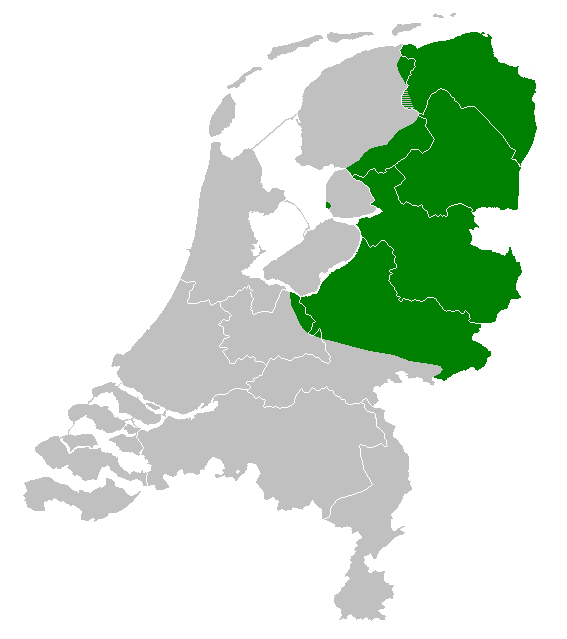
Dutch Low Saxon (Dutch Low Saxon: Nedersaksies, Dutch: Nedersaksisch) is a group of West Low German dialects spoken in the northeastern Netherlands. It is assumed to be the native language of between 1 and 2 million people in the Netherlands. Dutch Low Saxon is highly likely to be mutually intelligible with Low German; however, as each language is influenced by Dutch and High German, respectively, some misunderstandings are possible.
Difficulties
Since Dutch Low Saxon, like its counterpart across the German border, is not a unified language, it is often hard to find two people speaking the same version of Dutch Low Saxon. However, given its clear resemblance to Dutch and the fact that most people in the Netherlands were taught English, it won't be hard to be understood if you speak a poor Dutch Low Saxon. Communication is more likely to be in Dutch or even English, however the locals would be impressed seeing a foreigner talking with them in their own dialect.
Pronunciation
Dutch Low Saxon has some vowel sounds that are not known in many other languages so they may be hard to learn.
Short vowels a like 'a' in "calm", (but shorter) ä like 'e' in "pen" e like 'e' in "pen" or 'e' in "the" (at word endings) i like 'i' in "pin" o like 'o' in "fork" oe like 'oo' in "too" (but shorter) ö like 'e' in "mercy" u like 'u' in "put" y like 'i' in "pin" or 'ee' in "deep"
Long vowels a, aa like 'aa' in "Afrikaans" ä, ää somewhat similar to ee, like 'a' in "day" (without pronouncing the 'y'-sound at the end) e, ee like 'a' in "day" (without pronouncing the 'y'-sound at the end) eu similar to 'e' in "mercy" ie like 'ea' in "sea" o, oo like 'o' in "ago" oe like 'oo' in "too" ö, öö similar to eu, like 'e' in "mercy" u, uu like 'ü' in German "München"
Diphthongs au, ou like 'ow' in "how" ea, eai like the English 'yay' ei, i'j like 'ay' in "say" ieuw like 'ew' in "new" iew like 'ea' in "sea", followed by a 'w'-sound oa like 'oa' in goat, highly stressed oai like 'oa' followed by a 'y'-sound ooi like 'oo' followed by a 'y'-sound ööi like 'öö' followed by a 'y'-sound ui like 'i' in "sir" followed by a 'y'-sound, somewhat similar to 'ööi'
Consonants b like 'b' in "bed" c like 'c' in "can" (k) or the 'c' in "certain" (s) ch like 'ch' in Scottish "loch" d like 'd' in "do" f like 'f' in "feel" g like 'g' in "go" at the beginning of a word, within a word or at the end of it, 'g' is pronounced either like a kind of 'ch'-sound in German Nacht (a guttural sound similar to Spanish 'jotta'-sound) h like 'h' in "have" j like 'y' in "you" k like 'k' in "kilo" l like 'l' in "low" m like 'm' in "man" n like 'n' in "no"; often dropped at the end of words p like 'p' in "pet" q like 'q' in "quick" r similar to 'r' in "row" but from the back of the throat, like the French 'r' s like 's' in "say" sj like 'sh' in "she" t like 't' in "top" v like 'v' in "vein" w like 'w' in "we" x like 'x' in "axe" y like 'y' in "yes" z like 'z' in "zoo"
Other diagraphs ch similar to a strong Spanish 'jotta'-sound sch usually like 's' followed by 'ch'-sound, especially after e, i, can also sound like 'sk' in 'skip' or like 'sh' in 'ship' ng like both 'ng' in "singing", and 'ng
Phrase list
Basics Hello. Moi (MOAY) How are you? Hoe geat et met di'j? (hoo GHAYT et mett day?) How are you? (informal) Hoe geat et? (hoo GHAYT et?) Fine, thank you. Good, dank di'j. (GOOT dahnk uu) Fine, thank you. (informal) Good, dank joe. (GOOT dahnk yuh) What is your name? Hoe heet ie? (hoo HAYT ee?) What is your name? (informal) Hoe heetst du? (hoo HAYT-st doo?) My name is ______ . Mien naom is ______ . (meen NOHM is _____ .) Nice to meet you. Aonenaom kennis te maoken. (OHN-uh-nohm KEH-nis tuh MOH-kun), or simply Aonenaom (AHN-guh-nahm)
Numbers 1 ean (AYN) 2 twea (TWAY) 3 drea (DRAY) 4 veer (VEAR) 5 vief (VEEF) 6 zes (ZES) 7 zöven (ZÖ-vuhn) 8 acht (AHGT) 9 negen (NAY-ng) 10 tiene (TEEN-uh) 11 ölf (ELF) 12 twaolf (TWOHLF) 13 dartien (DARR-teen) 14 veertien (VEAR-teen) 15 vieftien (VEEF-teen) 16 zestien (ZES-teen) 17 zöventien (ZÖ-vuhn-teen) 18 achttien (AHGT-teen) 19 negentien (NAY-ng-teen) 20 twinnig (TWIN-ig) 21 eanentwantig (AYN-uhn-TWIN-tuhg) 22 tweaëntwantig (TWAY-uhn-TWIN-tuhg) 23 dreaëntwantig (DREE-uhn-TWIN-tuhg) 30 dartig (DARR-tuhg) 40 veertig (VAYR-tuhg) 50 vieftig (VEAF-tuhg) 60 zestig (ZES-tuhg) 70 zöventig (ZÖ-vuhn-tuhg) 80 tachtig (TAHG-tuhg) 90 negentig (NAY-ng-tuhg) 100 honderd (HON-duhrt) 200 tweahonderd (TWAY-hon-duhrt) 300 dreahonderd (DREE-hon-duhrt) 1000 duzend (DOO-zuhnt) 2000 tweaduzend (TWAY-doo-zuhnt) 1,000,000 ean miljoon (uhn mil-YOAN) number _____ (train, bus, etc.) nummer _____ (NUM-muhr) half de hälft (duh HELFT) less minder (MIN-duhr) more meer (MAYR)
Adapted from Wikivoyage (CC BY-SA)