
Cuisine of Malaysia, Singapore and Brunei
Travel topic
Malaysia, Singapore and Brunei are former British colonies in Southeast Asia that are at the crossroads of Malay, Indian and Chinese cultures, and topped off with British influences from the colonial era. This is most noticeably reflected in their cuisines, making them excellent places to makan (eat in Malay). Look out for regional specialities and Nyonya (Peranakan) cuisine, the fusion between Malay and Chinese cooking. There is even unique Eurasian cooking to be found in the Portuguese Settlement in Malacca, the heart of the Portuguese Eurasian community.
Understand
Malaysians are very proud of their cooking and most towns or even villages have their own delicious specialities such as Penang char kway teow, Kajang satay, Ipoh bean sprout chicken, Sarawak laksa, Kelantanese nasi dagang, Sabahan hinava, and many, many more. Most of them rely on word of mouth for advertising and are frequently located in the most inconvenient, out-of-the-way places, so you might want to try asking the locals for their personal recommendations. If you intend to travel around Malaysia trying out the local food, don't be fooled by the names. Sometimes two entirely different dishes from different parts of the country can be known by the same name. For example, laksa refers to completely different noodle dishes in Penang and Sarawak. Generally, you can eat pretty much anywhere in Malaysia. Food outlets are comparatively clean - the only thing you should avoid when you frequent the street or hawker stalls is ice for your drinks, since the blocks of ice used there might not be up to your hygienic standards. In actual restaurants this is not a problem. Also you might want to avoid ordering water from hawker stalls or the mamak restaurants as you will usually be served unboiled tap water. Cheaper places often do not display prices; most will charge tourists honestly, but check prices before ordering to make sure. Eating habits run the gamut, but most foods are eaten by fork and spoon: push and cut with the fork in the left hand, and eat with the spoon in the right. Eating is a favourite pastime of Malaysians. Many of them are adept at using chopsticks, including some Malaysians not of Chinese ethnicity. Noodles and Chinese dishes typically come with these. Malay and Indian food is traditionally eaten by hand, but can also be eaten with a fork and spoon. If eating by hand, always use your right hand to handle your food, as Malays and Indians traditionally use their left hand for dirty things like washing up after using the toilet. When eating with chopsticks at Chinese restaurants, take note of the usual etiquette and most importantly, do not stick your chopsticks vertically into a bowl of rice. This is reminiscent of incense sticks burning at the templ
Delicacies
Malay cuisine
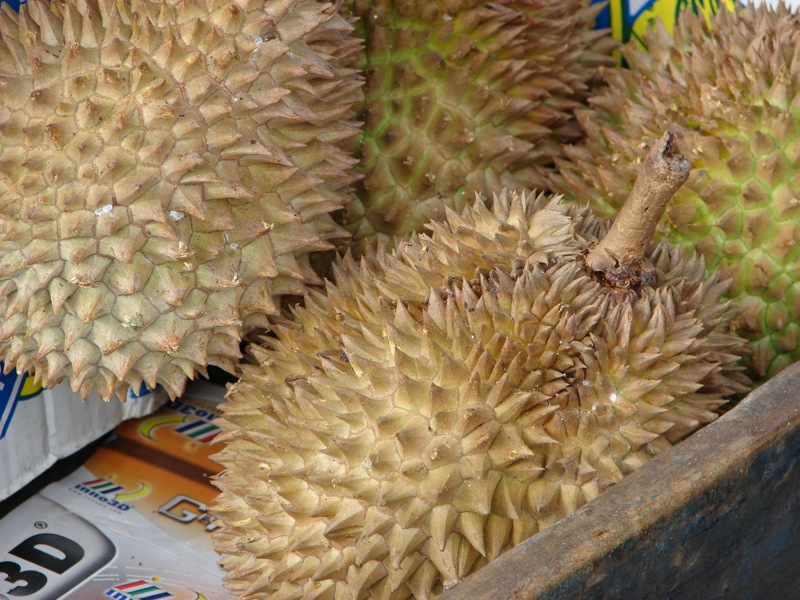
Subtlety is not a priority in Malay cooking, as it is characterised by a liberal use of spices (the most important are star anise, cinnamon/cassia, cardamom and cloves - dubbed rempah empat beradik or the four spice siblings), pungent edible rhizomes (mainly galangal, ginger and turmeric), coconut milk (santan in Malay), and occasionally fresh herbs (lemongrass, fresh coriander leaves, pandan leaves and various kinds of wild herbs or ulam). Most Malay dishes are curries, stews or dips of one kind or another, but all are full of flavour. In Malaysia and Singapore, the term "Malay" officially encompasses people from all over the Malay Archipelago, so many dishes that have their origins in modern-day Indonesia are locally regarded as traditional Malay dishes. Malaysia still has a great deal of local agriculture, so it is easy to find fresh, tree-ripened fruits in day and night markets throughout the country. In addition to the durian, popular fruits in Malaysia that are well worth buying include rambutan, mangosteen, banana (native to the country and available in tart as well as sweet varieties), mango (in three varieties, called mangga, kuini, and pauh in Malay, in decreasing order of desirability), papaya, guava (notably including the crunchy, somewhat tart jambu air), pineapple, watermelon, belimbing (star fruit/carambola), pomelo, langsat, duku, mata kucing, and jackfruit.
Curry puffs (karipap, epok-epok) are the Malaysian and Singaporean take on samosas, pastries usually stuffed with mild chicken and potato curry, although there are countless variants. Cheap, portable, filling and delicious. Although popularly associated with the Malay community, the Chinese and Indians have their own versions too. Nasi lemak (lit. "fatty rice") is the definitive Malay breakfast, consisting at its simplest of rice cooked in light coconut milk or coconut cream, some fried ikan bilis (anchovies), peanuts, slices of cucumber and a dab of chilli on the side, traditionally wrapped in a banana leaf (though paper is becoming more common these days). Originally, the 'ikan bilis' was cooked together with the chilli & spices to make "sambal tumis ikan bilis" but it ma
Where to eat
The cheapest places to eat are hawker stalls and coffeeshops, known as kedai kopi in Malay or kopitiam in Hokkien. These shops sell, besides coffee, many other types of food and drinks. Particularly popular and tasty are mamak stalls, run by Indian Muslims and serving up localized Indian fare like roti canai and nasi kandar. Most hawker stalls stay open till late and some even operate on shifts so you can find the same stall offering different food at different points throughout the day. You can also do take away from any stall, just ask for bungkus (Malay) or ta pao (Cantonese). A hawker meal will rarely cost you over RM5 in Malaysia or $4 in Singapore. Hawker stalls are generally located by the roadside in Malaysia, but have been moved into purpose-built government hawker centres in Singapore. Hygiene standards in Malaysia, while not up to that of Western countries, are still reasonable and much better than in China, India and most of the rest of Southeast Asia. In Singapore, hygiene standards are strictly regulated and are generally on par with the West. Just be observant, and generally speaking, if a stall is patronised by locals, it should be safe to eat there. One step up on the scale is the kedai makanan or the more Western-style restoran. A type to look out for is the nasi kandar restaurant, which originated among Tamil Muslim immigrants in Penang but now can be found in every Malaysian city, with a vast range of Indian-style curries and toppings to ladle on top of your rice. The Malay answer to nasi kandar is known as nasi campur, of which a subtype is nasi padang, originating among the Minangkabau people from Padang in what is today Indonesia. The Chinese equivalent is economy rice or mixed rice, also known by its Cantonese name chap fan (雜飯) in Malaysia or its Hokkien name chai png (菜飯) in Singapore. However, unlike nasi kandar or nasi campur, Chinese-style economy rice is typically not halal. Seafood restaurants (makanan laut) are comparatively pricy but still excellent values by most standards; do check prices before ordering though. Local prawns are gigantic, Chinese-style steamed fish is a treat and crab served with sticky chilli sauce is particul
Dietary restrictions
Finding halal food in Malaysia and Brunei is easy since they are Muslim-majority countries, but most Chinese stalls and restaurants are not halal. Ask if in doubt. Meals at Malay and most Indian restaurants, as well as Western fast food restaurants like McDonald's, Kentucky Fried Chicken, Pizza Hut are halal. Restaurants at major hotels in Malaysia are not certified 'halal' as they serve alcohol as well, but with the exception of Chinese restaurants, they generally don't serve pork. As the Iban, Kadazan and some other indigenous ethnic groups from East Malaysia are mostly Christian, their food is generally not halal. In Singapore, although Muslims are a minority, there is also no shortage of halal food, with many Malay and Indian Muslim options in every neighbourhood, as well as all the Western fast food chains being halal. Local Muslims will eat at Western, Chinese and Indian eateries if there is a halal sign on the walls. Most of the restaurants tend to display their halal certification or halal sign on their places. Halal certification is awarded and enforced by a government agency, which is Jabatan Kemajuan Islam Malaysia (JAKIM) in Malaysia, Majlis Ugama Islam Singapura (MUIS) in Singapore and Kementerian Hal Ehwal Ugama (KHEU) in Brunei. There are no kosher establishments in Malaysia or Brunei. In Singapore, there are two kosher restaurants, as well as a small kosher supe
Adapted from Wikivoyage (CC BY-SA)