
Caves
Travel topic
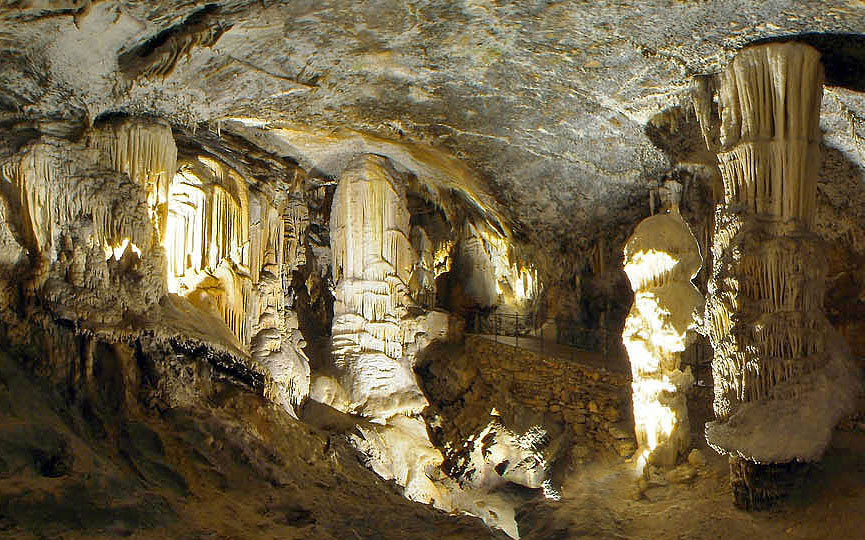
Since antiquity, humans have been using, living in, or hiding in caves, and our fascination with them is just as old. They connect us to our distant past because prehistoric remains and artefacts have been preserved in them, that outside would have been lost, especially in the north where Ice Age glaciers scoured everything from the surface. Our ancestors therefore had some choice over whether to venture into these places; so we today are "cave people" as much as they were.
Understand
Caves are natural underground spaces that are formed by various geological processes; they may have been adapted and modified for human use. They range from tiny recesses, to gigantic multi-mile systems such as Mammoth Cave in the United States. The forms of caves are as varied as the geological processes by which they form.
Karstic Karstic caves are the commonest type. Slightly acidic water (through natural carbonation) dissolves limestone, marble, dolomite or gypsum. Streams then enlarge the space, carving out long tunnels. Water drips from the roof, evaporating to leave a limestone deposit, which over thousands of years builds up into a stalactite. Similar deposits grow from the ground below as stalagmites, and eventually, the two may unite into a column. This creates "decorated" caves, filled with strange natural architecture and sculpture. Above ground, the outcrops and cliffs are also curiously eroded, so karst countryside is often very scenic. Here and there it's blighted by industry, as the stone is quarried for building masonry, quicklime, cement, chemicals and scores of other uses. Karst country is found worldwide and is riddled with caves, many of which are still being explored or remain to be discovered.
Sea caves Sea caves are carved out by wave action into fault lines, perhaps supplemented by frost. They're usually fairly short, as the power of the waves is spent within a few metres, but the larger caves are embellished by legends of pirate stash, fugitive princes and sleeping monsters. Striking examples are Fingal's Cave in Staffa, Scotland, and the "Hole in the hat" through Torghatten summit in Nordland - this is 110 m above sea level as post-glacial rebound has uplifted the region. Smoo in Sutherland, Scotland is an unusual hybrid, where a sea cave has become connected to a karstic cave.
Lava tubes Lava tubes result from vulcanism: the outer portion of a lava flow cools, hardens and forms a sheath for the molten interior. That enables the lava to flow further, before draining away when the eruption ceases to leave a tunnel. But this depends upon a particular fluid form of lava. Volcanoes with such lava form molten lakes (caldera) at th
Get in
The easiest natural underground works to access are tourist show caves, many of which have had tourist facilities installed specifically to aid access by visitors. Viewing natural caves that are not clearly adapted or generally open for tourist visits will depend on a number of factors, such as your level of fitness and expertise, availability of local guides, and the goodwill of owners and authorities to let you enter. Obtaining the consent of landowners and the owners of the cave is vital, as is obtaining in advance any relevant official permits from governmental agencies. If you have any doubts as to your fitness, both physically and mentally, stick to 'show caves'. More advanced 'caving' (or actual spelunking), requires detailed planning, specialist expertise as well as demanding fitness levels. It also typically requires specific technical equipment, and long-term training in the techniques used. For those that clearly understand and fully respect the risks it can be highly rewarding, but as with any extreme activity, the traveler must know the limits before embarking. Given this, detailed information is not provided here, and if you are interested, you should contact or join one of the specialist caving groups that exist.
See
Caves are numerous worldwide and only the outstanding examples can be mentioned here. For opening times, admission charges and so on see the relevant city or region page, which may also describe other caves in the vicinity.
Africa
Morocco
1 Caves of Hercules (14 km west of Tangier). Partially natural, partially man made, has functioned as a brothel and a concert venue for the metal band Def Leppard and today probably the most popular place for a quick sidetrip outside Tangier. According to a legend, the Roman god Hercules rested here and supposedly there is an underwater connection across the Strait to Gibraltar. Dh 5. (updated Dec 2015)
Americas
Argentina 2 Cueva de las Manos ("Cave of Hands") in Santa Cruz province has remarkable prehistoric stencils on its walls.
Brazil 3 Gruta do Lago Azul Protected natural area in Bonito (Mato Grosso do Sul) featuring a large cave with many unique formations and a large underground lake that takes on a surreal indigo color for much of the year.
Colombia 4 Cueva de los Guácharos - National Park in the Andes mountains of Western Colombia, surrounded by rainforest and old oak forests. Karst cave system formed by river systems of the Rio Magdalena and Rio Caquetá.
Ecuador 5 Cueva de los Tayos - Large cave complex in the Amazon rainforest with a number of myths and folk tales surrounding it (including tales of vast mounds of gold).
Mexico
The Cenotes of the Yucatán cover a wide area of that peninsula. The limestone bedrock is riddled with caves filled with fresh or sea water, so any small pool in a forest clearing may be the entrance to a vast underground network. Cenotes played an important role in Maya religious ceremonies and may have promoted the advance of American civilization - one famous example is called "Car Wash".
6 Garcia Caverns (Grutas de Garcia) Series of caverns inside the Sierra de Fraile mountain in northwest Monterrey. Cable car takes you to the top, the walking tour is about 2 miles long and includes several hundred steps. 7 Parque Nacional Grutas de Cacahuamilpa Large cavern system operated as a national park in the state of Guerrero. Another cave, Grutas de Pacheco, is located within a few hundred meters of Grutas de Cacahuamilpa. 8 Grutas de Tolontongo Commercial caves with waterfalls and warm thermal pools in the Central Mexico town of Ixmiquilpan. Another cave, Grutas Xoxofi is located nearby. 3 hours from Queretaro, 4 hours from Mexico City. 9 Sistema Huautla The deepest cave system in the Americas is not a commercial cave, but rather a remote wild cave for the serious cave explorer. In the town of Huautla, Oaxaca
United States 10 Mammoth Cave in Kentucky is the world's most extensive known cave system. 11 Carlsbad Caverns in New Mexico no longer hold the record for the world's largest cave chamber, but they're still pretty
Asia
China China's Danxia landscape bears some resemblance to karst; the most famous example is at 18 Danxiashan in Guangdong.
19 Guilin and 20 Yangshuo – The region around these towns in Guangxi (Southwest China) is one of China's most famous and popular tourist areas, primarily because of sensational scenery. The terrain is karst limestone and includes many caves. See the city articles for details on caves that are set up for tourist visits. The area is a major destination for rock climbers, and some of the climbing shops in Yangshuo organise trips to other caves; these all need at least basic rock-climbing skills, and some require advanced spelunking skills and equipment. 21 Mogao Caves. A group of caves near Dunhuang in Gansu Province, in the west of China along the old Silk Road. They have many Buddhist frescoes, mostly from a few centuries CE, and are on the UNESCO World Heritage List. (updated Feb 2020) 22 Panzhihua. This is a mining town in the south of Sichuan, on the highway and rail line into Yunnan. It is a popular tourist destination, mainly for Chinese travellers. Attractions nearby include forest and mountain areas, and many caves. (updated Feb 2020) 23 Shilin. The "Stone Forest" outside Kunming, the most famous karst landscape in China. 24 Zhangjiajie. Another popular destination for Chinese tourists, famous for karst landscapes, in Hunan province.
India
The following areas are considered the caving regions of India: Andhra Pradesh, Chhattisgarh, Haryana, Madhya Pradesh, Meghalaya and Uttarakhand. There are literally thousands of caves in India. There are caves that are man-made (rock cut), others which are religious sites (with or without temples), archaeolog
Adapted from Wikivoyage (CC BY-SA)