
Alexandra Palace
United Kingdom · Europe
About
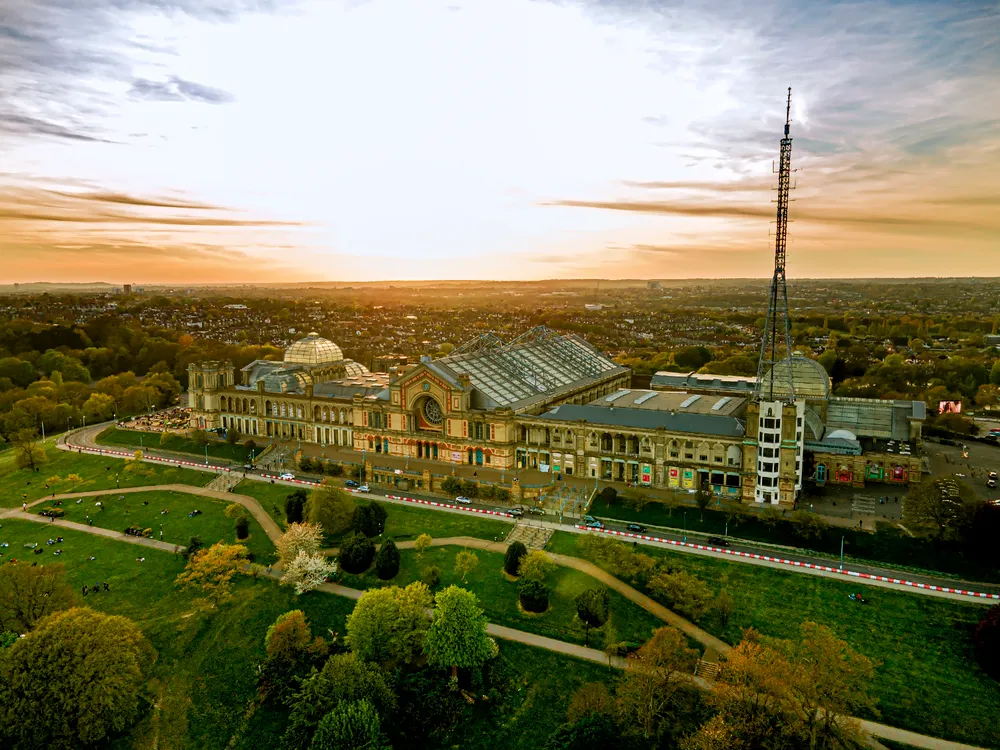
Alexandra Palace is an entertainment and sports venue in north London, situated between Wood Green and Muswell Hill in the London Borough of Haringey. A Grade II listed building, it is built on the site of Tottenham Wood and the later Tottenham Wood Farm. It was designed by John Johnson and Alfred Meeson. It opened in 1873 but following a fire two weeks after its opening, was rebuilt by Johnson. It was intended as "the People's Palace" and it is often referred to by the nickname "Ally Pally". At first a private venture, in 1900 the owners planned to sell it and Alexandra Park for development. A group of neighbouring local authorities managed to acquire it. An Act of Parliament created the Alexandra Palace and Park Trust. The Act required the trustees to maintain the building and the park, and make them available for the free use and recreation of the public forever. The present trustee is the London Borough of Haringey, whose coat of arms shows lightning bolts depicting Alexandra Palace's pioneering role in the development of television. In 1935 the trustees leased part of the Palace to the BBC for use as the production and transmission centre for their new television service. Thus, in 1936, it became the home of the world's first regular public (then) "high-definition" television service. The broadcasting system was 405-line monochrome analogue television – the first fully electronic television system to be used in regular broadcasting. Although other facilities soon superseded it after the Second World War, Alexandra Palace continued to be used by the BBC for many years, and its radio and television mast is still in use. The original Studios A and B still survive in the southeast wing with their producers' galleries, and are used for exhibiting original historical television equipment. The original Victorian Alexandra Palace Theatre with its stage machinery also survives and, as of 2019, is back in use. The theatre and the stage structure are on English Heritage's Buildings at Risk register. Alexandra Palace became a listed building in 1996, at the instigation of the Hornsey Historical Society. A planned commercial development of the building into a mixed leisure complex, including a hotel, a replacement ice-skating rink, a cinema, a ten-pin bowling alley and an exhibition centre, encountered opposition from public groups and was blocked by the High Court in 2007. The Great Hall and the West Hall are typically used for exhibitions, concerts and conferences. They are operated by the trading arm of the charitable trust that owns the building and the park on behalf of the public. There is also a pub, an ice rink, a palm court and a panoramic view of London. In 2013 Alexandra Park was declared a local nature reserve. It is also a Site of Borough Importance for Nature Conservation, Grade 1. The nearest railway stations are Alexandra Palace, with Great Northern services from Moorgate, and the London Underground station Wood Green on the Piccadilly line. Alexandra Palace is also served by London Buses route W3, which is operated by Arriva London.
The "Palace of the People" was conceived by Owen Jones in 1859. The Great Northern Palace Company, established by 1860, initially failed to raise financing for the construction of the Palace. Construction materials were acquired and recycled from the large 1862 International Exhibition building in South Kensington after it was demolished (the government had declined to take it over). In 1863 Alexandra Park Co. Ltd. acquired the land of Tottenham Wood Farm for conversion to a park and to build the People's Palace on a site on a ridge more than 300 ft (91 m) high, part of Muswell Hill. Alexandra Park opened to the public on 23 July 1863. The planned building was originally named "The Palace of the People"; it and its park were renamed to honour the popular new Princess of Wales, Alexandra of Denmark, who had married Prince Albert Edward (the future King Edward VII) on 10 March 1863. "The Palace of the People" and "The People's Palace" remained as alternative names. In September 1865, construction commenced, but to a design by John Johnson and Alfred Meeson rather than implementing the glass structure initially proposed by Jones. In 1871 work started on the Edgware, Highgate and London Railway to connect the site to Highgate station. Work on both the railway and the Palace finished in 1873 and, on 24 May of that year, Alexandra Palace and Park opened. The structure covers some 7.5 acres (3.0 ha). The Palace was built by Kelk and Lucas, who also built the Royal Albert Hall in South Kensington at around the same time. Sims Reeves sang on the opening day before an audience of 102,000. Only 16 days later a fire destroyed Alexandra Palace and also killed three members of staff. Only the outer walls survived; a loan exhibition of a collection of English pottery and porcelain, comprising some 4,700 items of historic and intrinsic value, was also destroyed. The Palace, quickly rebuilt, reopened on 1 May 1875. The new Alexandra Palace contained a concert hall, art galleries, a museum, a lecture hall, a library, a banqueting room and a large theatre. The stage of the theatre incorporated machinery that enabled special-effects for the then-popular pantomimes and melodramas: performers could disappear, reappear and be propelled into the air. The theatre was also used for political meetings. An open-air swimming pool was constructed at the base of the hill in the surrounding park; it is long since closed and little trace of it remains apart from some reeds. The grounds included a horse-racing course with a grandstand, named the Alexandra Park Racecourse but nicknamed the "Frying Pan" or the "Pan Handle" because of its layout. It was London's only racecourse from 1868 until its closure in 1970. There were also a Japanese village, a switchback ride, a boating lake and a nine-hole pitch-and-putt golf course. Alexandra Park cricket and football clubs have also played within the grounds (in the middle of the old racecourse) since 1888. A Henry Willis organ was installed in 1875, vandalised in 1918, and restored and reopened in 1929. In its restored form Willis's masterpiece was declared by Marcel Dupré to be the finest concert-organ in Europe.
Adapted from Wikipedia (CC BY-SA). Photography via Wikimedia Commons.