
44 Union Square
United States · Americas
About
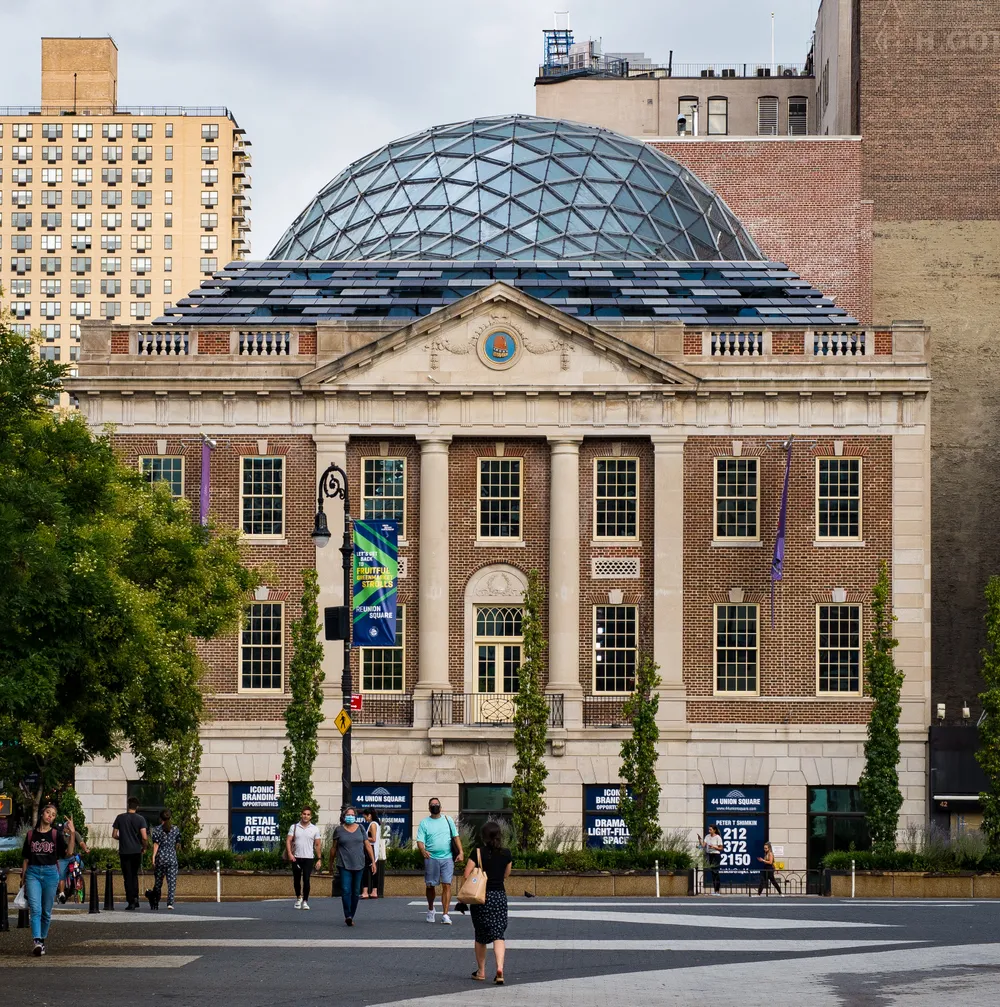
44 Union Square, also known as 100 East 17th Street and the Tammany Hall Building, is a three-story building at 44 Union Square East in Union Square, Manhattan, in New York City. It is at the southeast corner of Union Square East/Park Avenue South and East 17th Street. The neo-Georgian structure was erected in 1928–1929 and designed by architects Thompson, Holmes & Converse and Charles B. Meyers for the Tammany Society political organization, also known as Tammany Hall. It is the organization's oldest surviving headquarters building. The Tammany Society had relocated to 44 Union Square from a previous headquarters on nearby 14th Street. At the time of the building's commission, the society was at its maximum political popularity with members such as U.S. senator Robert F. Wagner, governor Al Smith, and mayor Jimmy Walker. However, after Tammany Hall lost its influence in the 1930s, the building was sold to an affiliate of the International Ladies' Garment Workers' Union in 1943. By the 1980s, it was used by the Union Square Theatre, while the New York Film Academy took space in 1994. The New York City Landmarks Preservation Commission designated the building as a city landmark in 2013, and it was converted into an office and retail structure during a renovation that took place between 2016 and 2020. The renovation preserved the facade while totally gutting the interior, and a glass domed roof was added to honor Chief Tamanend, namesake of the Tammany Society.
44 Union Square, a 3+1⁄2-story neo-Georgian building, was designed by Charles B. Meyers along with Thompson, Holmes & Converse. It was commissioned for Tammany Hall, a prominent Democratic Party political organization in New York City. The building measures 79 feet (24 m) on its western facade along Union Square East and 150 feet (46 m) on its northern facade along 17th Street. The particular neo-Georgian features in the Tammany Hall Building include Flemish bond brickwork; rectangular windows with stone keystones, set in arched openings; and wrought-iron balconies. The facades along Union Square East and on 17th Street are both arranged to give the appearance of symmetry. The bracketed gable, on the pediment above the portico, is not of neo-Georgian design but was likely inspired by a niche on the facade of the 14th Street building. The exterior design features are evocative of government buildings in the American colonial and Federal styles that were built in the later 19th century, when the society was founded. These features include a first level above a raised basement; a portico on Union Square East, with a pediment supported by columns in the Doric order; a hip roof; and a frieze running along the top of the structure. According to a commemorative publication from the Tammany Society, these features were inspired by the design of Federal Hall in Lower Manhattan, as well as by Somerset House in London. The Tammany Hall Building was one of several structures built in New York City in the early 20th century whose designs were inspired by government buildings. Other such structures included The Town Hall near Times Square, the Museum of the City of New York on the Upper East Side, and the original Staten Island Museum building in St. George.
The facade consists of limestone at the basement and first level. and English red brick on the second story and above. The Old Virginia Brick Company, who created the exterior brick, said in an advertisement that the hardiness of the brick, in conjunction with the "softening and toning down of the limestone", would turn the building into an enduring symbol of New York City's "historic yester-years". The building is topped by a glass-and-steel dome measuring 11,250 square feet (1,045 m2), which is placed on bearings around the building's perimeter.
Adapted from Wikipedia (CC BY-SA). Photography via Wikimedia Commons.