
Koneswaram Temple
Sri Lanka · Asia
About
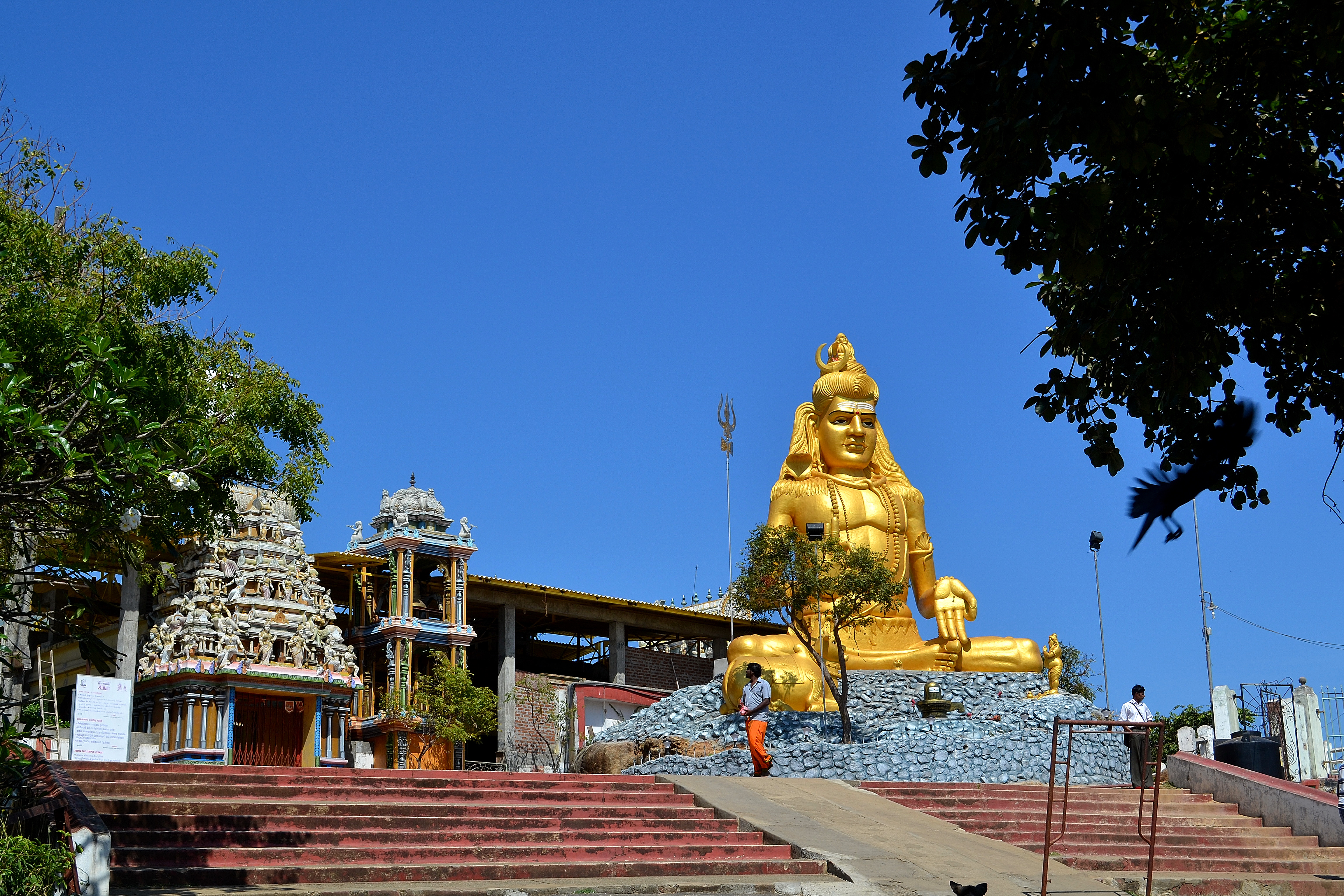
Koneswaram Temple of Trincomalee (Tamil: திருக்கோணேச்சரம் கோயில்) or Thirukonamalai Konesar Temple – The Temple of the Thousand Pillars and Dakshina-Then Kailasam (Southern / Ancient Kailash) is a classical-medieval Hindu temple complex in Trincomalee, a Hindu religious pilgrimage centre in Eastern Province, Sri Lanka. The most sacred of the Pancha Ishwarams of Sri Lanka, it was built significantly during the ancient period on top of Konesar Malai, a promontory overlooking Trincomalee District, Gokarna bay and the Indian Ocean. The monument contains its main shrine to Shiva in the form Kona-Ishvara, shortened to Konesar.
The original kovil combined key features to form its basic Dravidian temple plan, such as its thousand pillared hall – "Aayiram Kaal Mandapam" – and the Jagati. Regarded as the greatest building of its age for its architecture, elaborate sculptural bas-relief ornamentation adorned a black granite megalith while its multiple gold plated gopuram towers were expanded in the medieval period. One of three major Hindu shrines on the promontory with a colossal gopuram tower, it stood distinctly on the cape's highest eminence.
The journey for pilgrims in the town begins at the opening of Konesar Road and follows a path through courtyard shrines of the compound to the deities Bhadrakali, Ganesha, Vishnu Thirumal, Surya, Raavana, Ambal-Shakti, Murukan and Shiva who presides at the promontory's height. The annual Koneswaram Temple Ther Thiruvilah festival involves the Bhadrakali temple of Trincomalee, the Pavanasam Theertham at the preserved Papanasuchunai holy well and the proximal Back Bay Sea (Theertham Karatkarai) surrounding Konesar Malai.
The Sinhalese king Gajabahu II who ruled Polonnaruwa from 1131 to 1153 CE is described in the Konesar Kalvettu as a devout worshipper of Shiva and a benefactor of the temple of Konamalai. He spent his last days in the associated Brahmin settlement of Kantalai.
The complex was destroyed in colonial religious attacks between 1622 and 1624 and a fort was built at the site from its debris. A 1632-built temple located away from the city houses some of its original idols. Worldwide interest was renewed following the discovery of its underwater and land ruins, sculptures and Chola bronzes by archaeologists and Arthur C. Clarke. It has been preserved through restorations, most recently in the 1950s. Granted ownership of villages in its floruit to form the Trincomalee District, Trincomalee village is located on the cape isthmus within the compounds. Revenue from the temple provides services and food to local residents.
Adapted from Wikipedia (CC BY-SA). Photography via Wikimedia Commons.