
Anahuacalli Museum
Mexico · Americas
About
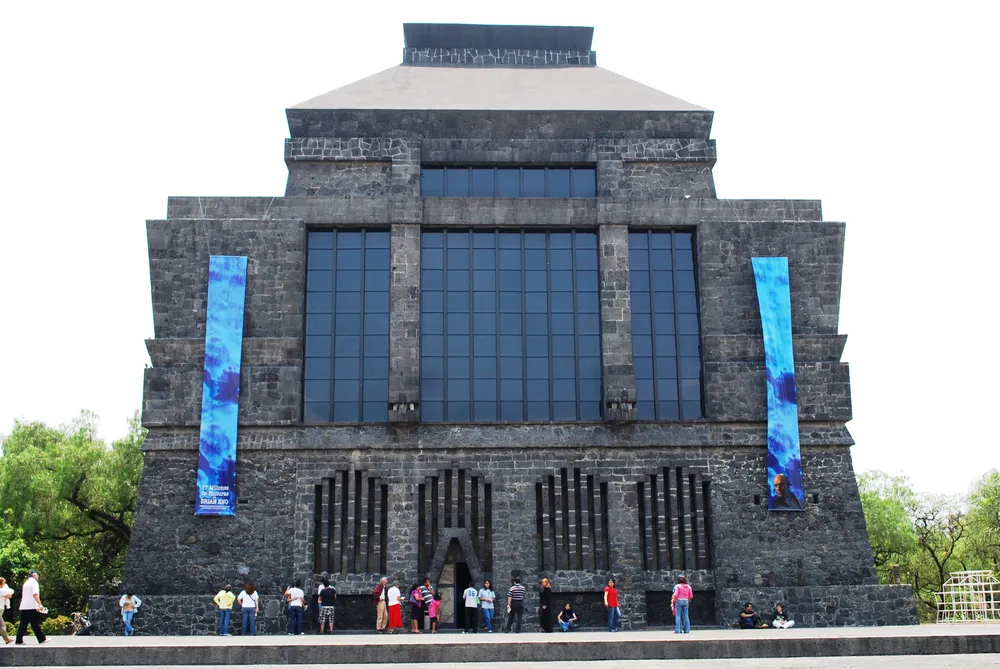
The Diego Rivera Anahuacalli Museum is a museum and arts center in Mexico City, located in the San Pablo de Tepetlapa neighborhood of Coyoacán, 10 minutes by car from the Frida Kahlo Museum, as well as from the tourist neighborhood of this district. The Anahuacalli (from the Nahuatl word, whose meaning is "house surrounded by water"), is a temple of the arts designed by the Mexican muralist Diego Rivera. This museum stands out for its extensive collection of pre-Columbian art, as well as for its Ecological Space that protects endemic flora and fauna. Rivera designed its architecture in order to safeguard his vast collection of pre-Hispanic pieces, while exhibiting the most beautiful works of this set in the museum's main building. Accordingly, a selection of 2,000 artworks, especially well executed and preserved, has been on display since the opening of the Anahuacalli to the public on September 18, 1964. The extravagant architecture of the building is inspired by Mesoamerican structures, with a unique style of its kind that mixes Mayan and Toltec influences mainly, although Rivera himself defined it as an amalgamation of Aztec, Mayan and "Traditional Rivera" styles. The Anahuacalli Museum building is erected with carved volcanic stone, extracted from the same place where it stands. According to the words of the Tabasco museographer and poet Carlos Pellicer, who designed the museum's permanent exhibition at the express indication of Rivera himself, the Anahuacalli responds to the following description: "It is a personal creation using pre-Hispanic elements, mainly from Toltec architecture and some of the Mayan: sloped walls, serpentine pilasters and rhomboid doors. The pyramidal crown accentuates the magnificent character of the building. The flat ceilings on the ground floor and the upper floors are decorated with original mosaics by the great painter, which are elements that are integrated into the architecture.
Every year, in compliance with the will that Rivera expressed for the Anahuacalli, contemporary art exhibitions are presented on the premises. These proposals are carefully chosen, as they must alternate harmoniously with the museum's architecture, with the pre-Columbian art on display, with the nature that surrounds it, and with the foundational and evolving concept of Diego's Anahuacalli.
In June, 1940, Diego Rivera painted the mural Pan American Unity for the "Art in Action" program of the Golden Gate International Exposition(GGIE). In this mural painting, the artist shows a clear interest in extolling the pre-Hispanic cultures. After his return to Mexico in 1941, he is willing to begin the construction of a museum that socialises the pre-Columbian aesthetics, both through its architecture and the collection on display. For these purposes, Diego chooses the land that he acquired in the Pedregal de San Ángel to plan his museum and City of the Arts. In the preparatory drafts, a plaza for art and handcart workshops was included, as well as forums dedicated to the performing arts, permanent exhibition halls and a Mexican art museum with nine venues. Rivera expended a considerable amount of his earnings in what would be one of the most ambitious projects of his life: the Anahuacalli. The Anahuacalli construction began in 1942, in the suburb and town of San Pablo Tepetlapa. A year later, the Mexican artist Frida Kahlo (1907–1954) wrote a letter to the engineer Marte R. Gómez, then Secretary of Agriculture and Development of the government of President Manuel Ávila Camacho, in which she explained her husband's need to build a space that houses his collection. In the words of Frida herself: "(…) after his painting work, what excites him most in his life are his idols (…). His idea was always to build a house for the idols." In said letter, Frida expresses her concern for the sadness of her husband, not having sufficient financial resources to complete the building. As a result, she proposes to the engineer Marte R. Gómez, that the Mexican government supports the continuation of the construction works, with the condition that the muralist donate his collection to Mexico and turn the Anahuacalli into an archaeological museum. Nevertheless, this proposal was not carried out, at least not at the time. The first museographic design was prepared by Rivera himself under the direction of the anthropologist Alfonso Caso y Andrade (1896–1970). Both Caso and his collaborators recognized Diego's ability to distinguish, in his collection, the most authentic and important components. Despite the essential collaboration of Caso, Pellicer did not organize the exhibition following historical or anthropological criteria while working under the supervision of Rivera. Differently, Pellicer prioritized the artistic quality of the pieces to organize its display, since this had been Rivera's motivation to assemble the collection in the first place. For this reason, none of the objects are shown linked to a museum card, since Rivera's intention does not respond to an archaeological classification, but to an aesthetic admiration. When master Rivera died, the Anahuacalli was still in its process of construction; hence his daughter, Ruth Rivera (1927–1969) together with the architects Juan O'Gorman (1905–1982) and Heriberto Pagelson, finished this project with the financial support of Dolores Olmedo. Thus, the construction concluded in 1963 and the museum was inaugurated on September 18, 1964. In memory of its creator, the following quote was chosen for the inscription engraved on the museum foundation stone: "I return to the people what I was able to rescue from the artistic heritage of their ancestors. Diego Rivera".
Adapted from Wikipedia (CC BY-SA). Photography via Wikimedia Commons.