
Aconcagua
Argentina · Americas
About
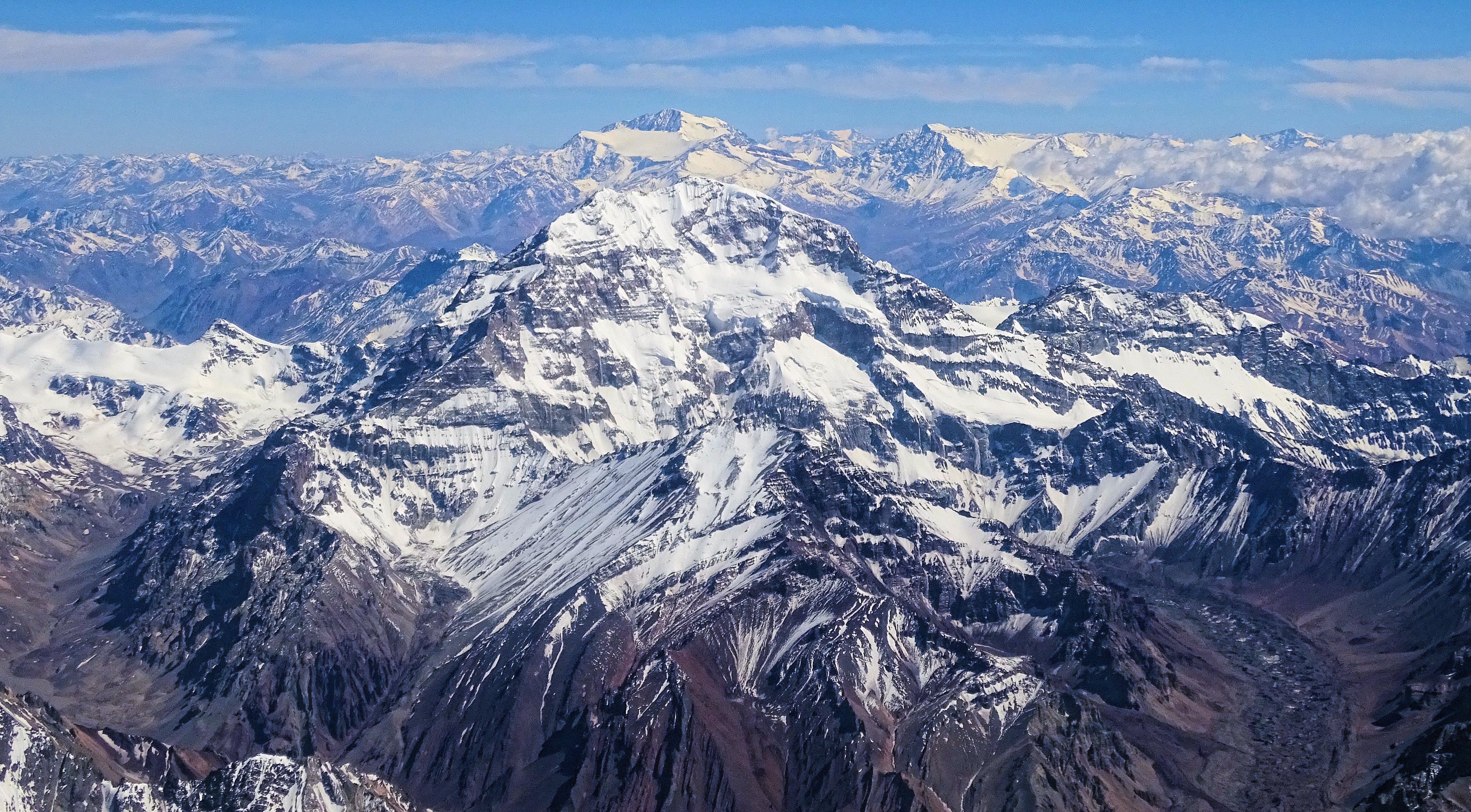
Aconcagua (Spanish pronunciation: [akoŋˈkaɣwa]) is a mountain in the Principal Cordillera of the Andes range, located in Mendoza Province, Argentina. With a summit elevation of 6,967.15 metres (22,858.1 feet), it is the highest mountain outside Asia. It is the second-most topographically prominent peak in the world and one of the Seven Summits, the highest mountains on each of the seven continents. The mountain lies 112 kilometres (70 mi) northwest of Mendoza, approximately 15 kilometres (9.3 mi) from the Argentine–Chilean border. It is bounded by the Vacas Valley to the north and east and the Horcones Inferior Valley to the west and south, and is protected within Aconcagua Provincial Park. Several glaciers descend its flanks, the largest being the Horcones Inferior glacier (Ventisquero Horcones Inferior), at roughly 10 kilometres (6.2 mi) long. Aconcagua was formed by the subduction of the Nazca Plate beneath the South American Plate and was once an active stratovolcano, before tectonic shifts during the Miocene halted volcanic activity. The first recorded ascent was made on 14 January 1897 by Swiss guide Matthias Zurbriggen, as part of a British expedition led by Edward FitzGerald. From the north via the normal route, Aconcagua is considered technically straightforward and is often described as the highest non-technical mountain in the world, requiring no ropes or specialized equipment. Nevertheless, the extreme altitude—where atmospheric pressure is roughly 40% of sea level—means altitude sickness affects most climbers, and the mountain records approximately three deaths per year, earning it the nickname "Mountain of Death." Summit success rates are estimated at 30–40%.
The origin of the name is uncertain. It may be from the Mapudungun Aconca-Hue, which refers to the Aconcagua River and means "comes from the other side"; the Quechua Ackon Cahuak, meaning "Sentinel of Stone"; the Quechua Anco Cahuac, meaning "White Sentinel"; or the Aymara Janq'u Q'awa, meaning "White Ravine".
The mountain was created by the subduction of the Nazca Plate beneath the South American Plate. Aconcagua used to be an active stratovolcano (from the Late Cretaceous or Early Paleocene through the Miocene) and consisted of several volcanic complexes on the edge of a basin with a shallow sea. However, sometime in the Miocene, about 8 to 10 million years ago, the subduction angle started to decrease, resulting in a stop of the melting and more horizontal stresses between the oceanic plate and the continent, causing the thrust faults that lifted Aconcagua off its volcanic root. Volcanic activity ceased a long time ago. The rocks on Aconcagua's flanks are all volcanic and consist of lavas, breccias and pyroclastics. The shallow marine basin had already formed earlier (Triassic), even before Aconcagua arose as a volcano. However, volcanism has been present in this region for as long as this basin was around and volcanic deposits interfinger with marine deposits throughout the sequence. The colorful greenish, bluish and grey deposits seen in the Horcones Valley and south of Puente Del Inca, are carbonates, limestones, turbidites and evaporates that filled this basin. The red-colored rocks are intrusions, cinder deposits and conglomerates of volcanic origin.
In mountaineering terms, Aconcagua is technically an easy mountain if approached from the north, via the normal route. Aconcagua is arguably the highest non-technical mountain in the world since the northern route does not absolutely require ropes, axes, and pins. Although the effects of altitude are severe (atmospheric pressure is 40% of sea level at the summit), the use of supplemental oxygen is not common. Altitude sickness will affect most climbers to some extent, depending on the degree of acclimatization. Although the normal climb is technically easy, multiple casualties occur every year on this mountain (in January 2009 alone, five climbers died). This is due to the large numbers of climbers who attempt the ascent and because many climbers underestimate the significant risk posed by the elevation and cold weather. Given the weather conditions close to the summit, hypothermia is very common.
Adapted from Wikipedia (CC BY-SA). Photography via Wikimedia Commons.