
Rubislaw Quarry
United Kingdom · Europe
About
Rubislaw Quarry is a quarry situated at the Hill of Rubislaw in the west end of the city of Aberdeen, Scotland.
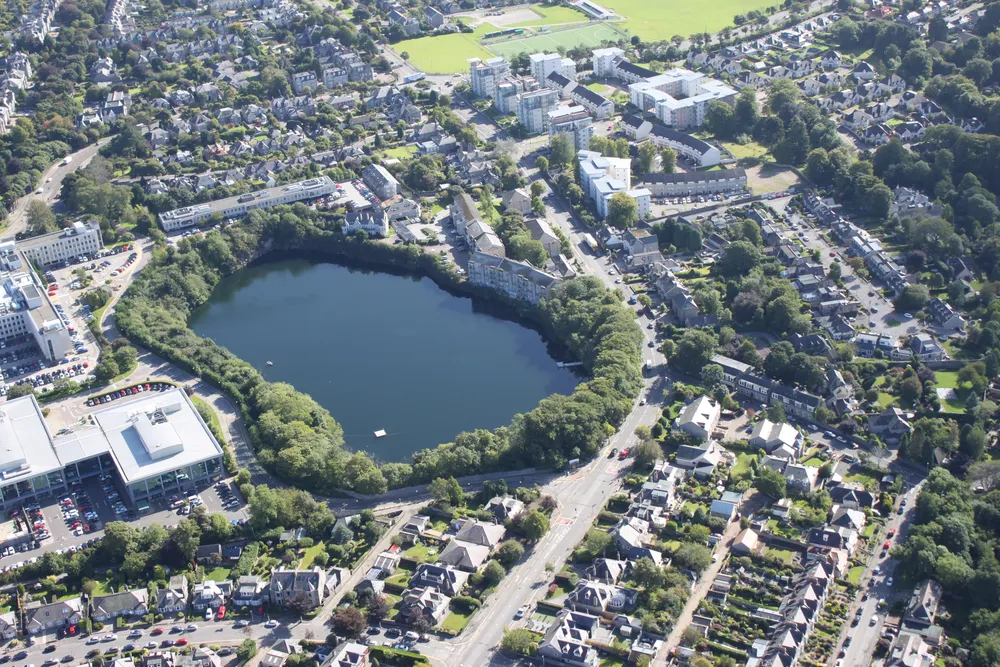
The quarry is one of the biggest man-made holes in Europe at approximately 466 ft. (142m) deep, and with a diameter of 394 ft. (120m). Since its closure in 1971, it has filled with water and is currently inaccessible to the public.
As late as the 1800s, the quarry would have stood on the farmland surrounding Aberdeen but slowly it was encircled as the town grew into a city. In the present day, the quarry's situation feels unusual, sited on a main road, sandwiched between residential areas on three sides and a business park to the north.
An estimated six million tonnes of granite were extracted from the quarry over a period of 200 years which directly contributed to Aberdeen's reputation as the Granite City. The majority of prestigious buildings erected in Aberdeen in the late 18th century and early 19th century were made from the quarry's contents, and designed by the likes of John Smith and Archibald Simpson. One local building of particular note is Marischal College, the second-largest granite building in the world and the current headquarters of Aberdeen City Council.
The granite from the quarry was known for its quality and was used, for example, on Waterloo Bridge in London, the terrace of the Palace of Westminster, and the Forth Bridge.
Adapted from Wikipedia (CC BY-SA)。Photography via Wikimedia Commons.