
Lake Sevan
Armenia · Asia
About
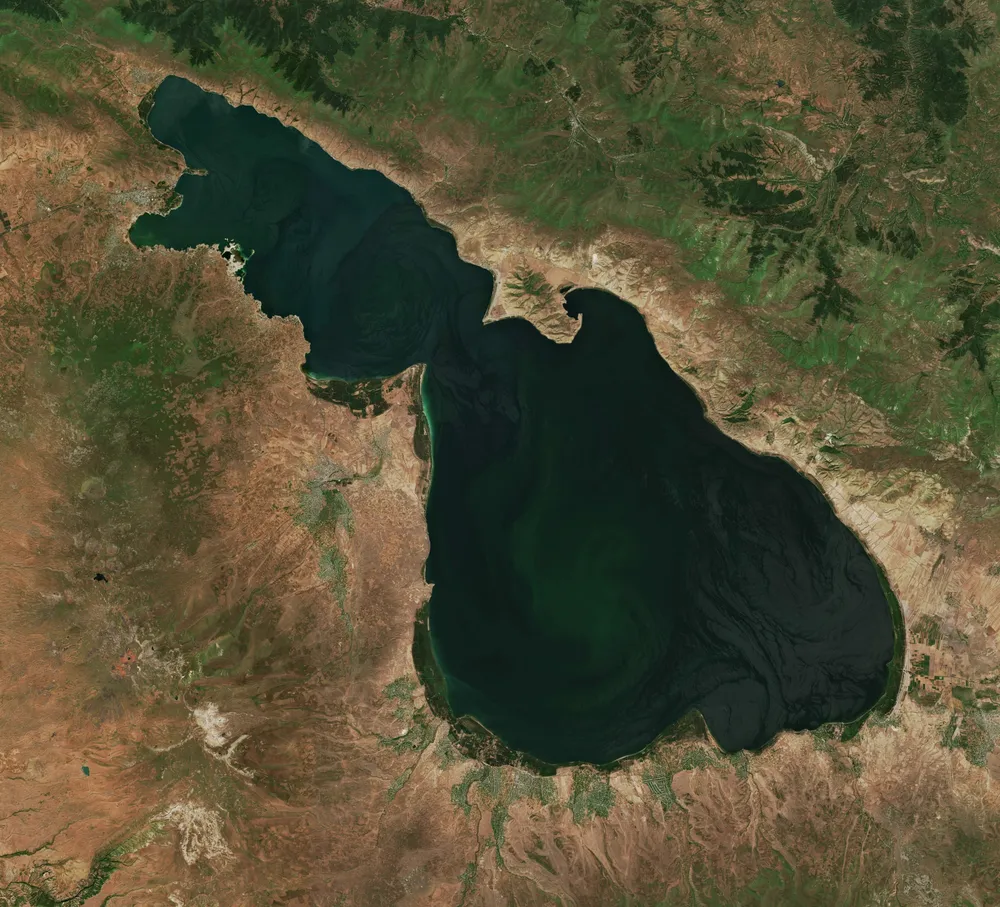
Lake Sevan (Armenian: Սևանա լիճ) is the largest body of water in Armenia and the broader Caucasus region. It is one of the largest freshwater alpine lakes in Eurasia. The lake is situated in Gegharkunik Province, at an altitude of 1,900 m (6,234 ft) above sea level. It is fed by 28 rivers and streams. 10% of this incoming water is drained by the Hrazdan River, while the remaining 90% evaporates.
The total surface area of its basin is about 5,000 km2 (1,900 sq mi), which makes up 1⁄6 of Armenia's territory. The lake itself is 1,242 km2 (480 sq mi), and the volume is 32.8 km3 (7.9 cu mi).
Lake Sevan has significant economic, cultural, and recreational value. Sevan Island was the lake's sole major island and is the site of Sevanavank, a monastery built in the period of Medieval Armenia. Due to falling water levels, the island is now a peninsula. The lake provides some 90% of the fish and 80% of the crayfish catch of Armenia.
Lake Sevan was heavily exploited for irrigation of the Ararat plain and hydroelectric power generation during the Soviet period. Consequently, its water level decreased by around 20 m (66 ft) and its volume reduced by more than 40%. Later, two tunnels were built to divert water from highland rivers to the lake. Before human intervention dramatically changed the lake's ecosystem, the lake was at an altitude of 1,916 m (6,286 ft) above sea level, 95 m (312 ft) deep, covered an area of 1,416 km2 (547 sq mi) (5% of Armenia's entire area), and had a volume of 58.5 km3 (14.0 cu mi).
Adapted from Wikipedia (CC BY-SA). Photography via Wikimedia Commons.