
Caspian Sea
Iran · Asia
About
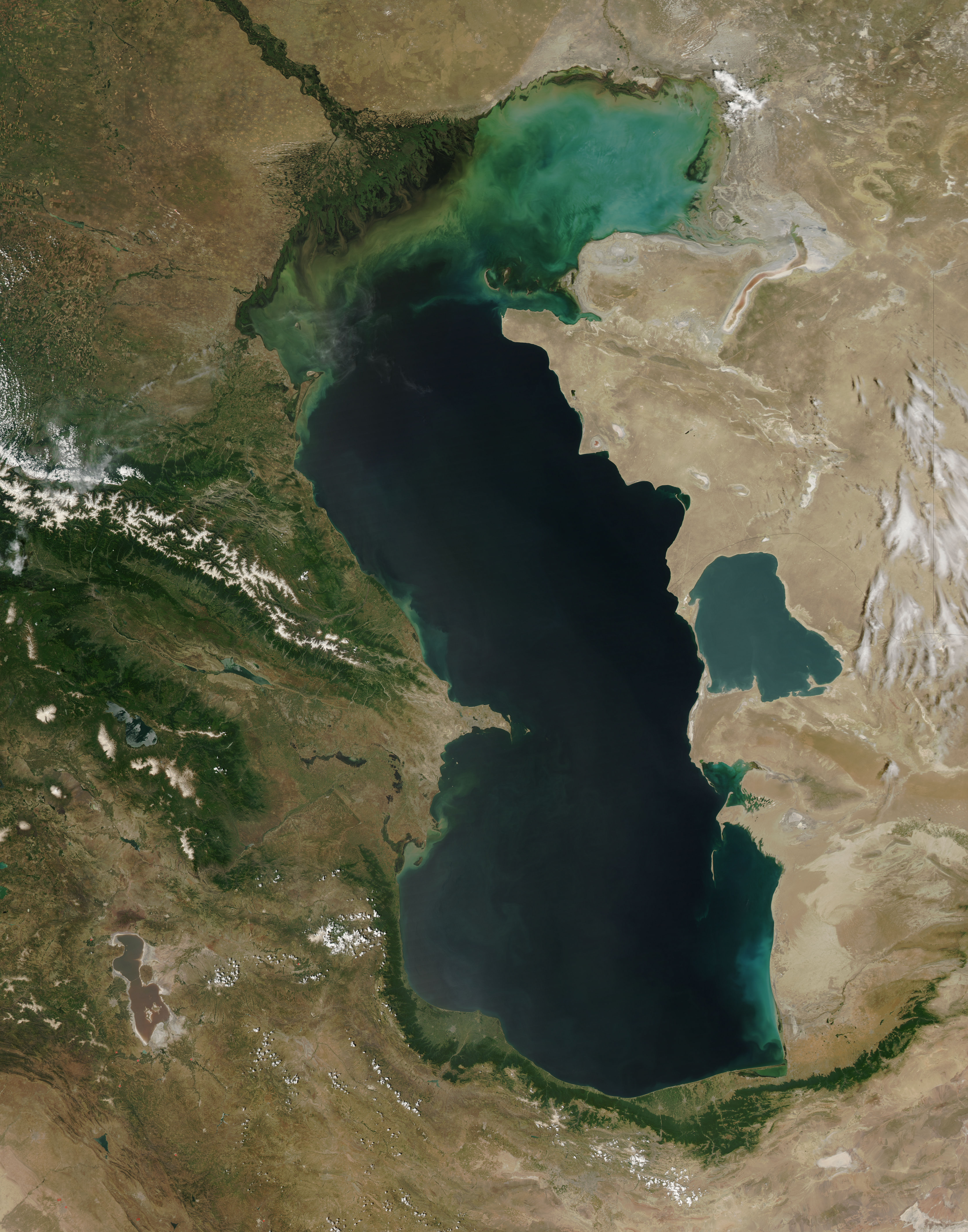
The Caspian Sea is the world's largest inland body of water, also described as the world's largest lake and usually referred to as a full-fledged sea. An endorheic basin, it is situated in both Europe and Asia: east of the Caucasus, west of the broad steppe of Central Asia, south of the fertile plains of Southern Russia in Eastern Europe, and north of the mountainous Iranian Plateau. It covers a surface area of 371,000 km2 (143,244 sq mi) (excluding the highly saline lagoon of Garabogazköl to its east), an area similar to Japan, with a volume of 78,200 km3 (19,000 cu mi). It has a salinity of approximately 1.2% (12 g/L), about a third of the salinity of average seawater. It is bounded by Kazakhstan to the northeast, Russia to the northwest, Azerbaijan to the southwest, Iran to the south, and Turkmenistan to the southeast. The name of the Caspian Sea is derived from the ancient Iranic Caspi people. The lake stretches 1,200 km (750 mi) from north to south, with an average width of 320 km (200 mi). Its gross coverage is 386,400 km2 (149,200 sq mi) and the surface is about 27 m (89 ft) below sea level. Its main freshwater inflow, Europe's longest river, the Volga, enters at the shallow north end. Two deep basins form its central and southern zones. These lead to horizontal differences in temperature, salinity, and ecology. The seabed in the south reaches 1,023 m (3,356 ft) below sea level, which is the third-lowest natural non-oceanic depression on Earth after Baikal and Tanganyika lakes. The Caspian Sea is home to a wide range of animal species. It is famous for its caviar and oil industries. Pollution from the oil industry and dams on rivers that drain into it have harmed its ecology. It is predicted that during the 21st century, the depth of the sea will decrease by 9–18 m (30–60 ft) due to global warming and the process of desertification, leading to an ecocide.
The sea's name stems from Caspi, the ancient people who lived to the southwest of the sea in Transcaucasia. Strabo (died circa AD 24) wrote that "to the country of the Albanians belongs also the territory called Caspiane, which was named after the Caspian tribe, as was also the sea; but the tribe has now disappeared". Moreover, the Caspian Gates, part of Iran's Tehran province, may evince such people migrated to the south. The Iranian city of Qazvin shares the root of its name with this common name for the sea. The traditional and medieval Arabic name for the sea was Baḥr al-Khazar ("sea of the Khazars"), but in recent centuries the common and standard name in the Arabic language has become بحر قزوين Baḥr Qazvin, the Arabized form of Caspian. In modern Russian: Каспи́йское мо́ре, Kaspiyskoye more. Some Turkic ethnic groups refer to it with the Caspi(an) descriptor; in Kazakh it is called Каспий теңізі, Kaspiy teñizi, Kyrgyz: Каспий деңизи, romanized: Kaspiy deñizi, Uzbek: Kaspiy dengizi. Others refer to it as the Khazar sea: Turkmen: Hazar deňzi; Azerbaijani: Xəzər dənizi, Turkish: Hazar Denizi. In all these the first word refers to the historical Khazar Khaganate, a large empire based to the north of the Caspian Sea between the 7th–10th centuries. In Iran, the lake is called the Mazandaran Sea (Persian: دریای مازندران), after the historic Mazandaran Province at its southern shores. Old Russian sources use the Khvalyn or Khvalis Sea (Хвалынское море / Хвалисское море) after the name of Khwarezmia. Among Greeks and Persians in classical antiquity it was the Hyrcanian Sea (Hyrcanium Mare). Renaissance European maps labelled it as the Abbacuch Sea (Oronce Fine's 1531 world map), Mar de Bachu (Ortellius' 1570 map), or Mar de Sala (the Mercator 1569 world map). It was also sometimes called the Kumyk Sea and Tarki Sea (derived from the name of the Kumyks and their historical capital Tarki).
Adapted from Wikipedia (CC BY-SA). Photography via Wikimedia Commons.