
Bolshoy Ussuriysky Island
Russia · Europe
About
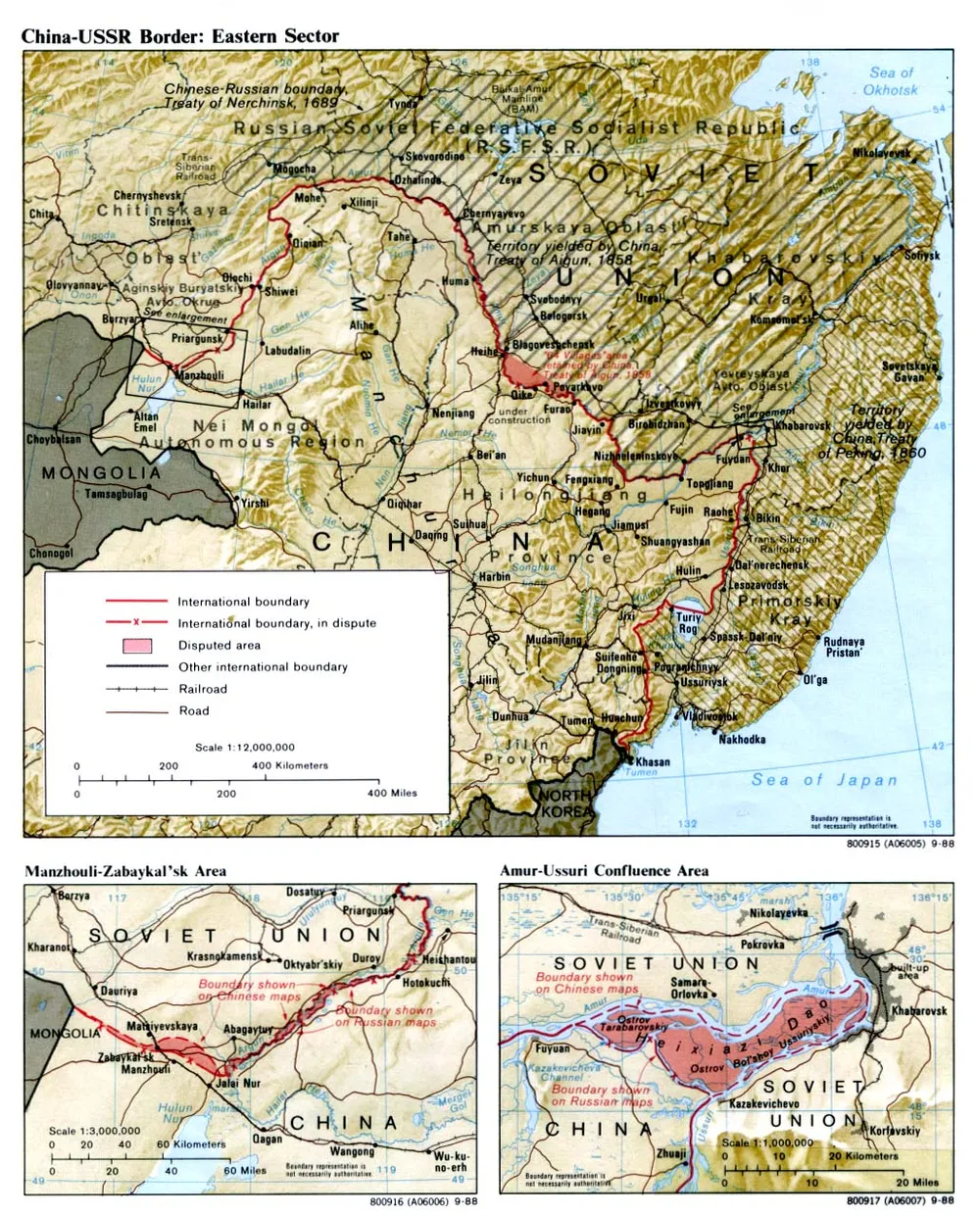
Bolshoi Ussuriysky Island (Russian: Большо́й Уссури́йский о́стров, romanized: Bol'shoy Ussuriyskiy Ostrov), or Heixiazi Island (simplified Chinese: ; traditional Chinese: ; pinyin: Hēixiāzi Dǎo; lit. 'black bear island'), is a sedimentary island at the confluence of the Amur and Ussuri rivers. Since the Sino-Russian Border Agreement that was fully implemented in 2008, Bolshoy Ussuriysky Island was divided between China and Russia. Western part of the island and Yinlong/Tarabarov Island island were returned to China, and Russia retained the eastern part. Since then, the issue has been peacefully settled, and China no longer claims the entire island. It has an area of about 327 to 350 km2 and is bounded closely by Yinlong Island, and over 90 islets. Its position at the confluence of the Amur and the Ussuri, and right next to the major Russian city of Khabarovsk, has given it great strategic importance.
The 1860 Convention of Peking stipulated that the boundary between China and Russia lay along the Amur and Ussuri rivers. Until 2004, Bolshoy Ussuriyskiy Island was the site of a territorial dispute between China and Russia. The Soviet Union forcefully occupied Bolshoy Ussuriyskiy and Yinlong Islands in 1929 in the wake of a Russo-Manchurian conflict, but this was not accepted by China. While Russia governed the islands as a part of Khabarovsk Krai, China claimed them as a part of Fuyuan County, Heilongjiang province, the easternmost part of China. The difficulty in settling this dispute involved competing interests between China and Russia. To settle the boundary along the lines claimed by China would have subjected settled parts of the city of Khabarovsk to the range of artillery emplaced on Heixiazi. However, by occupying the entire island, Russia controlled the entire Amur and Ussuri waterway and gave Khabarovsk a comfortable buffer zone. During its control of the island, Russia refused navigational access to the Amur and Ussuri to Chinese ships. On 14 October 2004, the Complementary Agreement between the People's Republic of China and the Russian Federation on the Eastern Section of the China-Russia Boundary was signed, in which Russia agreed to relinquish control over Yinlong Island and around half of Bolshoy Ussuriysky. About 170 square kilometres of Bolshoy Ussuriysky was transferred to China, while the rest remained under Russia's jurisdiction. In return, China agreed to drop all territorial claims to the remainder of Bolshoy Ussuriysky kept by Russia and received the right to navigate ships along the main channel of the Amur.
In 2005, the Russian Federal Assembly and the Chinese National People's Congress approved the Sino-Russian Border Agreement. On 21 July 2008, an agreement was signed in Beijing by the Chinese and Russian Foreign Ministers that finalized the border demarcation and formally ended negotiations. Under the agreement, Russia would transfer approximately 174 km2 of territory to China. The transfer took place on 14 October 2008. The area transferred to China is largely uninhabited. The Chinese part of the island is situated in the district of Fuyuan City in the province of Heilongjiang, China's easternmost county.
The agreement was met with controversy on both sides of the border. In May 2005, Cossacks in Khabarovsk demonstrated against the loss of half of Bolshoy Ussuriysky. In return, some Chinese media commentators in Hong Kong, Taiwan and along with overseas Chinese groups criticized China for signing the agreement, which they regarded as sealing as permanent the loss of former Chinese territory such as Outer Manchuria to the Russian Federation.
Adapted from Wikipedia (CC BY-SA). Photography via Wikimedia Commons.