
Humayun's Tomb
India · Asia
About
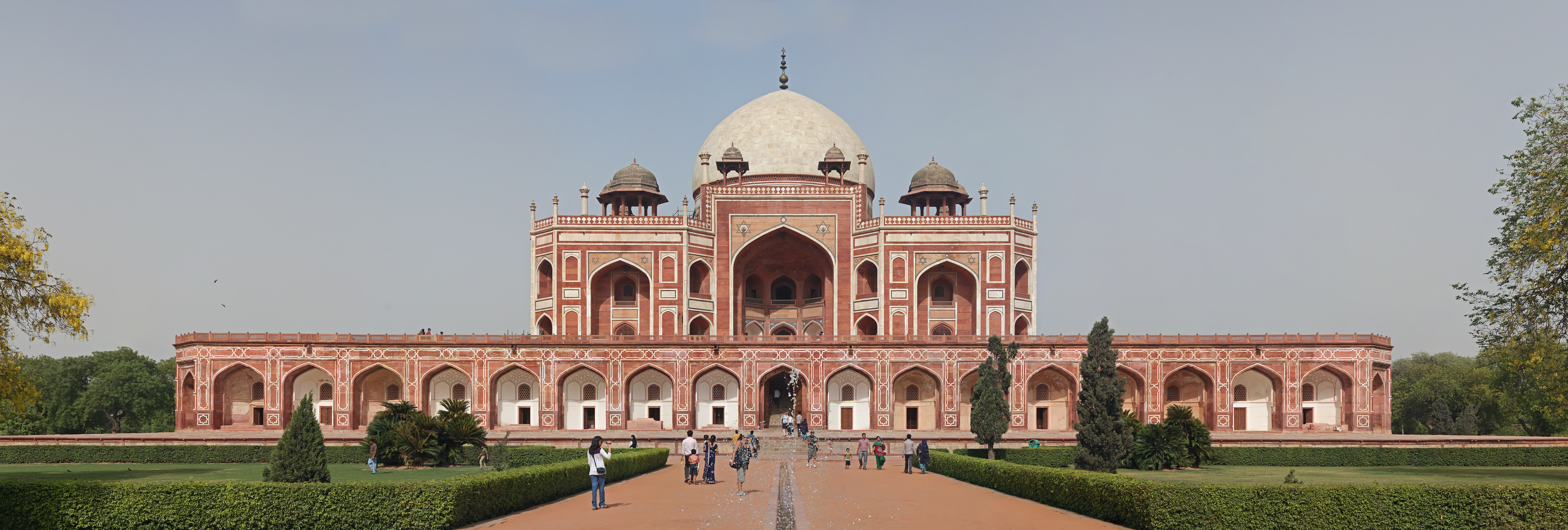
Humayun's tomb (Persian: Maqbara-i Humayun) is the tomb of the Mughal Emperor Humayun located in Delhi, India. The tomb was commissioned by Humayun's first wife and chief consort, Empress Bega Begum, under her patronage in 1558, and designed by Persian architects Mirak Mirza Ghiyas and his son, Sayyid Muhammad, whom she personally chose. It was the first garden-tomb on the Indian subcontinent, and is located in Nizamuddin East, Delhi, close to the Dina-panah Citadel, also known as Purana Qila (Old Fort), that Humayun found in 1538. It was also the first structure to use red sandstone at such a scale.
The tomb was declared a UNESCO World Heritage Site in 1993, and has, thereafter, undergone extensive restoration work that have concluded. Beside the main tomb enclosure of Humayun, several smaller monuments dot the pathway leading up to it from the main entrance in the West, including one that even pre-dates the main tomb itself by twenty years: it is the tomb complex of Isa Khan Niazi, an Afghan noble in Sher Shah Suri's court of the Sur Empire, who fought against the Mughals, and was constructed in 1547 CE.
The complex encompasses the main tomb of the Emperor Humayun, which also houses the graves of Empress Bega Begum, Hajji Begum, and that of Dara Shikoh, the great-great-grandson of Humayun and son of the later Emperor Shah Jahan, as well as numerous other subsequent Mughals, including Emperor Jahandar Shah, Farrukhsiyar, Rafi Ul-Darjat, Rafi Ud-Daulat, Muhammad Kam Bakhsh and Alamgir II. It represented a leap in Mughal architecture, and, in conjunction with its accomplished Charbagh garden, typical of Persian gardens, but previously unwitnessed in India, set a precedent for subsequent Mughal architecture. It is seen as a clear departure from the fairly modest mausoleum of his father, the first Mughal Emperor, Babur, called Bagh-e Babur (Gardens of Babur) in Kabul, Afghanistan. The latter, however, was the inaugural Emperor to start the tradition of being buried in a paradise garden. Modelled after Gur-e Amir, the tomb of his ancestor and Asia's conqueror Timur in Samarkand, it established a precedent for future Mughal architecture of royal mausolea, which reached its zenith upon the construction of the Taj Mahal in Agra.
The site was chosen on the banks of Yamuna River owing to its proximity to Nizamuddin Dargah, the mausoleum of the celebrated Sufi saint of Delhi, Nizamuddin Auliya. He was amply revered by the rulers of Delhi, and whose residence, Chilla Nizamuddin Auliya, lies just north-east of the tomb. In later Mughal history, the last Mughal Emperor, Bahadur Shah Zafar, took refuge here during the Indian Rebellion of 1857 along with three princes. He was eventually captured by Captain Hodson before being exiled to Rangoon. During the reign of the Slave Dynasty, this land was under the 'KiloKheri Fort', which served as the capital of Sultan Qaiqabad, son of Nasiruddin (1268–1287).
The Tombs of Battashewala Complex lie in the buffer zone of the World Heritage Site of the Humayun Tomb Complex; the two complexes are separated by a small road but enclosed within their own separate compound wall.
Adapted from Wikipedia (CC BY-SA). Photography via Wikimedia Commons.